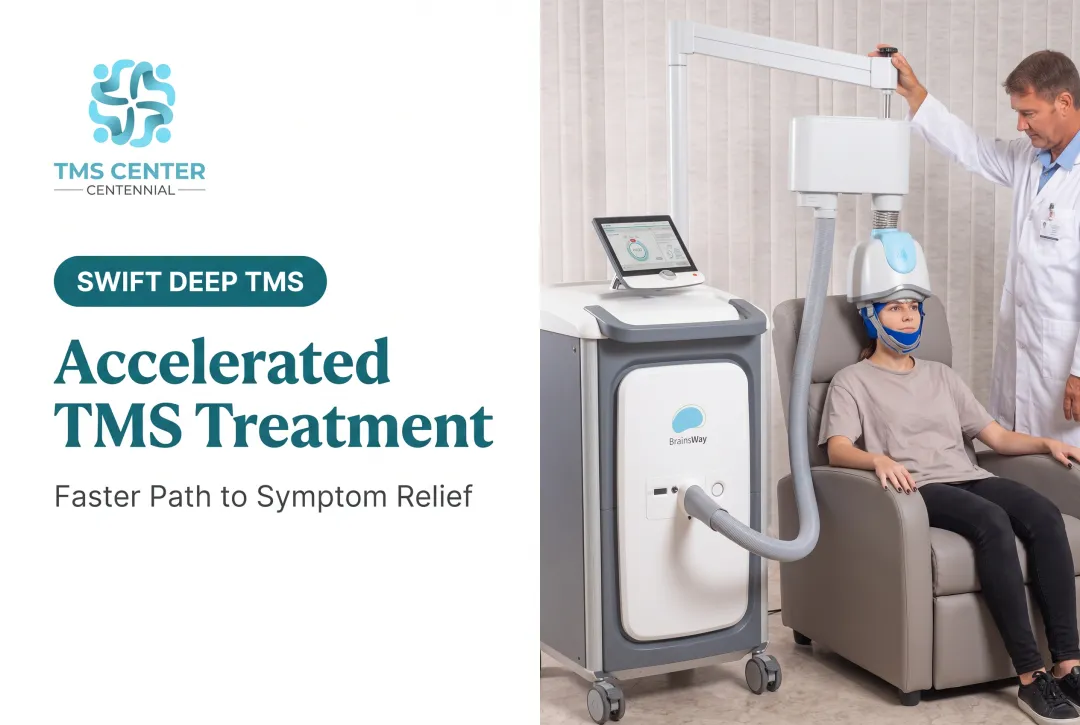

Accelerated Deep TMS changes that math. This FDA-cleared protocol, built on BrainsWay's SWIFT approach, delivers the same H-coil stimulation used in standard Deep TMS but compresses it into a matter of days instead of months. This guide breaks down how it works, what the research shows, who qualifies, and what to expect at TMS Center Centennial in Centennial, Colorado.
Key Takeaways
- Accelerated Deep TMS condenses treatment into about six half-day visits, plus weekly maintenance
- Clinical trials show remission rates comparable to standard Deep TMS, with a faster median time to remission
- Uses the same FDA-cleared BrainsWay H-coil technology—no experimental devices
- Major insurers, including Tricare and Medicare, often cover TMS protocols
- A psychiatric evaluation is required to confirm candidacy before starting
What Is Accelerated Deep TMS?
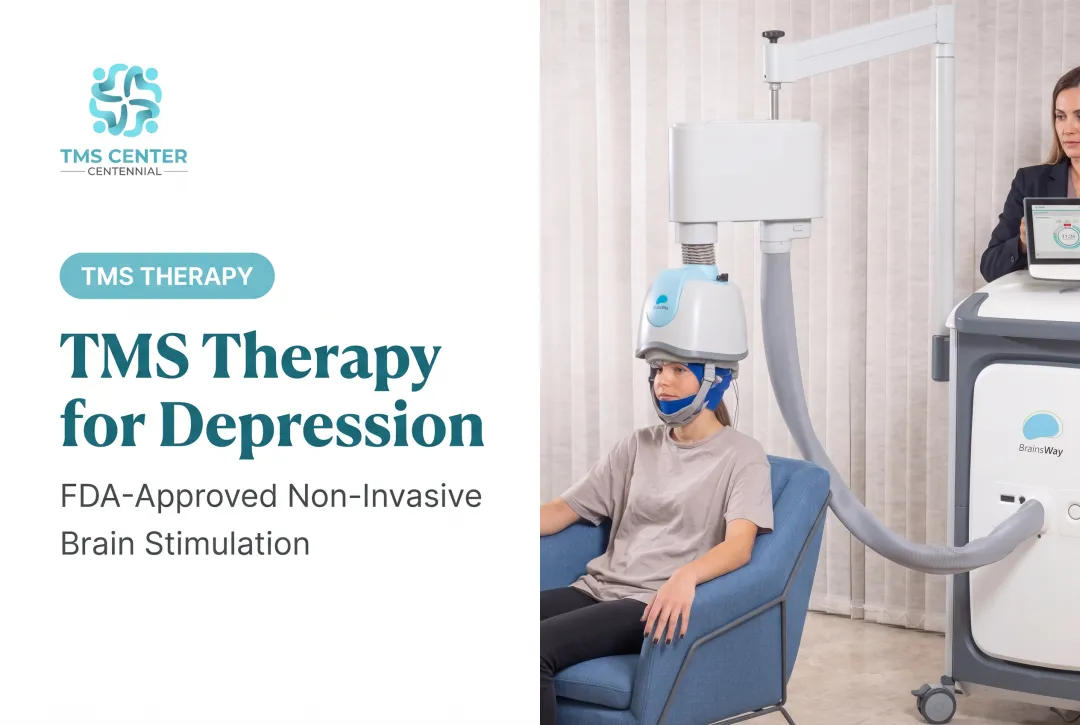
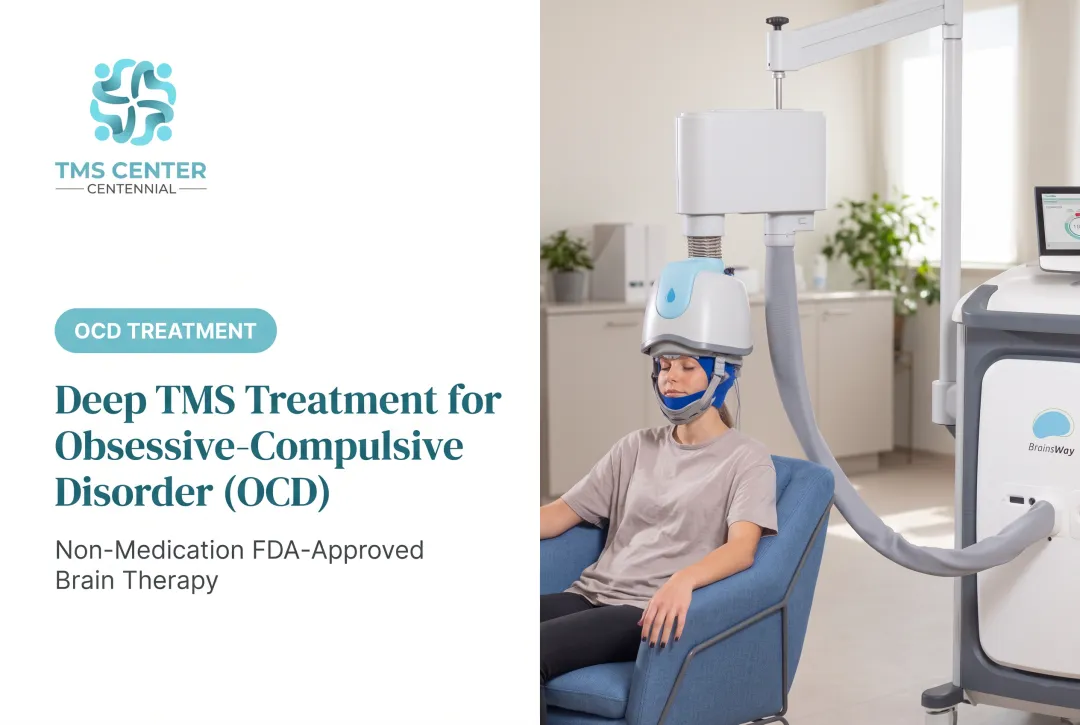
Deep TMS uses BrainsWay's patented H-coil, built into a helmet-style device that reaches deeper and broader brain regions than the figure-eight coils used in standard rTMS. That broader reach is why Deep TMS holds FDA clearances not just for depression, but for OCD, smoking cessation, and anxious depression as well.
Accelerated Deep TMS doesn't change the technology. It changes the delivery schedule. Instead of one session a day, five days a week, for six weeks, patients receive multiple short sessions using intermittent theta burst stimulation (iTBS) in a single day.
The FDA-Cleared SWIFT Protocol Structure
BrainsWay received FDA clearance for this accelerated protocol in September 2025. The structure:
- Acute phase: 5 sessions per day, roughly 10 minutes each, spaced at least 50 minutes apart, over 6 treatment days completed within about 2 weeks
- Continuation phase: 4 weekly follow-up sessions after the acute phase

Unlike SAINT, another accelerated TMS approach, SWIFT doesn't require fMRI scans or neuronavigation to individually map each patient's brain. That makes it deliverable in a standard outpatient clinic setting like TMS Center Centennial, without specialized imaging infrastructure.
The protocol is cleared for major depressive disorder, including anxious depression — not a narrow subset of patients.
Deep TMS vs. Standard TMS
The core difference comes down to coil design. Deep TMS's H-coil produces a wider, deeper magnetic field that engages broader prefrontal circuits. Standard TMS relies on a figure-eight coil, which is more focal and superficial.
How Effective Is Accelerated Deep TMS?
Here's the honest answer: accelerated Deep TMS isn't necessarily more effective than the standard protocol. It's comparably effective, and considerably faster.
A multisite, randomized, blinded non-inferiority trial compared the accelerated H1-coil protocol against standard Deep TMS in 104 patients. The results:
- Response rate: 87.8% (accelerated) vs. 87.5% (standard)
- Remission rate: 78.0% (accelerated) vs. 87.5% (standard)
- Median time to remission: 21 days (accelerated) vs. 28 days (standard)
- Total clinic visits: 10 (accelerated) vs. 24 (standard)

The research, published in Brain Stimulation, met its primary non-inferiority endpoint, with no serious adverse events in either group. Non-severe headache was more common in the accelerated group (41.2% vs. 15.1%), but nothing beyond what's typically seen with standard TMS.
Faster is not a shortcut. The total pulse dose across the accelerated protocol matches a standard course; it is compressed into fewer calendar days, not reduced in intensity.
The practical upside is significant. Accelerated protocols cut required clinic visits by roughly 70%, which removes one of the main reasons patients stop TMS early: the time commitment.
Optimal dosing and session spacing for accelerated protocols are still being refined, and results can vary by person and by protocol variant. Even so, current trial data support comparable effectiveness with a much shorter treatment calendar.
What to Expect During an Accelerated Deep TMS Session
Evaluation and Calibration
Before any stimulation begins, a physician at TMS Center Centennial conducts a full psychiatric evaluation to confirm Deep TMS is appropriate. If it is, the clinical team builds a personalized treatment plan, including any medication adjustment guidance.
Next comes motor threshold calibration. A Certified TMS Technician maps the patient's head to identify correct helmet placement, then delivers small electromagnetic pulses to find the patient's lowest effective stimulation level. Patients typically notice brief, reflex-like twitching in the fingers or face during this step — it's normal and passes quickly.
The Half-Day Visit
During the acute phase, patients return for a half-day visit involving multiple short sessions spaced roughly 50 minutes apart, rather than one appointment a day for weeks on end.
There's no anesthesia, no sedation, and no downtime. Patients can drive themselves to and from appointments and return to work or normal activities immediately afterward.
Support Built Into the Process
TMS Center Centennial builds comfort into the accelerated schedule:
- Therapy dogs on-site — available to sit with patients, or in their lap, during sessions
- One-on-one attention in a naturally lit, low-stress treatment room
- Coordinated care from psychiatrists, TMS coordinators, and technicians working together on each patient's plan
- Entertainment options — patients can watch TV or use a phone during treatment

Patients generally stay on their current prescribed medications throughout treatment. The clinical team prefers stability during the protocol so they can accurately assess what's driving improvement; any changes are typically made afterward under the prescribing clinician's guidance.
Who Is a Good Candidate for Accelerated Deep TMS?
Accelerated Deep TMS tends to fit best for:
- Patients with treatment-resistant depression, anxiety, PTSD, or OCD who haven't found relief through medication alone
- Anyone whose schedule (work, caregiving, travel) makes a standard 6-week daily commitment impractical
- Patients who want to complete an intensive treatment phase quickly, then transition to lighter maintenance visits
Not everyone qualifies without further screening. Certain factors still need careful clinical evaluation before Deep TMS, including:
- Metal implants in or around the head (standard dental fillings are fine)
- A history of seizures or epilepsy
- Bipolar disorder, which needs closer clinical assessment before starting
A psychiatric evaluation determines whether accelerated Deep TMS (versus the standard protocol or another treatment entirely) is the right fit for your specific history.
Accelerated Deep TMS vs. Other Treatment Options
| Treatment | Timeline | Effectiveness | Side Effects |
|---|---|---|---|
| Accelerated Deep TMS | ~6 days acute + 4 weekly visits | Comparable to standard Deep TMS | Mild scalp discomfort, headache |
| Standard Deep TMS | ~6 weeks, daily visits | Strong response/remission rates | Mild scalp discomfort, headache |
| Antidepressant medication | 6-12 weeks for full effect | Varies by individual | Nausea, weight change, sexual side effects |
| Ketamine/esketamine | Ongoing maintenance dosing | Rapid but often short-lived | Sedation, dissociation, blood pressure increases |

Beyond speed, Accelerated Deep TMS stands out for its safety profile. There's no medication involved, no sedation, and side effects are typically limited to mild, temporary scalp discomfort or headache. Compare that to esketamine, which carries FDA warnings for sedation, dissociation, and blood pressure increases, and requires a monitored REMS program.
Insurance is another practical factor. TMS Center Centennial accepts Cigna, Anthem BCBS, Tricare, United Healthcare, Aetna, and most Medicare plans. The center handles initial paperwork, authorization, and benefits verification before treatment starts — including a free consultation to review coverage.
Frequently Asked Questions
Is accelerated TMS more effective?
Accelerated Deep TMS is comparably effective to the standard protocol. The real advantage is speed: patients reach remission in a median of 21 days versus 28 for standard treatment.
What's the difference between TMS and deep TMS?
Deep TMS uses a specialized H-coil that reaches deeper, broader brain regions than the figure-eight coil used in standard TMS. That broader reach is why Deep TMS also holds FDA clearance for OCD, unlike standard TMS.
How long does accelerated Deep TMS treatment take overall?
The acute phase runs about 6 treatment days over roughly two weeks, followed by 4 weekly maintenance visits. Total time commitment is far shorter than the standard 6-week course.
Is accelerated Deep TMS covered by insurance?
Coverage is expanding as more insurers recognize accelerated protocols. TMS Center Centennial accepts major plans, including Tricare and most Medicare plans, and verifies benefits before treatment begins.
What are the side effects of accelerated Deep TMS?
Most patients experience only mild, temporary effects like scalp discomfort, headache, or fatigue. There's no anesthesia, sedation, or downtime required.
How do I know if accelerated Deep TMS is right for me?
The only way to know for sure is a clinical consultation. TMS Center Centennial's team reviews your treatment history and current symptoms to determine whether the accelerated protocol fits your goals.