
OCD affects roughly 1.2% of U.S. adults each year, according to NIMH data. For many, standard treatments like SSRIs and cognitive behavioral therapy help. For others, symptoms persist despite doing everything "right."
That's where Transcranial Magnetic Stimulation (TMS) comes in. The FDA cleared TMS specifically for treatment-resistant OCD in 2018, offering a non-medication path forward. This article covers how TMS works, what the research actually shows, what treatment involves, safety considerations, and how to know if it's a fit for you.
Key Takeaways
- FDA cleared TMS for OCD in 2018 as an add-on treatment that reaches deeper brain targets than depression protocols
- Response rates run about 38% in controlled trials and over 50% in real-world clinics
- No anesthesia, no downtime — most side effects are mild and fade within the first week
- TMS Center Centennial pairs BrainsWay Deep TMS™ with collaborative counseling to support fuller recovery
What Is TMS and How Does It Target OCD?
OCD isn't simply a chemical imbalance. Research points to a specific brain circuit, the cortico-striato-thalamo-cortical loop, getting stuck in a feedback pattern. Think of it like a smoke alarm that keeps blaring long after the toast has stopped burning. The signal won't shut off, even when there's no real threat.
TMS works by delivering magnetic pulses that calm this overactive circuitry. For OCD specifically, treatment targets the dorsomedial prefrontal cortex and anterior cingulate cortex, regions involved in that stuck alarm loop.
Standard TMS vs. Deep TMS for OCD
The brain regions tied to OCD sit deeper than the areas targeted for depression. That depth difference drives coil choice:
- Standard figure-eight coils: Reach about 1.5 cm into the brain, which is not deep enough for OCD circuitry
- BrainsWay H7 coil (Deep TMS): Reaches deeper structures with a broader magnetic field
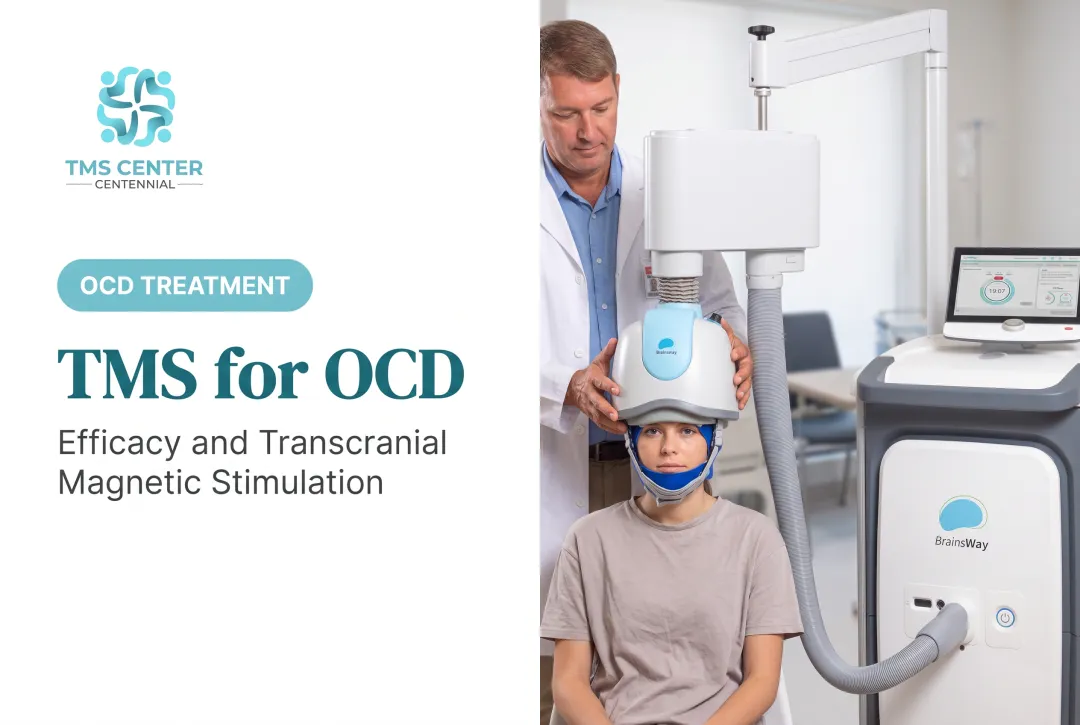
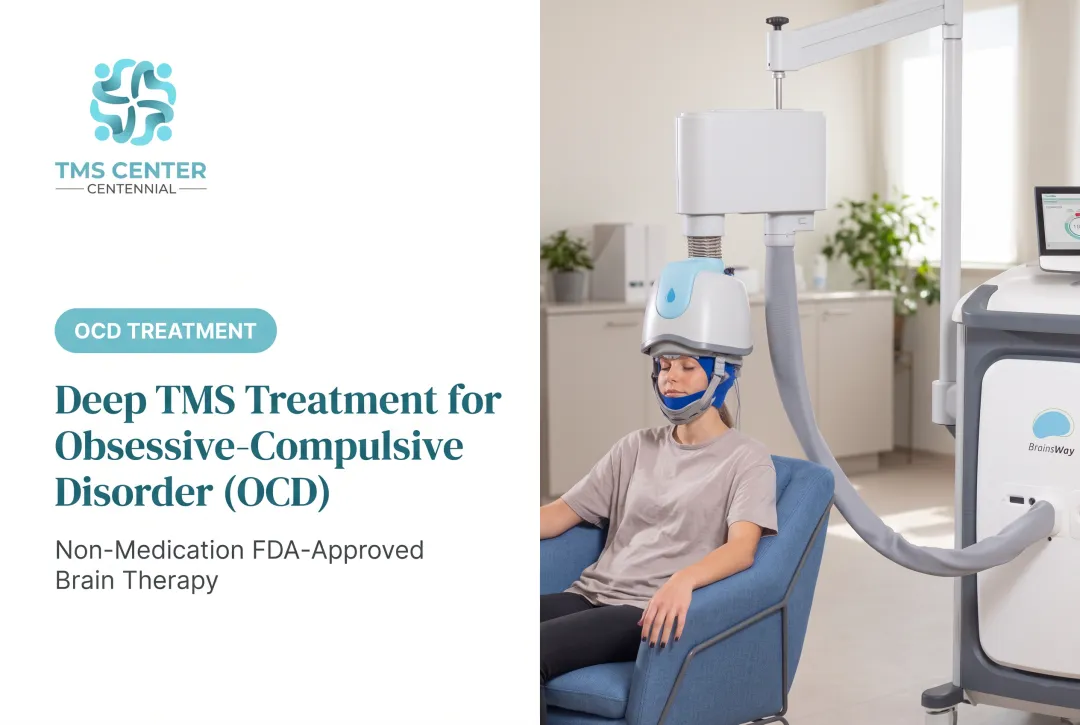
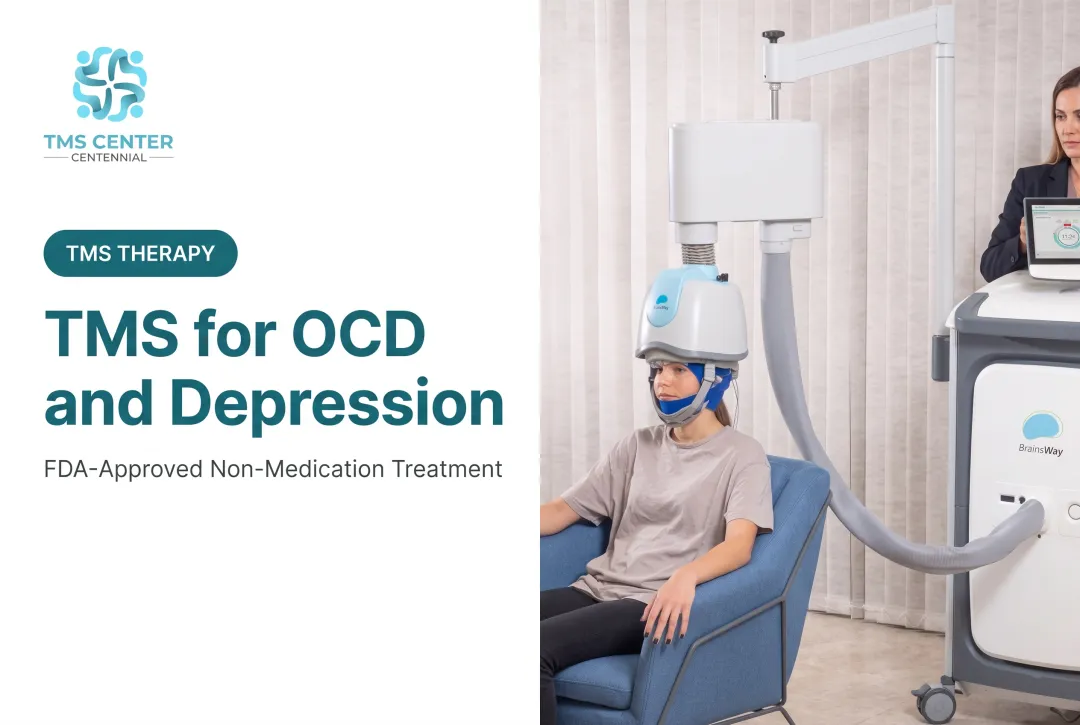
FDA clearance for OCD specifically involved BrainsWay's H7 coil for this reason. TMS Center Centennial uses this BrainsWay Deep TMS™ technology, administered by certified technicians trained on the system.

How Effective Is TMS for OCD? What the Research Shows
The pivotal trial behind FDA clearance, published in the American Journal of Psychiatry by Carmi and colleagues in 2019, tested Deep TMS against a sham treatment in OCD patients who hadn't responded well to prior care.
Results after 6 weeks:
- 38.1% of active-treatment patients responded, compared to 11.1% on sham
- At one-month follow-up, response climbed to 45.2% active vs. 17.8% sham
- Response was defined as at least a 30% reduction on the Yale-Brown Obsessive Compulsive Scale (Y-BOCS), the standard measurement tool
Real-world data often looks even better. A multisite analysis tracking day-to-day clinical practice found response rates climbing higher than trial numbers, likely because real-world protocols allow more flexibility in session count and patient selection.

Response vs. Remission — And Can You Fully Recover?
"Response" means significant improvement. "Remission" means symptoms drop to a minimal level. Most OCD research uses a 35% Y-BOCS reduction as the response threshold, though the Carmi FDA trial above used 30%.
Here's the honest answer: TMS more often produces meaningful symptom reduction than a complete cure. Some patients do reach near-full remission. Others gain enough relief to function well day-to-day while still managing some symptoms.
Complex presentations, like severe hoarding or "pure-O" intrusive thought patterns, can be harder to treat, though patients with these subtypes still see benefit from TMS.
One consistent finding: combining TMS with Exposure and Response Prevention (ERP) therapy or medication tends to outperform TMS alone, which is why many clinics pair stimulation with ongoing counseling.
What to Expect: The TMS Treatment Process for OCD
A typical course follows the protocol used in the pivotal trial: daily sessions, five days a week, for about six weeks (roughly 29-30 total sessions). Each session runs about 20-30 minutes.
What makes OCD protocols different from depression TMS is symptom provocation. Before stimulation, you briefly engage with something that triggers your obsessive thoughts. That primes the targeted brain circuit so the magnetic pulses can work more effectively.
During the session itself:
- You'll feel a tapping sensation on your scalp, often described as a woodpecker-like knock
- No anesthesia or sedation is used
- You stay awake and alert the entire time
- You can drive yourself home and return to normal activities immediately after

Most patients don't notice change overnight. Improvement typically begins to emerge within the first 20 sessions, though timing varies by individual.
At TMS Center Centennial, TMS sessions run alongside collaborative counseling with licensed therapists. That support reinforces progress between appointments rather than leaving you to process changes alone.
Safety, Side Effects, and How Long Results Last
TMS carries a notably lighter side effect profile than many OCD medications. Common effects include:
- Mild scalp discomfort at the treatment site
- Headache, especially in the first few sessions
Both typically fade within the first week as your scalp adjusts.
Seizure risk
Survey data on rTMS safety shows the absolute risk remains low, though some analyses suggest H-coil systems carry a slightly higher relative risk than standard figure-eight coils. That risk is comparable to or lower than risks tied to certain SSRIs.
How long results last
A durability study tracking Deep TMS patients found an average maintenance period of nearly 2 years, with 62% of patients sustaining their improvement at last follow-up. Some patients benefit from periodic booster sessions to maintain gains.

Who should not receive TMS
Safety screening still matters. TMS is contraindicated for patients with:
- Non-removable metal implants near the head
- Cochlear implants
- Active deep brain stimulators
If any of these apply, a clinician can review your history and discuss safer alternatives.
Is TMS Worth It? Who's a Good Candidate?
For the right patient, Deep TMS is often worth trying when medications and therapy have not delivered enough OCD relief. Typical eligibility includes:
- A confirmed OCD diagnosis from a psychiatric evaluation
- Inadequate response to prior SSRI treatment at an adequate dose and duration
- Age 18 or older
Worth considering before you start:
- The time commitment is real: six weeks of near-daily visits isn't a quick fix
- Without insurance, out-of-pocket costs can add up, though coverage has improved significantly since FDA clearance
- TMS won't guarantee a complete cure; think of it as one strong tool in a larger recovery plan
TMS Center Centennial accepts most major insurance plans, including Tricare and Medicare, which removes a common barrier for patients considering this option. The clinic's team handles benefits verification directly, so you're not left guessing about coverage before committing to treatment.
Frequently Asked Questions
How many TMS sessions are needed to see improvement for OCD?
Most patients notice change around sessions 15-19 within a standard six-week, roughly 30-session course. Improvement tends to build gradually rather than appear suddenly.
How long do the effects of TMS for OCD last?
Research shows many responders maintain improvement for a year or longer, with average durability approaching two years in follow-up studies. Some patients opt for occasional booster sessions to sustain results.
How effective is TMS for OCD?
Clinical trial response rates are about 38%, while real-world clinic data often run higher—sometimes above 50%. Response means a meaningful reduction on the Y-BOCS scale.
What are the side effects and long-term risks of TMS for OCD?
Common side effects are mild scalp discomfort and headache, usually fading within the first week. Seizure risk exists but is rare, generally comparable to risks tied to certain SSRI medications.
What TMS devices are FDA-approved for treating OCD, and how do they differ?
Standard figure-eight coils weren't cleared for OCD because they don't reach deep enough into the brain. The BrainsWay H7 coil used for Deep TMS™ was specifically FDA-cleared for OCD because it can reach those deeper structures—the system used at TMS Center Centennial.
Can you fully recover from OCD?
Some patients do reach substantial or near-complete remission with TMS. More commonly, patients experience significant symptom reduction that makes daily life more manageable, rather than a total cure.