
TBS is an FDA-cleared evolution of transcranial magnetic stimulation that compresses treatment into a fraction of the time, without asking patients to start a new medication. If you've struggled with depression that hasn't responded to antidepressants, or you simply want a non-drug option that fits your calendar, TBS deserves a look.
This article covers how TBS works, how it stacks up against standard TMS, its safety profile, what a session actually feels like, and what treatment looks like at TMS Center Centennial in Colorado.
Key Takeaways
- Intermittent TBS (iTBS) delivers a full TMS session in about 3 minutes, versus 20-40 minutes for standard rTMS
- FDA-cleared since 2018 for major depressive disorder, with trial results matching standard TMS
- Side effects are typically mild (headache and scalp discomfort), with seizure risk well under 1%
- TMS Center Centennial pairs BrainsWay Deep TMS™ with TBS, a multidisciplinary team, and on-site therapy dogs
What Is Theta Burst Stimulation (TBS)?
TBS is a specialized TMS protocol that mimics the brain's natural theta rhythm—the electrical pattern your brain produces during memory formation and mood regulation. Instead of delivering evenly spaced pulses like standard TMS, TBS fires pulses in rapid triplet bursts.
Intermittent TBS (iTBS) is the pattern used for depression. A typical session looks like this:
- Three pulses at 50Hz, repeated at 5Hz
- Delivered in a 2-second-on, 8-second-off cycle
- Roughly 600 total pulses in about 3 minutes per session
- Compared with about 3,000 pulses over 20+ minutes in standard 10Hz rTMS
Like standard TMS, iTBS targets the left dorsolateral prefrontal cortex (L-DLPFC), a region tied to mood regulation and executive function.
The Science Behind FDA Clearance
The FDA cleared iTBS for major depressive disorder in 2018, based largely on the THREE-D trial, a landmark study of 414 patients with treatment-resistant depression. Researchers randomized patients to either standard 10Hz rTMS or iTBS.
The results, published in The Lancet (THREE-D trial), showed:
- Depression scores dropped from roughly 23.5 to 13.4 in both groups
- Response rates: 47% (standard TMS) vs. 49% (iTBS)
- Remission rates: 27% (standard TMS) vs. 32% (iTBS)
- Dropout rates were statistically similar between groups (6% vs. 8%)

In plain terms: patients got equivalent relief in a fraction of the time.
Why Speed Doesn't Sacrifice Effectiveness
TBS works through long-term potentiation (LTP), a neuroplasticity mechanism first described in TBS research from 2005. The rapid burst pattern strengthens synaptic connections in the prefrontal cortex more efficiently than evenly spaced pulses.
That efficiency is why a few minutes of iTBS can match a full standard TMS session: same brain region, same core mechanism, far less chair time.
Is Theta Burst Stimulation More Effective Than Standard TMS?
"More effective" isn't quite the right frame. Clinical evidence shows iTBS is non-inferior to standard rTMS, meaning it performs just as well statistically, while taking a fraction of the time to deliver.
Real-world data supports this. Outcomes tracking shows 69% response and 36% remission rates across TMS protocols, consistent with what controlled trials found for iTBS specifically.
Where iTBS May Have an Edge
Some findings suggest iTBS offers unique advantages beyond convenience:
- Faster symptom relief — daily iTBS to the left DLPFC over two weeks reduced suicidal ideation in a controlled trial
- Accelerated protocols — multiple sessions in one day can produce rapid improvement in treatment-resistant depression without cognitive side effects
- Flexible dosing — sessions take minutes, so clinics can schedule more than one per day when appropriate
Personalized Targeting Matters
Roughly half of patients don't respond adequately to standard DLPFC targeting, according to research on connectivity-guided TMS. Neuronavigation and personalized targeting are improving precision for both iTBS and standard rTMS, though beam-based (F3) targeting remains the clinical standard.
Individual response varies. A psychiatric evaluation, not a generic protocol, determines whether iTBS or standard TMS makes more sense for your situation.
Is TBS Safe? What Are the Side Effects?
TBS carries the same safety profile as standard TMS. It's non-invasive, requires no anesthesia, and involves no recovery downtime. Patients drive themselves home and return to work the same day.
Common, mild side effects:
- Headache
- Scalp discomfort at the treatment site
- Rare, temporary lightheadedness
Seizure is the most serious known risk, but it's rare. Research estimates the rate at 0.8 seizures per 10,000 sessions overall, dropping to 0.2 per 10,000 when screening guidelines are followed properly. Broader reviews place overall risk under 1%.
How TBS Compares to Other Options
| Treatment | Common Side Effects | Recovery Time |
|---|---|---|
| TBS/TMS | Headache, scalp discomfort | None — resume activities immediately |
| ECT | Short-term memory loss (in ~10% of patients) | Requires anesthesia, sedation recovery |
| Antidepressant medication | Sleep disturbance, sexual dysfunction (up to 73% with SSRIs), weight gain | Ongoing, no procedural downtime |

Patients with a history of seizures or certain neurological conditions need careful screening before starting.
At TMS Center Centennial, that screening includes a medical-history review by the clinical team. They assess suitability from individual risk factors, including any implanted metal devices near the head.
What Does a TBS Treatment Session Look Like?
A TBS appointment is short by design. Here's the general flow:
- Brief check-in with your TMS coordinator
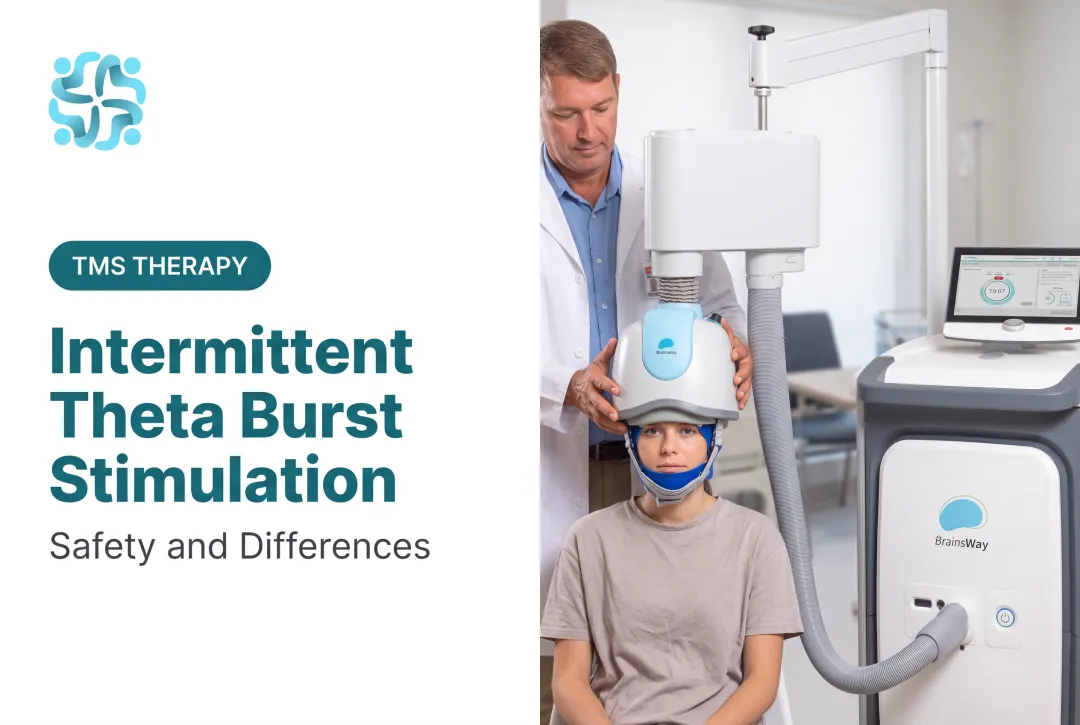
- Comfortable seated setup: you sit in a chair, fully clothed, with no sedation needed
- Helmet placement, mapped during your first session by a certified technician to pinpoint your exact treatment location
- Targeted magnetic pulses delivered to the left dorsolateral prefrontal cortex (L-DLPFC), with the TBS stimulation itself lasting about 3 minutes
- You're done: walk out and resume your day

At TMS Center Centennial, TBS is offered alongside Deep TMS™ protocols rather than as a separately billed treatment. The clinic's accelerated Swift Deep TMS™ protocol condenses a course into 30 sessions over roughly six days, then two treatment days weekly for two more weeks. That schedule suits patients who want faster results.
A few things that make sessions more comfortable here:
- Certified BrainsWay™ technicians and a physician team personalize your treatment plan from day one
- Two resident therapy dogs, Finn and Fergus, are available to sit with patients during sessions
- The clinic's naturally lit space is designed to feel calm rather than clinical

Cost and Insurance Considerations
TBS pricing generally tracks with standard TMS costs. Nationally, a full TMS course without insurance typically runs $6,000-$15,000, with per-session cash rates around $300-$500.
TMS coverage has expanded significantly. Medicare has a national coverage determination for TMS in treatment-resistant depression, and most commercial insurers now cover it after documented failure of prior antidepressants.
TMS Center Centennial accepts:
- Cigna
- Anthem Blue Cross Blue Shield
- Tricare
- United Healthcare
- Aetna
- Most Medicare plans
TriWest and most other insurance panels also cover treatment. TMS Center Centennial verifies benefits and handles paperwork before you start, so you know your out-of-pocket cost upfront.
TBS is included as part of the clinic's depression protocols rather than billed as a separate line item.
What If TBS Doesn't Work?
Not every patient responds to a first course of TBS, and that's not the end of the road. Non-response is common enough that clinicians plan for it.
Options after an incomplete response include:
- Protocol adjustment: Switch between accelerated and standard iTBS schedules, or explore standard rTMS if iTBS alone wasn't sufficient
- Counseling: One study found iTBS combined with CBT achieved an 85.71% remission rate, compared to 42.85% with iTBS alone
- Neurofeedback: Non-invasive brain training that supports self-regulation, sleep, and emotional stability alongside TMS
- Retreatment: A second course has shown real promise; in one study, 40% of patients who relapsed responded to another active round
TMS Center Centennial's team, which includes a psychiatrist, licensed therapists, and TMS coordinators, offers neurofeedback and collaborative counseling alongside Deep TMS™ and TBS. If your first round doesn't get you where you want to be, the next step is a clinical conversation, not a dead end.
Frequently Asked Questions
What is the theta burst stimulation protocol?
Intermittent TBS (iTBS) delivers pulses in triplet bursts at 50 Hz, repeated at 5 Hz, targeting the left dorsolateral prefrontal cortex (DLPFC)—a region involved in mood regulation. A single session takes about 3 minutes, and a full course typically runs daily over several weeks.
How long do the benefits of theta burst stimulation last?
Benefits vary by patient, but many people sustain remission for months after completing a course. If symptoms return, maintenance sessions can help restore the improvement.
Can theta burst stimulation be used to treat depression?
Yes. The FDA cleared iTBS in 2018 specifically for major depressive disorder, including cases that haven't responded to antidepressant medication.
How much does a session of theta burst stimulation cost?
Cash-pay TMS sessions typically range from $300–$500, with full courses often totaling $6,000–$15,000. Most major insurers, including Medicare, now cover TMS treatment, so check your specific plan.
What if theta burst stimulation doesn't work?
Non-response doesn't mean you're out of options. Protocol adjustments, combining TBS with counseling or CBT, or a retreatment course can still produce meaningful improvement for many patients.
Is theta burst stimulation (TBS) safe, and what are the side effects?
Yes. TBS is non-invasive, with no anesthesia or downtime. The most common side effects are headache and scalp discomfort; serious risks like seizure occur in well under 1% of patients.