
That's why non-drug options like Transcranial Magnetic Stimulation (TMS) have gained real traction since the FDA cleared it for depression in 2008. Still, plenty of patients hesitate. TMS sounds technical, and it's often confused with electroconvulsive therapy (ECT), or "shock therapy." It's nothing like that.
This guide walks through exactly how TMS works, step by step, from the physics behind it to what a treatment session actually feels like.
TL;DR
- Magnetic pulses (MRI-level strength) stimulate underactive mood-related brain regions—no surgery, sedation, or drugs
- Sessions target the left prefrontal cortex daily over 4–6 weeks
- Patients stay awake; most feel only a light tapping on the scalp
- Research shows clear symptom reduction for many with treatment-resistant depression
- TMS Center Centennial uses BrainsWay Deep TMS™ to reach deeper, broader brain regions than standard coils
What Is TMS?
TMS is an FDA-approved, non-invasive therapy that uses magnetic fields to activate nerve cells in specific brain regions. Clinicians use it when patients with depression, anxiety, PTSD, or OCD don't respond adequately to medication or can't tolerate the side effects.
TMS is not ECT. There's no seizure induction and no anesthesia. It's neither a drug nor an implant. It's a scalp-level magnetic stimulation delivered while you're sitting in a chair, fully conscious.
Two main coil types deliver the stimulation:
- Standard rTMS uses a figure-eight coil that reaches roughly 3 cm into the skull, focused mainly on the prefrontal cortex
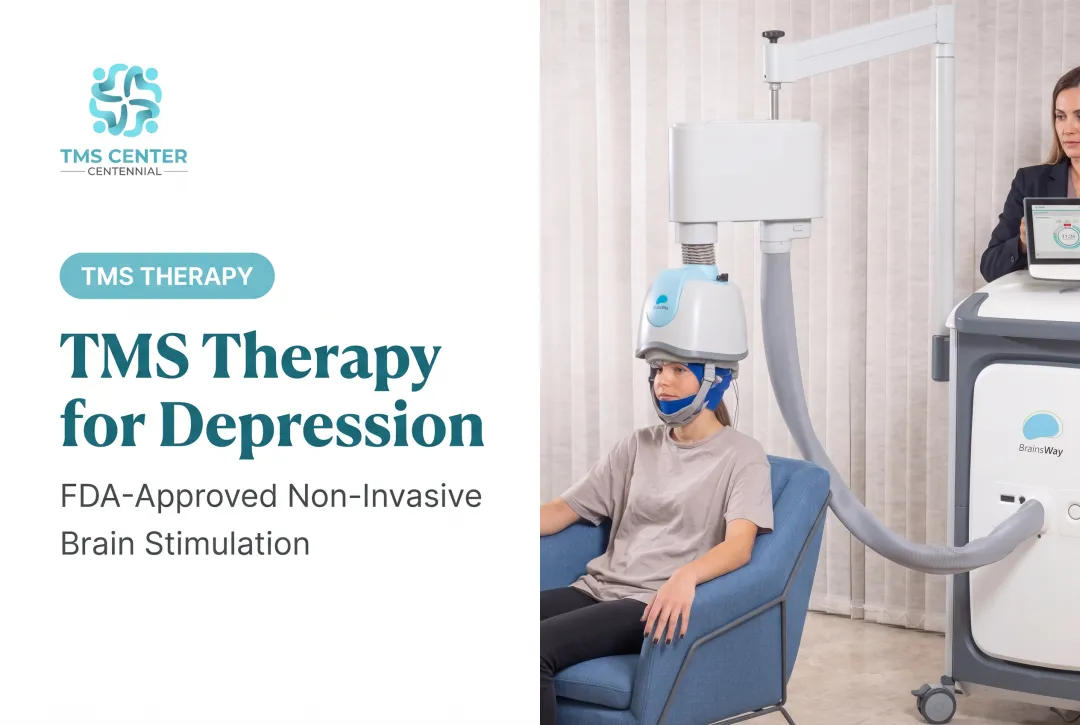
- Deep TMS™ uses an H-coil built into a fitted helmet, reaching up to 4 cm and activating a broader network of neurons
TMS Center Centennial uses BrainsWay Deep TMS™ specifically because of that broader, deeper coverage.

How Does TMS Work?
TMS follows a defined sequence: mapping, coil placement, magnetic pulse delivery, and monitoring the brain's response. Here's how each stage plays out.
Initiation: Motor Threshold Mapping
Your first session establishes a personalized "motor threshold"—the minimum magnetic intensity needed to trigger a small thumb or finger twitch. At TMS Center Centennial, the clinician seats you upright, places the treatment helmet, and delivers small pulses while watching for a response.
That response looks like an involuntary twitch, similar to the reflex when a doctor taps your knee with a rubber hammer. This step is clinician-guided, not automated, and it's calibrated to your specific brain anatomy. That calibration keeps intensity in a safe, effective range—strong enough to work, without excess stimulation.
Core Operation: Magnetic Pulse Delivery
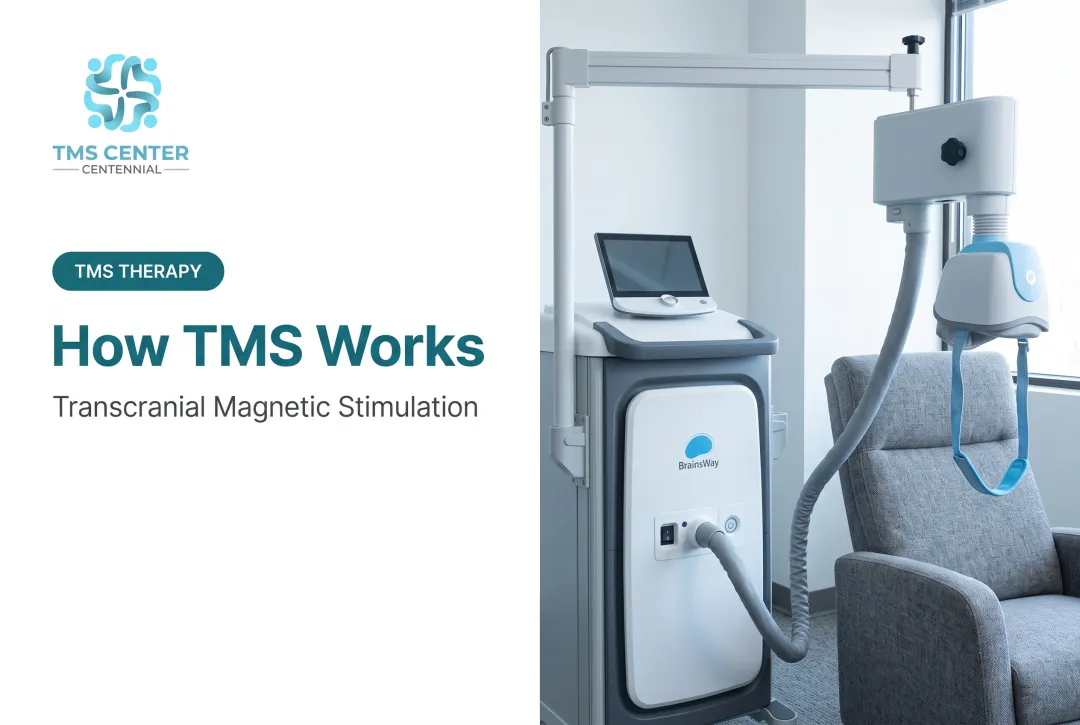
An electromagnetic coil placed against your scalp generates pulses roughly comparable in field strength to an MRI. These pulses pass painlessly through your skull.
At the cellular level, the pulses induce small electrical currents that excite or inhibit neuron firing in the targeted region, typically the left prefrontal cortex for depression. Repeated stimulation over several weeks encourages neuroplasticity—the brain gradually builds healthier mood-regulation pathways.
BrainsWay Deep TMS™'s helmet design is engineered to reach deeper cortical structures than a standard figure-eight coil. BrainsWay-cited clinical comparisons report:
| Protocol | Response Rate | Remission Rate |
|---|---|---|
| Deep TMS™ (after 30 sessions) | ~75% | ~51% |
| Standard rTMS | ~58% | ~37% |

Regulation: Session Monitoring and Adjustment
Throughout each session, your TMS coordinator watches your comfort and response, adjusting pulse intensity as needed. Your care team tracks progress with symptom scales at regular intervals across the course. For OCD specifically, researchers commonly use the Yale-Brown Obsessive-Compulsive Scale as the gold-standard measure of symptom severity.
Monitoring catches minor side effects early—mainly scalp discomfort or headache—and confirms the protocol is working as intended. Most discomfort resolves within the first week.
Output: Cumulative Symptom Relief
The end goal is a gradual reduction in symptoms as neural circuits normalize. In a 2015 sham-controlled trial of Deep TMS, active treatment produced a 38.4% response rate versus 21.4% for sham, with remission at 32.6% versus 14.6% (Levkovitz et al., 2015). A 2023 meta-analysis pooling nine studies found remission in roughly 36% of patients.
TMS Center Centennial reports stronger real-world numbers: about 89% of patients see significant symptom reduction, and around 69% achieve full remission.
These are clinic-reported figures, not a controlled trial—useful as real-world outcomes, not a guarantee.

What a TMS Treatment Course Looks Like
A standard course runs five sessions per week for 4-6 weeks, with each session lasting roughly 20-30 minutes. Some clinics, including TMS Center Centennial, also offer Swift Deep TMS™, an accelerated theta-burst protocol using shorter, more frequent sessions to compress the timeline.
Key things patients should expect:
- Remain fully awake throughout each session
- Drive yourself to and from appointments
- Resume normal activities immediately afterward
- Optionally add periodic maintenance sessions after the initial course to sustain results
That schedule fits around work and daily life, but results are rarely immediate. Mayo Clinic notes most patients don't feel better until several weeks into treatment, so patience through the early sessions matters.

Where TMS Fits in Mental Health Treatment
TMS is typically considered after a patient has tried one or more antidepressant medications without adequate relief. TMS Center Centennial generally uses two or more failed medication trials as the threshold most insurers look for when reviewing coverage.
TMS is most often used for:
- Treatment-resistant depression
- OCD (FDA-cleared indication)
- Off-label anxiety and PTSD, including veterans and active-duty service members
One 2021 veteran cohort study found 65.3% reported clinically meaningful PTSD symptom reduction, and 46.1% no longer met PTSD threshold criteria after treatment. That's promising, though it is not an FDA-cleared indication for PTSD.
Patients can generally keep taking their current medications during TMS. TMS Center Centennial's team coordinates with prescribing physicians and typically recommends holding medication changes until after the protocol is complete.
Many patients also pair TMS with ongoing counseling through the center's collaborative care team of therapists and psychiatrists.
The Bottom Line
TMS works by delivering precisely targeted magnetic pulses that reactivate underperforming brain regions tied to mood. Over a multi-week course, this builds lasting change through neuroplasticity rather than a one-time fix.
If you've struggled with treatment-resistant depression, anxiety, PTSD, or OCD, knowing how TMS works helps you decide whether it fits your care plan. TMS Center Centennial offers candidacy evaluations with board-certified psychiatrists and certified BrainsWay technicians.
Frequently Asked Questions
How does TMS therapy actually work?
Magnetic pulses stimulate the left prefrontal cortex to normalize activity in mood-related brain circuits. There is no surgery, sedation, or medication involved. Treatment uses repeated, calibrated magnetic stimulation over several weeks.
What does a TMS session look like?
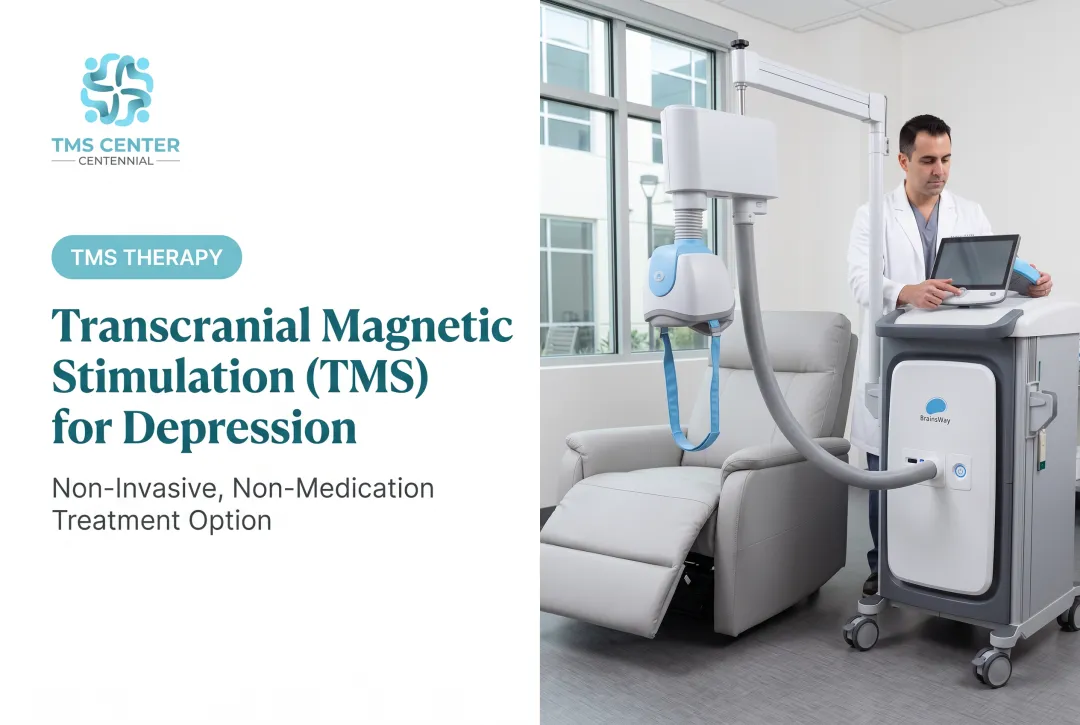
You sit in a reclining chair while a coil or helmet is positioned against your scalp. You'll feel a tapping sensation as pulses are delivered, and the whole session runs about 20-40 minutes.
How long does TMS typically last?
Standard courses run 4-6 weeks, five days a week, totaling roughly 20-36 sessions. Accelerated protocols like Swift Deep TMS™ can shorten the overall course when appropriate.
What are the signs that TMS is working?
Improved mood, sleep, and energy often start emerging within 2-3 weeks. Full benefit is usually clear after you complete the entire course.
Is TMS better for anxiety or depression?
TMS is FDA-cleared for depression and OCD. Clinicians also use it off-label for anxiety and PTSD, with results that depend on which brain region is targeted.
How painful is TMS therapy?
Most patients describe it as light tapping or mild scalp discomfort, most noticeable in the first few sessions. It typically becomes easier to tolerate as treatment progresses.