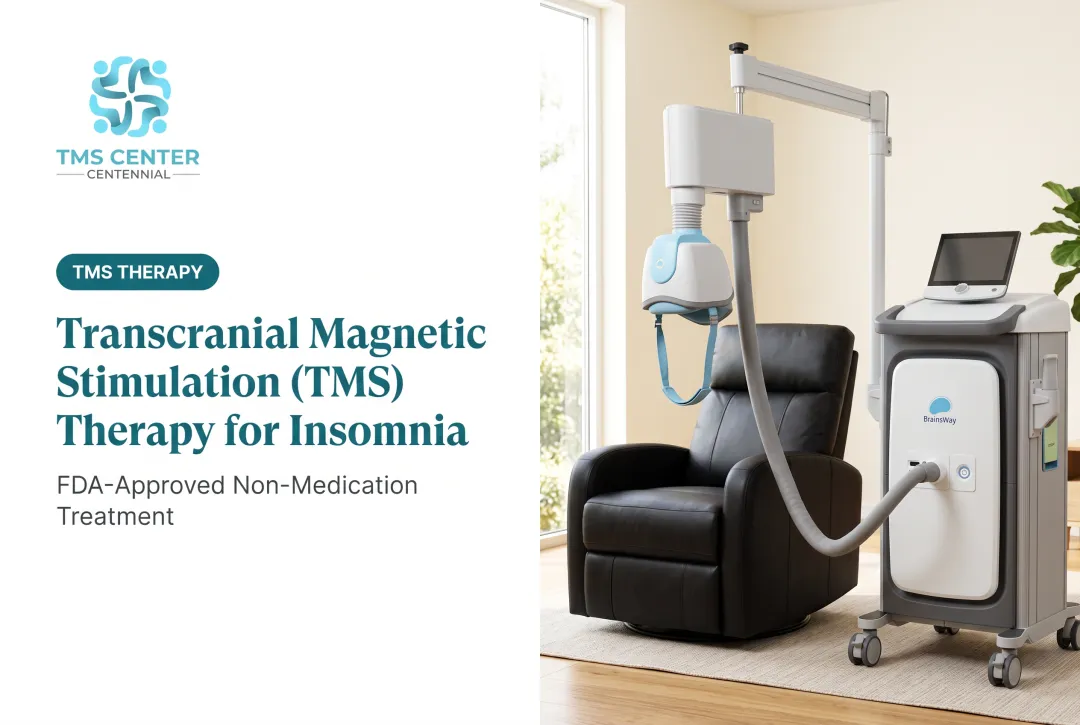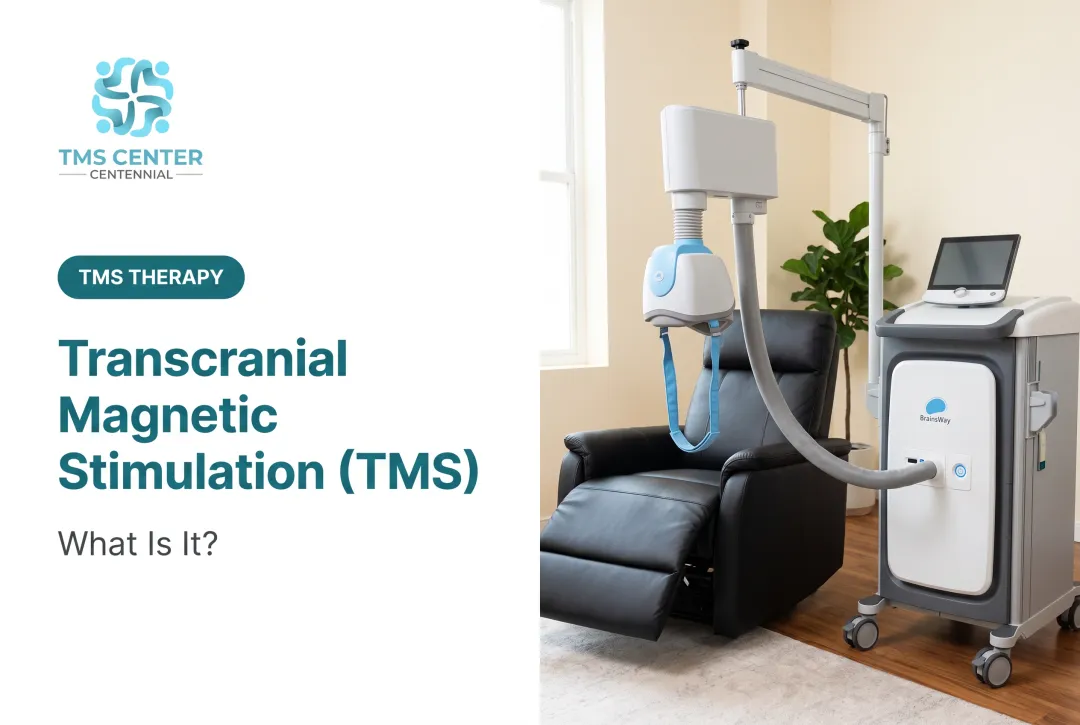

Transcranial Magnetic Stimulation (TMS) offers a different path. It's an FDA-approved, non-invasive therapy that uses magnetic pulses instead of medication to target the brain circuits tied to mood regulation. No pills, no surgery, no anesthesia.
This guide covers how TMS works, what conditions it treats, what a session actually feels like, and how to know if it might be right for you.
Key Takeaways
- TMS uses magnetic pulses to stimulate brain regions linked to mood regulation — no medication involved
- FDA-cleared for treatment-resistant depression, OCD, and anxious depression
- Outpatient sessions require no anesthesia; most patients drive themselves home afterward
- 89% of TMS Center Centennial patients see significant symptom reduction; 69% reach complete remission
What Is Transcranial Magnetic Stimulation (TMS) Therapy?
Transcranial magnetic stimulation (TMS) is a non-invasive treatment that uses magnetic fields to stimulate nerve cells in the brain. It is most often used for depression and related conditions when medication has not helped enough.
During a session, an electromagnetic coil rests against the scalp and delivers targeted magnetic pulses to the dorsolateral prefrontal cortex (DLPFC)—an area tied to mood regulation and decision-making. Those pulses create small electrical currents that activate underactive neurons.
The technology isn't new. Researchers developed TMS in the 1980s, but it took decades of refinement before the FDA cleared the first TMS device for depression in 2008. Since then, the FDA has expanded clearances significantly:
- 2018: OCD, as an adjunct treatment
- 2020: Smoking cessation (short-term aid)
- 2021: Major depression with comorbid anxiety symptoms
Types of TMS Devices
Not all TMS is the same. The two main approaches differ in coil design and how deep the stimulation reaches:
- Standard rTMS: Uses a figure-8 coil to stimulate a narrow, focal area about 2 centimeters deep
- Deep TMS: Uses an H-coil to reach broader structures about 5.5 centimeters deep, according to BrainsWay's clinical compendium
That extra depth and breadth matter. Deep TMS holds FDA clearances that standard rTMS does not, including OCD and anxious depression.

At TMS Center Centennial, treatment is delivered with BrainsWay Deep TMS™ technology. Swift Deep TMS™ is also available as an accelerated protocol that compresses a full course into about two weeks instead of four to six.
How Does TMS Therapy Work on the Brain?
Magnetic pulses pass painlessly through the skull and induce small electrical currents in targeted neurons. Over repeated sessions, that activity changes how mood-related brain networks communicate—including the default mode network, the salience network, and cognitive control circuits.
Think of depression and anxiety as dysfunctional wiring between these networks. TMS doesn't rewire the brain in one shot. It works cumulatively. That is why the first visit focuses on calibrating treatment to your brain before the full course begins.
What the first session typically involves:
- Motor threshold mapping to set pulse intensity to your brain's sensitivity
- Coil placement check to confirm a comfortable, accurate target
- Baseline settings used for the rest of your treatment course
According to the American Psychiatric Association, roughly 1 in 2 patients see a significant clinical response, and about 1 in 3 achieve full remission from depression symptoms. Results build gradually. Most patients notice change over several weeks, not after a single visit.

What Conditions Does TMS Treat?
TMS holds FDA clearance for several conditions, though most patients arrive after other treatments have failed.
FDA-cleared uses include:
- Major depressive disorder and treatment-resistant depression
- OCD (as an adjunct therapy)
- Anxious depression (MDD with comorbid anxiety)
- Smoking cessation
- Migraine with aura
Most patients qualify after failing to respond to two or more antidepressant medications or a meaningful course of therapy. For OCD specifically, a multicenter trial found that 38.1% of patients on active Deep TMS achieved full response, compared to just 11.1% on sham treatment.
TMS also shows promise off-label for PTSD, though this isn't yet an FDA-cleared indication. TMS Center Centennial has particular experience here: its Clinical Director, Rodney Placzek, is a retired Army Sergeant Major who underwent TMS himself before co-founding the clinic.
The center works regularly with active-duty service members, veterans, and military families dealing with PTSD symptoms like intrusive memories and hypervigilance.
What Happens During a TMS Treatment Session?
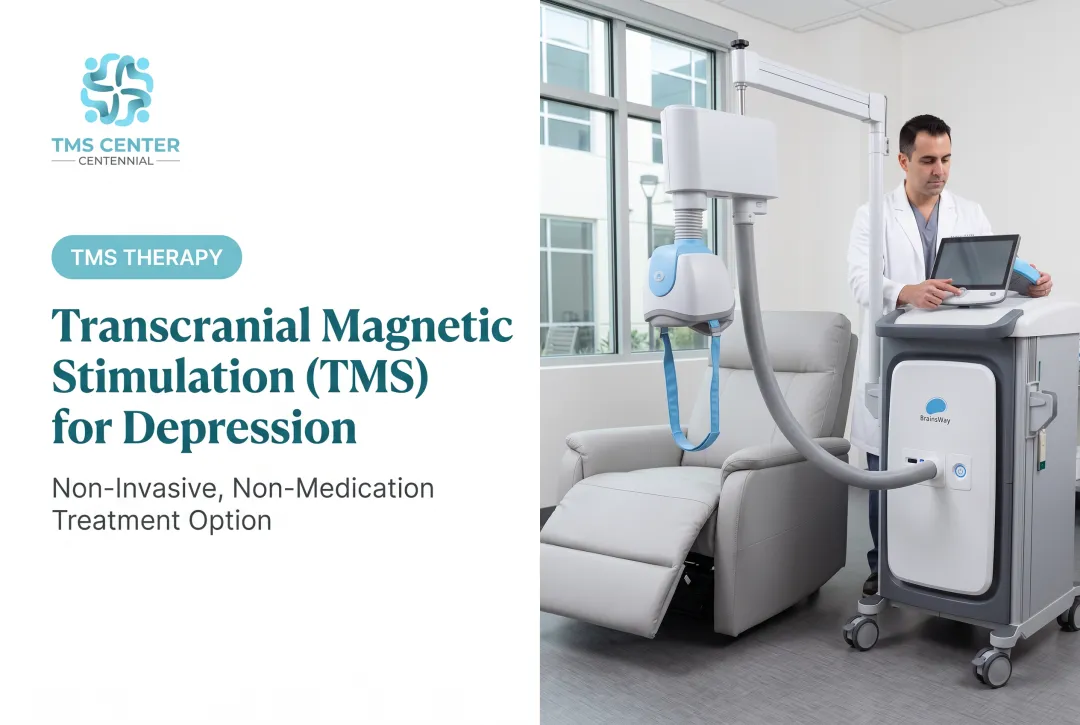
A TMS session is far less intimidating than most people expect. You sit in a reclining chair, fully awake, while a technician positions the coil against your scalp. No sedation, no IV, no recovery room.
A typical session:
- You settle into the treatment chair
- The technician positions the coil based on your calibrated mapping
- Magnetic pulses begin — you'll hear clicking and feel light tapping on your scalp
Treatment itself runs about 20 minutes. The full appointment is closer to 45 minutes including setup.
At TMS Center Centennial, standard treatment runs five days a week for four to six weeks, totaling around 20 to 30 sessions. Patients considering the accelerated Swift Deep TMS™ protocol can complete a similar course in about two weeks, with up to 10 treatments a day over six days.

Mild side effects can include scalp discomfort or a temporary headache. Both usually fade quickly. You can drive yourself home and return to work immediately after each session.
Is TMS Safe? Benefits, Side Effects, and Who Should Avoid It
TMS carries a strong safety profile, especially compared to treatments that involve anesthesia or systemic medication effects.
Key benefits:
- Non-invasive with no systemic side effects like weight gain or sexual dysfunction
- No downtime between sessions
- Lower relapse risk than medication alone, especially with maintenance sessions
Common side effects are usually mild and short-lived:
- Scalp discomfort or tingling at the treatment site
- Mild headache during or after a session
- Temporary lightheadedness that fades quickly
Seizure risk remains the most serious concern associated with TMS, and it is exceptionally low. A large safety survey found roughly 0.08 seizures per 1,000 sessions, and the American Psychiatric Association describes seizures as occurring in about 1 in 10,000 patients.

TMS isn't right for everyone. You should avoid it if you have:
- Metal implants or fragments in or near the head
- Cochlear implants
- Pacemakers or implanted electronic devices
- A history of seizure disorders
When screening clears you as a candidate, access is the next practical step. Most major insurance plans cover TMS for depression once medical-necessity criteria are met. TMS Center Centennial accepts Cigna, Anthem BCBS, Tricare, United Healthcare, and Aetna, and handles insurance verification and paperwork before treatment begins.
Frequently Asked Questions
How much does TMS therapy cost?
Cost varies by provider, session count, and insurance coverage. Most major insurance plans cover TMS for depression once medical-necessity criteria, like prior medication failures, are met. TMS Center Centennial offers free consultations to verify your specific coverage.
How long do TMS treatment effects usually last?
Many patients remain symptom-free for months to over a year, particularly with occasional maintenance sessions. Research shows roughly 50% of patients maintain remission at the six-month mark.
Can TMS work after just one session?
No single session produces lasting change. TMS requires a full course, typically 20 to 30 sessions, though some patients notice early improvements within the first two to three weeks.
What qualifies you for TMS therapy?
Most patients qualify after failing to respond to two or more antidepressant medications or an adequate course of therapy. A psychiatric evaluation confirms eligibility and rules out contraindications like metal implants.
Does TMS therapy actually work for OCD?
Yes. The FDA cleared Deep TMS for OCD in 2018 based on clinical trial data showing significantly higher response rates than sham treatment. Many patients see meaningful symptom reduction within six weeks.
Where can I find TMS therapy near me?
Look for a certified provider using FDA-cleared equipment. TMS Center Centennial, located at 6075 S Quebec, #203, Centennial, CO, serves patients throughout the Denver metro area. Call (720) 642-6555 to schedule a consultation.