
Still, plenty of people who've heard the term "magnetic pulses to the brain" have no idea how that actually translates into fewer depressive symptoms. Is it like an MRI? Does it hurt? Does it work like electroconvulsive therapy?
This guide walks through exactly what happens — from the science behind the magnetic field to what a session actually feels like.
TL;DR
- Stimulates underactive mood circuits, mainly the left dorsolateral prefrontal cortex
- Non-invasive: no anesthesia; patients stay awake and alert
- Full course: 5 days a week for 4–6 weeks, with gains building through neuroplasticity
- FDA-cleared for major depressive disorder and OCD; also used for anxiety and PTSD
- TMS Center Centennial pairs BrainsWay Deep TMS™ with neurofeedback for non-medication care
What Is Transcranial Magnetic Stimulation (TMS)?
TMS is a non-invasive neuromodulation technique. It uses electromagnetic pulses, delivered through a coil placed against the scalp, to stimulate brain regions involved in regulating mood.
It is designed for patients with treatment-resistant depression, OCD, PTSD, or anxiety who haven't gotten enough relief from medication or therapy alone.
What TMS is not:
- ECT induces a seizure under anesthesia; TMS does neither
- Medications act through the bloodstream; TMS stays local to targeted brain regions
- A full course of sessions is required — it is not a one-time fix
Newer options like ketamine and Spravato are part of the same treatment landscape, but TMS still stands apart: no systemic side effects, and no sedation or recovery time. Patients drive themselves home after every visit.
Standard rTMS vs. Deep TMS™
Two coil types dominate the field:
- Figure-eight coil (standard rTMS): Delivers a focused, shallow field
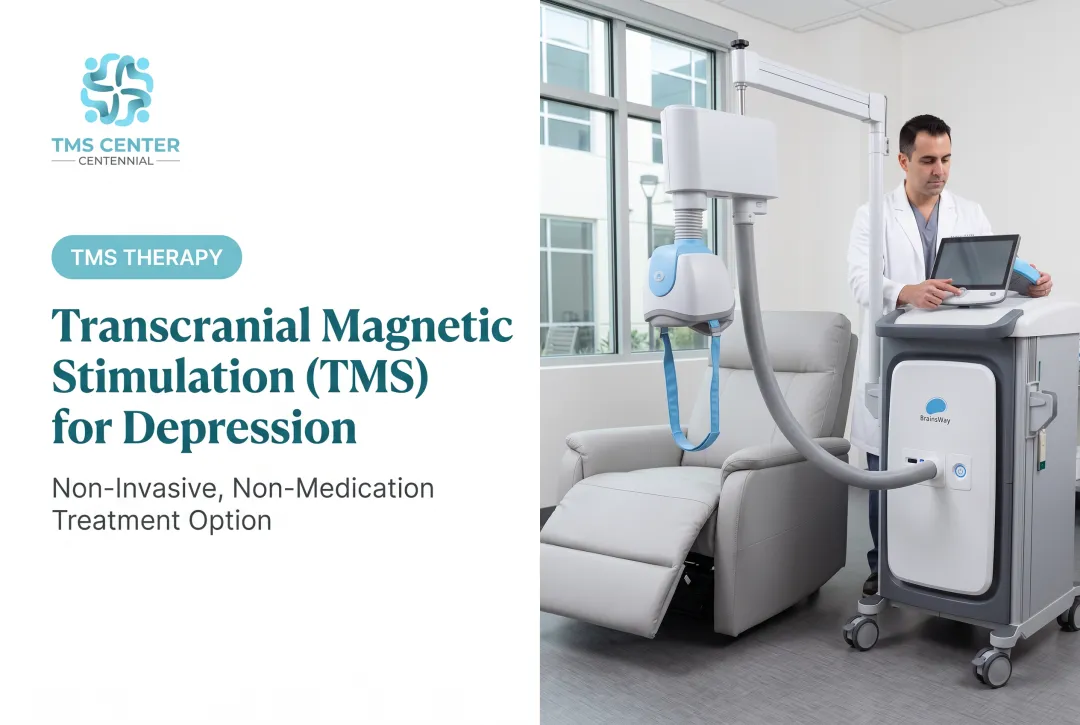
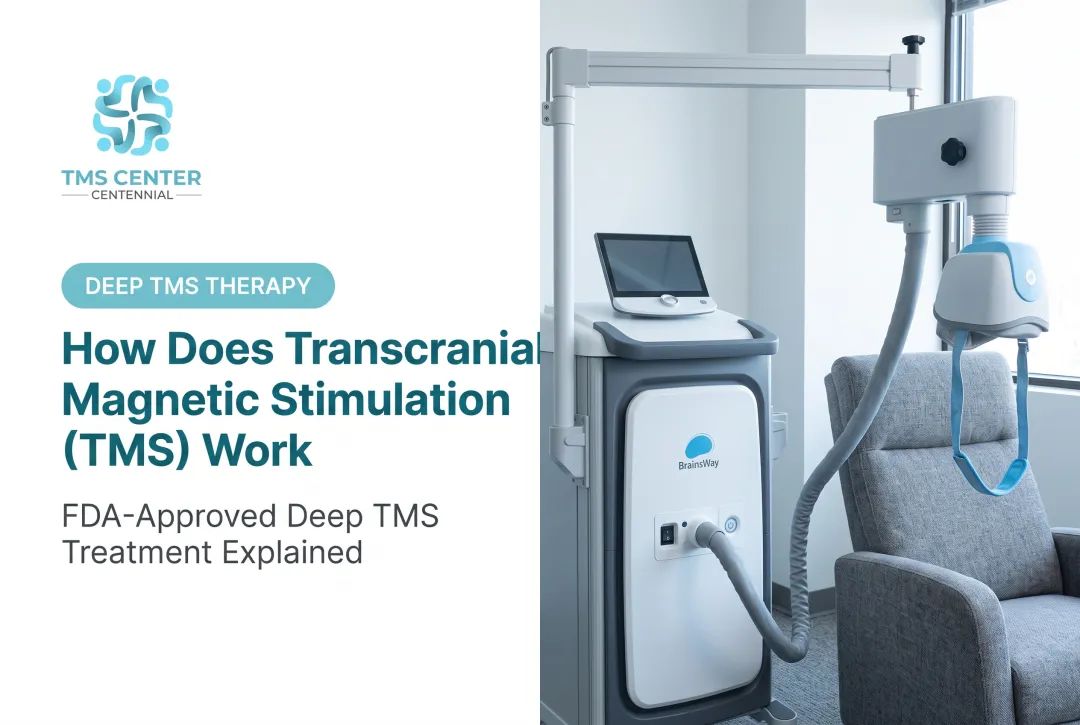
- H-coil (Deep TMS™, used by BrainsWay): Reaches broader and deeper brain regions, trading some focality for depth
Peer-reviewed modeling confirms H-coils achieve deeper field penetration than conventional figure-8 coils, which is part of why BrainsWay's system has become a common choice at specialized centers.

How Does TMS Work?
TMS follows a defined sequence: coil placement, magnetic field generation, induced neural current, and cumulative brain change over weeks. Each stage builds on the last.
Initiation: Motor Threshold Mapping
Before any treatment begins, clinicians map the patient's motor threshold — the minimum magnetic intensity needed to produce a visible thumb or finger twitch. This step is guided by a technician and physician, and it's personalized to each patient's brain anatomy.
At TMS Center Centennial, this mapping is conducted by a certified TMS technician and the patient's assigned psychiatrist, and it's why the first appointment runs longer than later ones — the center advises allowing about 45 minutes for that initial visit.
This threshold calibrates everything that follows. If it's set too low, sessions may be too weak to help; set too high, and stimulation can be unnecessarily uncomfortable.
Core Operation: Magnetic Pulse Delivery
Once the threshold is set, an electromagnetic coil against the scalp generates a focused magnetic field — comparable in strength to an MRI magnet, though brief and localized. This field passes painlessly through the skull and induces small electrical currents in targeted neurons, primarily in the left DLPFC.
A single pulse won't produce lasting change. That's why repeated pulses (rTMS) are necessary. A common depression protocol delivers 10 Hz stimulation with roughly 3,000 pulses per session at about 120% of resting motor threshold.
Regulation: Targeting and Personalization
Clinicians adjust three variables based on the condition being treated:
- Intensity — how strong the pulse is
- Frequency — how rapidly pulses fire
- Target location — which brain region receives stimulation
For depression, the left DLPFC is standard. For OCD, BrainsWay's proprietary H7-coil targets the frontal lobes differently, and OCD sessions typically run shorter — around 30 minutes at TMS Center Centennial, compared to longer depression protocols.
Precise targeting matters. Hit the wrong region and effectiveness drops, or patients experience unnecessary discomfort. Deep TMS™ reaches broader, deeper cortical targets than standard figure-8 coils, which helps keep stimulation on the intended network across a full treatment course.
Output: Neuroplasticity and Lasting Change
Repeated sessions strengthen neural pathways through neuroplasticity, gradually normalizing brain circuits dysregulated by depression or OCD.
Clinical data backs this up. In one pivotal H-coil trial, patients saw 37% response and 30% remission rates, compared to 28% and 16% for sham treatment — figures documented in a Clinical TMS Society consensus review. TMS Center Centennial reports its own outcomes of 89% symptom reduction and 69% complete remission among treated patients, though these are clinic-reported figures rather than a published trial.
No sedation is involved, so patients can return to work, errands, or driving right after each session.

What Happens During a TMS Session?
Walking into a TMS session for the first time can feel intimidating. In practice, it's fairly routine:
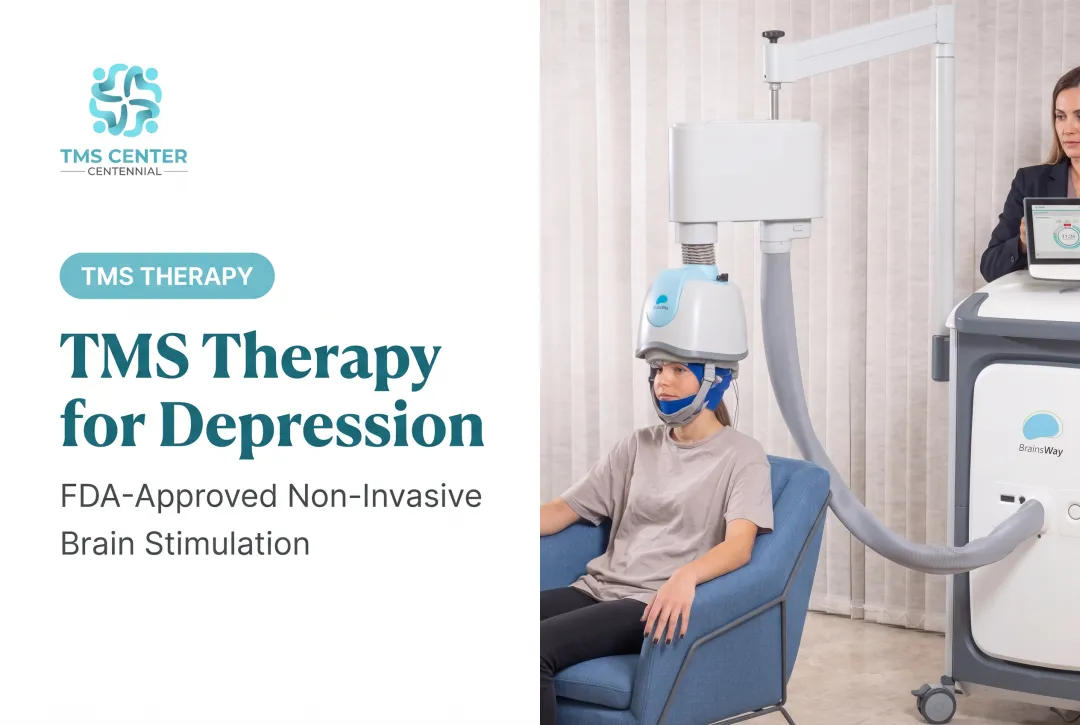
- Sit down in a reclining chair: no gowns, no IVs, no prep
- Coil positioning: a technician places the coil against your scalp at the mapped location
- Pulses begin: you'll feel a light tapping or clicking sensation on the scalp
- Session ends: most last 20-30 minutes, though the full appointment (including setup) runs closer to 45 minutes
The tapping sensation tends to fade after the first few visits as you get used to it. Mild scalp soreness is the most commonly reported effect, and it typically resolves within about 20 minutes, sometimes followed by a sense of relaxation.
A full course involves daily visits, five days a week, for 4-6 weeks (generally around 30 total sessions). You remain fully awake throughout. You can talk, listen to music, and drive yourself home the moment treatment ends.

At TMS Center Centennial, certified BrainsWay™ technicians like Christine Cook, who became a technician after experiencing TMS herself as a patient, guide each session personally. That firsthand perspective tends to ease first-timers' nerves more than any brochure can.
Where Is TMS Used and Who Is It For?
TMS is delivered in an outpatient clinic setting. It typically enters the picture after other treatments have already been tried, and it is not usually a first-line option.
Who tends to benefit most:
- Patients with treatment-resistant depression who've tried two or more antidepressants without adequate relief
- Individuals with OCD who haven't responded fully to medication or therapy
- PTSD patients, including veterans and active-duty service members
- People managing anxiety disorders alongside depression
Contraindications to know:
- Non-removable metal or magnetic-sensitive implants near the head, including cochlear implants, deep brain stimulators, and vagus nerve stimulators
- Certain seizure histories, which are reviewed case by case
A clinical evaluation is required beforehand to confirm candidacy. TMS Center Centennial's team, which includes psychiatrist Dr. Cheryl Dasler, reviews each patient's treatment history—generally including prior psychotherapy—before approving a plan.
How TMS Compares to Other Brain Stimulation Treatments
How TMS Compares to ECT and Antidepressants
| Factor | TMS | ECT | Antidepressants |
|---|---|---|---|
| Anesthesia required | No | Yes | No |
| Seizure induced | No | Yes (intentional) | No |
| Memory loss risk | None documented | Possible | None |
| Systemic side effects | Minimal | Moderate | Common (weight gain, sexual side effects) |
| Recovery time | None | Hours | None |
A 2025 systematic review found ECT has a stronger short-term antidepressant effect than TMS, with pooled response rates around 64% versus typically lower response rates for TMS. That advantage comes with tradeoffs: anesthesia, induced seizures, and a real risk of memory disruption. TMS trades some raw efficacy for a gentler side-effect profile.

Compared to oral antidepressants, TMS acts locally in the brain rather than systemically, so it avoids the weight gain and sexual dysfunction that drive many patients to stop taking medication altogether.
TMS Center Centennial combines Deep TMS™ with NeurOptimal® neurofeedback and collaborative counseling from licensed therapists, so care extends beyond stimulation alone.
Conclusion
TMS is a precise, stepwise process—not a one-session fix. Motor threshold mapping calibrates treatment, targeted magnetic pulses stimulate specific brain circuits, and weeks of cumulative sessions drive the neuroplastic change that reduces symptoms.
Understanding that process matters when you're deciding whether TMS is right for you. If medication hasn't worked and you're weighing options, a consult with a certified provider like TMS Center Centennial can confirm whether you're a candidate.
Frequently Asked Questions
What is the average cost of TMS therapy?
Cost depends on your provider, insurance plan, and session count. Most major plans cover TMS for treatment-resistant depression, including plans accepted at TMS Center Centennial, so many patients pay little out of pocket beyond standard copays or deductibles.
Does insurance pay for TMS therapy?
Most major insurers cover TMS when criteria like documented antidepressant failure are met. TMS Center Centennial accepts Cigna, Anthem BCBS, TRICARE, United Healthcare, and Aetna.
Is TMS an effective treatment for depression and anxiety?
Yes for depression. TMS is FDA-cleared, and BrainsWay clinical data report about 89% significant symptom reduction and roughly 69% full remission. For anxiety, it is often used off-label with promising but less established results.
What disqualifies you from TMS therapy?
Non-removable metal or magnetic implants near the head (like cochlear implants or deep brain stimulators) and certain seizure disorders are the main exclusions. A clinical evaluation screens for these before starting.
Is there a difference between TMS and Deep TMS?
Standard TMS uses a figure-eight coil for narrow, focused stimulation. Deep TMS™ (BrainsWay) uses an H-coil that reaches deeper and broader brain regions.
Are there any long-term side effects of TMS?
No known long-term side effects have been documented. Most side effects, such as mild scalp discomfort or headache, stay limited to the treatment period itself.