
Introduction
If you've tried two, three, or even five antidepressants without relief, you're not alone. An estimated 2.8 million U.S. adults meet criteria for treatment-resistant depression. That's roughly 31% of people being medically treated for major depressive disorder, according to a 2021 national prevalence study.
Many of these patients are searching for something beyond pills.
Transcranial Magnetic Stimulation, or TMS, is an FDA-approved non-drug option for depression. It's backed by clinical research and increasingly available at outpatient clinics across the country. But it's also widely misunderstood.
This guide breaks down how TMS works, what the research says about success rates, who qualifies, and what a real session looks like at TMS Center Centennial in Centennial, Colorado.
Key Takeaways
- TMS stimulates underactive brain regions tied to depression with magnetic pulses—no anesthesia or downtime
- Trials show improvement in about one-third to half of patients; TMS Center Centennial reports 89% improvement and 69% remission
- Metal implants or a seizure history usually disqualify candidates; a medical screening confirms eligibility
- TMS Center Centennial pairs Deep TMS™ with neurofeedback and counseling and accepts most major insurance
What Is TMS Therapy and How Does It Work for Depression?
TMS is a non-invasive, outpatient procedure that delivers repetitive magnetic pulses to the dorsolateral prefrontal cortex (DLPFC), a region of the brain closely tied to mood regulation. In many people with depression, this area shows reduced activity. TMS aims to wake it back up.
The mechanism is straightforward: a coil placed near the scalp generates a magnetic field that passes painlessly through the skull and induces a small electrical current in the underlying brain tissue. That current activates neurons in the DLPFC. Over repeated sessions, this stimulation appears to:
- Increase neurotransmitter activity in mood-regulating circuits
- Encourage neuroplasticity, meaning the brain's ability to rewire itself
- Help rebalance communication between brain regions involved in depression
No sedation or anesthesia is required. Patients stay awake, sit in a chair, and can drive themselves home or return to work immediately after each session.
TMS isn't new. The FDA first cleared it for treatment-resistant depression in 2008, specifically for adults who hadn't responded well to at least one antidepressant. Since then, the FDA has expanded approvals to include OCD (2018), smoking cessation (2020), and comorbid anxiety within depression (2021).
Deep TMS™ vs. Traditional TMS: Why the Technology Matters
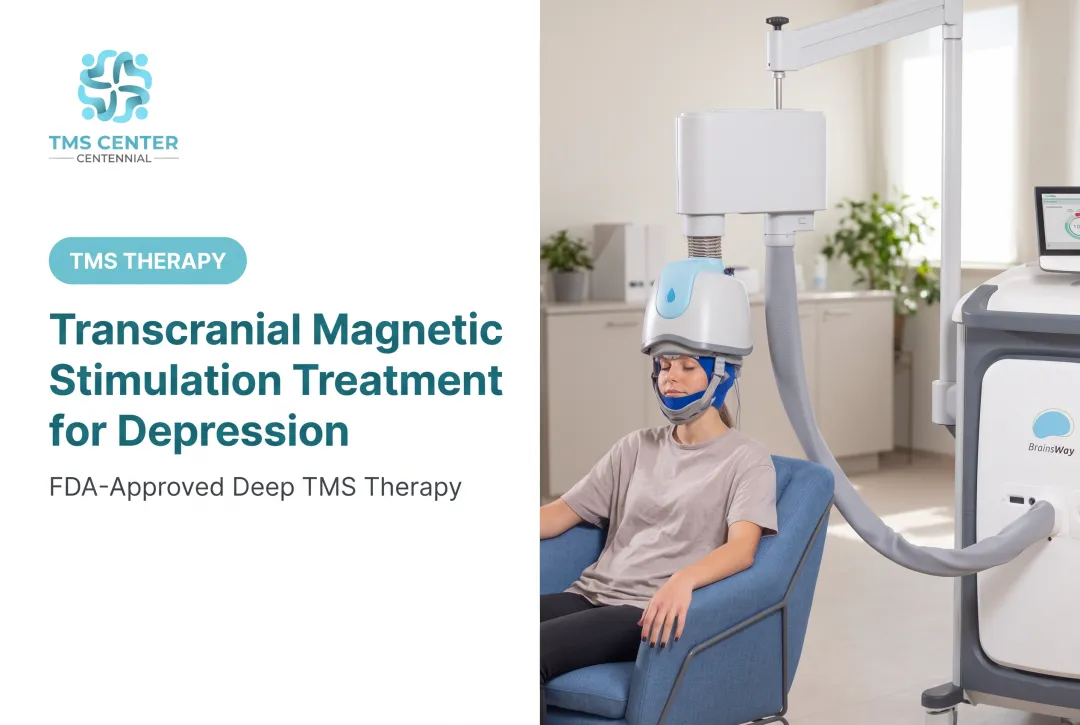
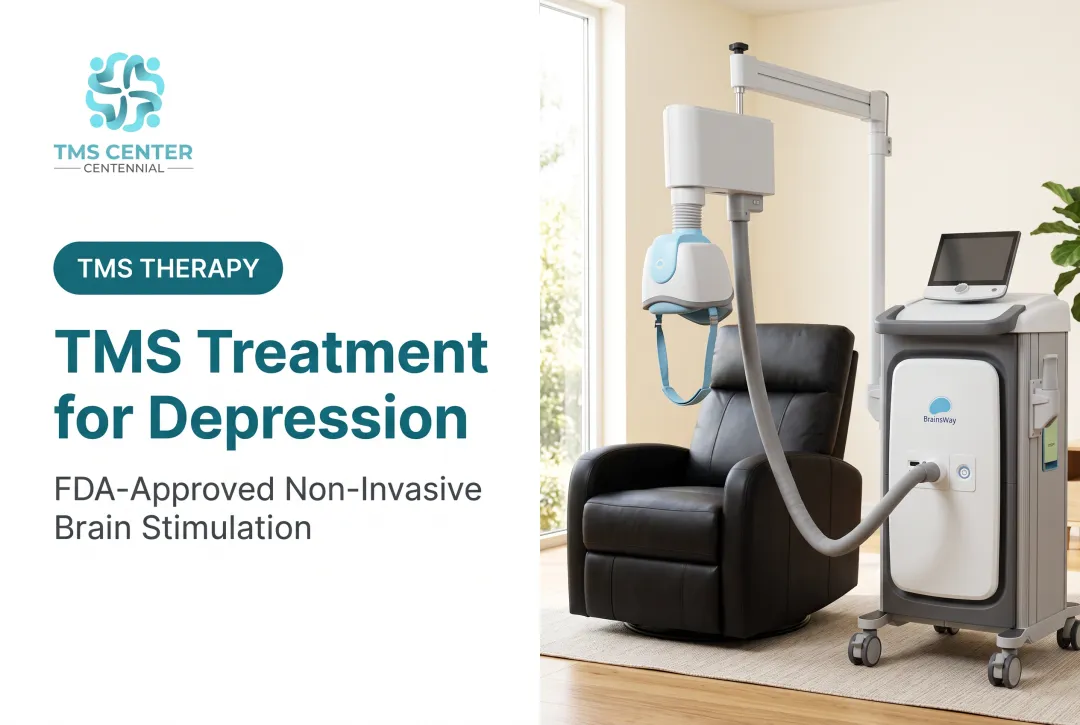
Not all TMS coils are built the same. Traditional rTMS uses a figure-8 coil, which produces a focused but shallow magnetic field. Deep TMS™, delivered through an H-coil system like BrainsWay's, is designed to reach broader and deeper brain regions - stimulating the brain's neural pathways more broadly and at approximately four times the depth of conventional rTMS.
| Feature | Traditional Figure-8 Coil | Deep TMS™ (H-Coil) |
|---|---|---|
| Field shape | Narrow, focal | Wider, covers multiple regions |
| Modeled stimulation depth | Up to ~1.5 cm | Up to 4-5 cm at higher output |
| Brain coverage | Concentrated | Broader lateral and medial reach |
Greater depth and breadth don't automatically guarantee better outcomes for every patient. Results still depend on the individual and the clinical trial evidence behind each protocol. What Deep TMS™ does offer is the ability to engage a larger network of neurons in a single pulse.
That broader reach is why TMS Center Centennial uses FDA-approved BrainsWay Deep TMS™, delivered by certified technicians. Lead TMS Coordinator Christine Cook became certified after going through the treatment herself as a patient.

Does TMS Therapy Really Work? Success Rates and Clinical Evidence
Short answer: yes. Multiple peer-reviewed studies support TMS as an effective, evidence-based treatment for depression that hasn't responded to medication. Major psychiatric guidelines treat it as a standard option for treatment-resistant depression.
A 2014 PubMed meta-analysis of randomized, sham-controlled trials found that standard high-frequency rTMS produced a 29.3% response rate versus 10.4% for sham treatment. Remission rates were 18.6% versus 5.0%—roughly triple the odds of improvement compared with sham control.
Compare that to medication alone. In the landmark STAR*D trial, about one-third of patients reached remission after their first antidepressant trial, and another 10-15% responded without fully remitting. For the roughly one-third of patients who don't get adequate relief from drugs, TMS offers a different path forward.
Here's how the numbers stack up:
| Treatment approach | Response rate | Remission rate |
|---|---|---|
| Standard rTMS (RCT data) | 29.3% | 18.6% |
| H1-coil Deep TMS (pivotal trial) | 38.4% | 32.6% |
| Real-world clinical practice | 58.0% | 37.1% |
| TMS Center Centennial (reported) | 89% | ~69% |
TMS Center Centennial's own reported outcomes, based on its patient population after a full course of treatment, sit above the published clinical averages. That gap is worth noting honestly: real-world clinics often see different results than controlled trials, partly because of patient selection and partly because clinics combine TMS with other supports.
At TMS Center Centennial, patients who pair Deep TMS™ with collaborative counseling through LMFT Carolyn Riviere's team often report stronger sustained outcomes than with stimulation alone. Counseling builds coping skills and addresses thought patterns while TMS targets the biology.
What Do Neurologists and Psychiatrists Think of TMS?
Consensus guidelines from the National Network of Depression Centers and the Clinical TMS Society endorse TMS and cite strong evidence for its safety and effectiveness.
That clinical acceptance shapes care at TMS Center Centennial. Board-certified psychiatrist Dr. Cheryl Dasler—double board-certified in General and Child/Adolescent Psychiatry—uses TMS as a non-medication option within a mind-body approach, not only after every drug option has failed.
Who Is a Good Candidate for TMS — and Who Isn't?
The ideal TMS candidate is an adult with major depressive disorder who hasn't found adequate relief from two or more antidepressant medications, the bar most insurers set before approving treatment. If medication hasn't worked or caused side effects you can't tolerate, TMS is worth discussing with a doctor.
Signs TMS might be worth exploring:
- Depression is interfering with work, relationships, or daily functioning
- You've lost interest in things you used to enjoy
- Antidepressants haven't helped, or the side effects outweigh the benefits
- You're looking for a treatment without systemic drug side effects
Things We Need to Know About Before TMS
TMS isn't right for everyone. Based on established clinical consensus guidelines, the following are things we need to know about - not automatic turn-aways - and often need specialized evaluation first:
- Removable metal around the head and neck (earrings, necklaces, hearing aids, hairpins, and similar items): taken off before the session and not a disqualifier
- Implanted or permanent metal needing clinical evaluation: cochlear implants, aneurysm clips or coils, stents, metal within about 30 centimeters of the treatment area, retained bullet fragments or other ferrous metal fragments, and tattoos containing inks formulated with metals
- Implanted stimulators or electrodes close to the treatment area
- A personal or family history of seizures
- Certain neurological conditions that lower seizure threshold
Pacemakers and other electronic implants aren't always an automatic disqualifier, but they require device-specific safety review, according to 2018 consensus recommendations for clinical TMS use. Dental hardware and non-ferromagnetic orthodontic devices generally aren't a concern. Please raise anything you are unsure about during your evaluation.
Beyond depression alone, TMS can also help with anxiety, PTSD, and OCD. At TMS Center Centennial, Dr. Cheryl Dasler, Psychiatrist, reviews medical history and safety factors before confirming whether someone is a good candidate.

What to Expect During TMS Treatment
A TMS session is far less dramatic than most people imagine. You sit comfortably in a chair while a certified technician positions the coil near your scalp, based on measurements taken during your initial mapping appointment.
You'll feel a tapping sensation and hear a clicking sound as the machine pulses.
A typical session at TMS Center Centennial:
- Arrive and get settled (a therapy dog is available if you'd like company)
- Technician positions the coil using your personalized treatment map
- A depression session takes about 30 minutes in the office
- You can read, watch TV, or chat during the session
- Walk out and resume your day immediately, with no recovery time needed
Most standard courses run five days a week for four to six weeks, totaling around 20-30 sessions. Some patients notice mood or sleep improvements within the first few weeks; others need the full course before change becomes noticeable.
Side effects are typically mild. Scalp discomfort or a mild headache is most common in the first week, and some people feel brief facial or jaw discomfort during stimulation.
These effects usually fade as your body adjusts. They're far less disruptive than the fatigue, weight gain, or sexual side effects often associated with antidepressant medications. Serious risks like seizure are rare, estimated at roughly 1 in 30,000 treatments under standard clinical use.
Why Choose TMS Center Centennial for TMS Therapy in Denver
Choosing a TMS provider matters as much as choosing the treatment itself. TMS Center Centennial has operated in the Denver metro area since 2017, and its team brings hands-on clinical experience shaped by real patient recovery stories.
The care team includes:
- Dr. Cheryl Dasler, Psychiatrist, double board-certified in General Psychiatry and Child and Adolescent Psychiatry
- Carolyn Riviere, LMFT, co-owner overseeing collaborative counseling
- Rodney Placzek, Clinical Director and Certified TMS Trainer
- Certified TMS coordinators, including Christine Cook
Insurance and accessibility: The center accepts most major insurance plans, including Cigna, Anthem Blue Cross Blue Shield, Tricare, United Healthcare, Aetna, and most Medicare plans. That Tricare acceptance isn't incidental — Rodney is a retired Army Sergeant Major who underwent TMS himself after struggling with the transition to civilian life. His own recovery shapes the center's veteran-informed, empathetic approach to care.
Beyond TMS, the center offers NeurOptimal® neurofeedback and collaborative counseling under one roof, plus small comfort touches like on-site therapy dogs, Finn and Furgus, who patients can hold during sessions. Those details matter when you're the one sitting in the chair. Reported BrainsWay clinical data show an 89% symptom reduction rate and about 69% complete remission — outcomes the center tracks as part of its Deep TMS care model.

Frequently Asked Questions
Does TMS therapy really work?
Yes. Clinical trials show meaningful response and remission rates compared to sham treatment. Real-world results, including TMS Center Centennial's reported 89% improvement rate, support its effectiveness for treatment-resistant depression.
What do neurologists think of TMS?
Neurologists and psychiatrists broadly accept TMS as a safe, FDA-approved, evidence-based treatment. Professional consensus guidelines endorse its use for medication-resistant depression.
Who is not a good candidate for TMS?
Patients with certain implanted or permanent metal near the head, active seizure disorders, or specific neurological conditions typically need medical evaluation rather than automatic exclusion. Things we need to know about metal: removable items such as earrings, necklaces, hearing aids, and hairpins are taken off before the session and are not a disqualifier. Implanted or permanent concerns include aneurysm clips, cochlear implants, stents, metal within about 30 centimeters of the treatment area, retained bullet fragments or other ferrous metal fragments, and tattoos containing inks formulated with metals. Please raise anything you are unsure about during your evaluation.
How many TMS sessions will I need before seeing results?
Most treatment courses run five days a week for four to six weeks, roughly 20-30 sessions total. Some patients notice changes within the first few weeks, though full benefits usually appear after completing the course.
Is TMS therapy covered by insurance?
Most major insurance providers cover TMS for treatment-resistant depression. TMS Center Centennial accepts Cigna, Anthem BCBS, TRICARE, United Healthcare, Aetna, and most Medicare plans, among others.
Can I continue taking my medications during TMS treatment?
Patients can generally continue their current medications during the TMS protocol. The clinical expectation is that patients stay stable on their medications during treatment rather than making unplanned adjustments between sessions. Keeping medications stable helps limit variables during treatment, so the clinical team can tell what is actually working. Any medication changes should be made under medical supervision, and preferably after finishing the TMS protocol rather than during it - always with guidance from the prescribing clinician.
What does a TMS session actually feel like?
Patients feel a tapping sensation on the scalp and hear a clicking sound during stimulation. Some notice mild discomfort at first, but most adjust within the first few sessions.