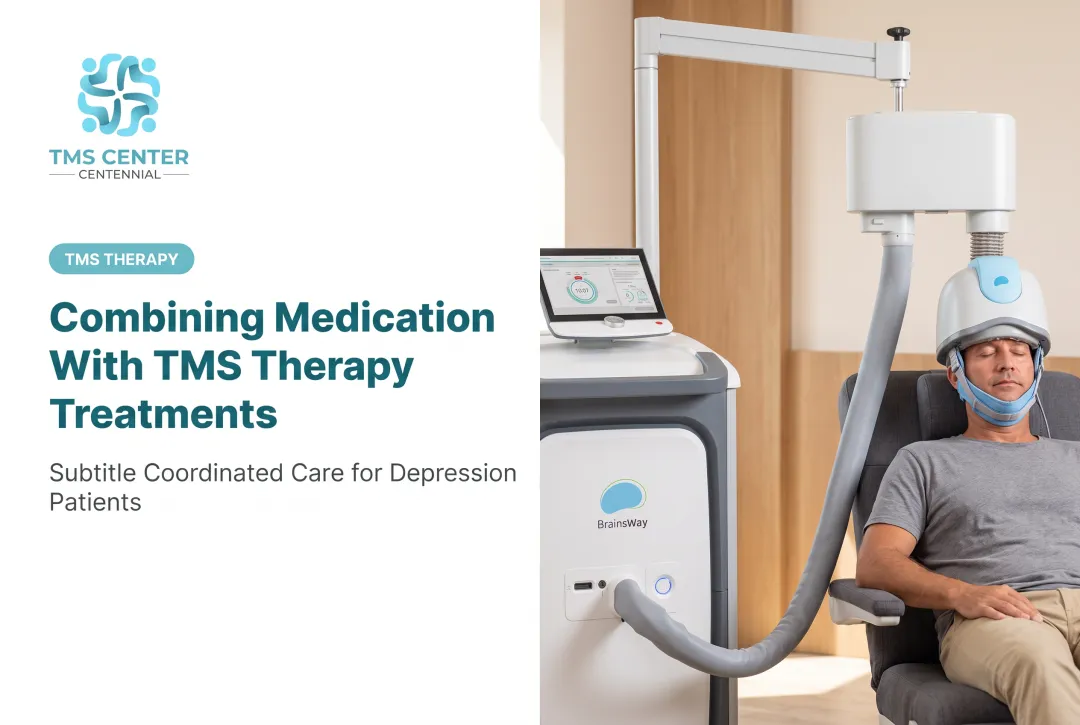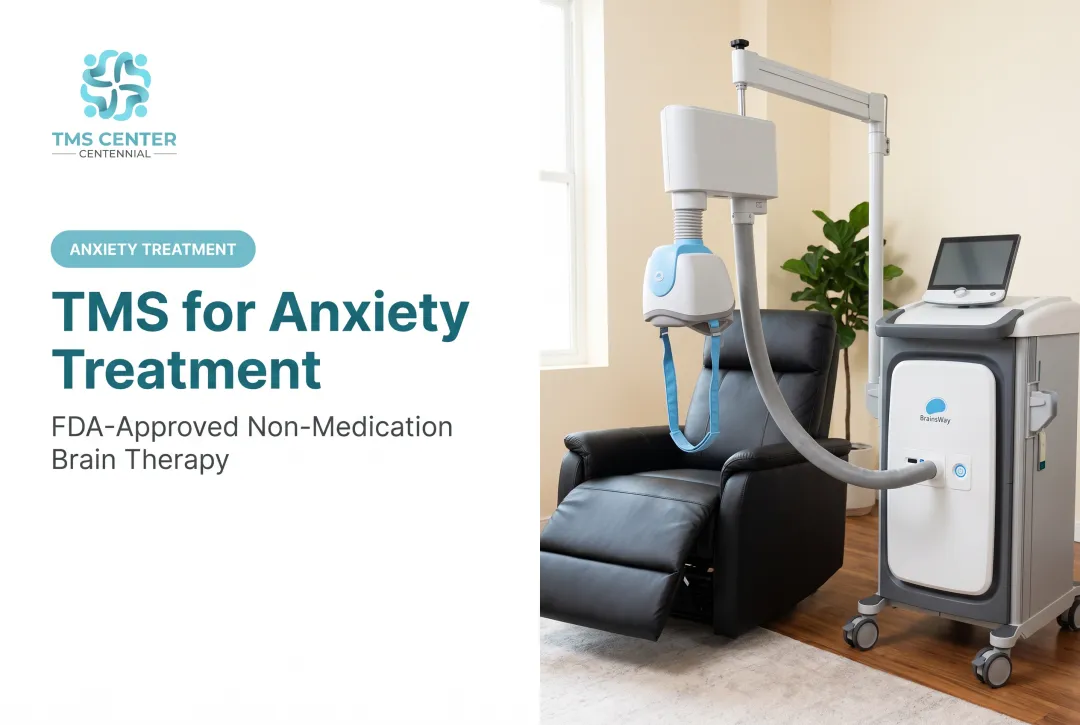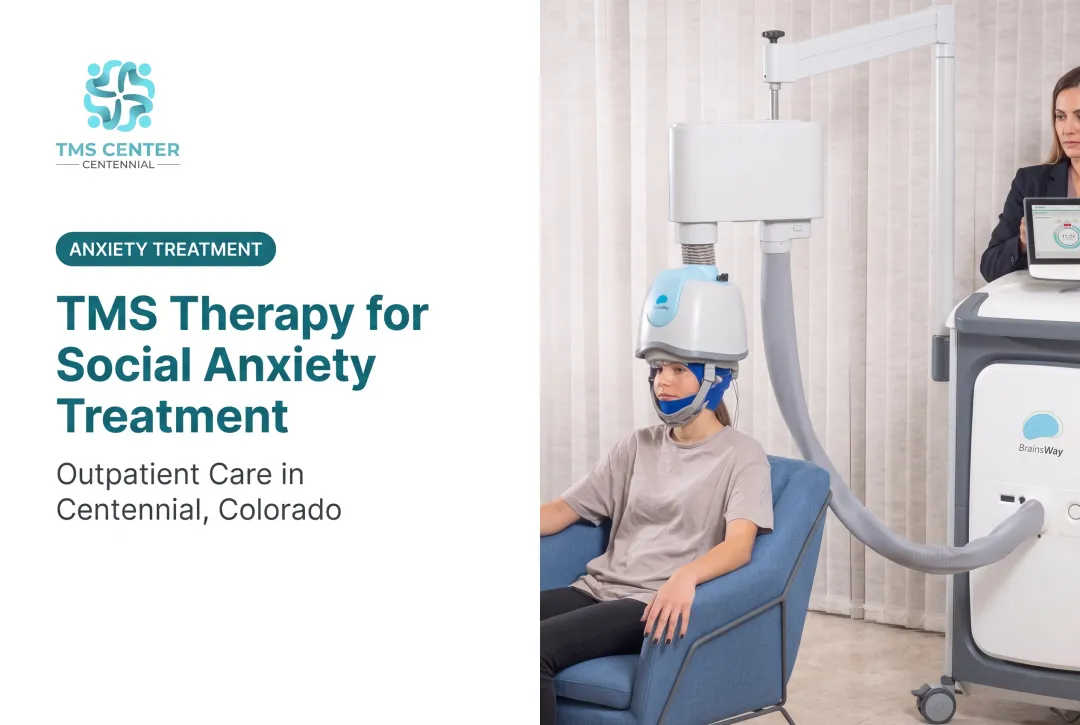

Anxiety disorders affect roughly 19.1% of U.S. adults in a given year, according to the National Institute of Mental Health, and a substantial share of them never get full relief from first-line treatment. This article breaks down what the research actually shows about Transcranial Magnetic Stimulation (TMS) for anxiety, what a treatment course looks like, and how to know if it's worth exploring.
Key Takeaways
- Anxiety disorders affect 19.1% of U.S. adults yearly, and about 50% of GAD patients don't respond fully to first-line medication
- TMS is FDA-cleared for anxious depression, not yet as a standalone anxiety treatment
- Meta-analyses report large effect sizes for TMS in generalized anxiety disorder
- Sessions are non-invasive, last 20–45 minutes, and patients resume normal activity immediately
- Side effects are typically mild; TMS avoids the systemic effects of medication
Understanding Anxiety Disorders and Why Standard Treatments Sometimes Fall Short
Everyday worry passes. Clinical anxiety disorders don't. Generalized anxiety disorder (GAD), panic disorder, and social anxiety disorder are marked by excessive, hard-to-control fear or worry that disrupts daily functioning for months at a time.
Common symptoms include:
- Racing heart or chest tightness
- Persistent muscle tension
- Rumination and intrusive worry loops
- Sleep disturbance
- Difficulty concentrating
Why First-Line Treatment Doesn't Always Work
SSRIs and SNRIs (escitalopram, venlafaxine, duloxetine) remain the standard first step, alongside cognitive behavioral therapy. CBT carries solid evidence, with remission rates around 54% across studies, according to a 2025 meta-analysis.
But medication doesn't work for everyone. About 50% of adults with GAD don't respond adequately to first-line antidepressants, according to a 2020 review of treatment-resistant GAD. That leaves roughly half of patients stuck between "somewhat better" and actually functioning again.
Does TMS Work for Anxiety? What the Research Shows
TMS targets the dorsolateral prefrontal cortex (dlPFC), a brain region that normally exerts top-down control over the amygdala, our fear-processing hub. In anxiety disorders, this dlPFC-amygdala connection often malfunctions. Magnetic pulses aimed at the dlPFC are thought to help restore that regulatory circuit, according to a 2023 neuropharmacology review.

The Evidence for GAD
A 2019 meta-analysis found large pooled effects for rTMS in generalized anxiety disorder, with a Hedges' g around -2.06 (Cirillo et al., 2019). Some patients kept improving at follow-up rather than relapsing. That's a strong signal, though study sizes remain small.
Where TMS Currently Stands with the FDA
FDA status is more specific than the research headlines:
- TMS is FDA-cleared for anxious depression — reducing anxiety symptoms in patients who also have major depressive disorder
- It is not yet FDA-cleared as a standalone treatment for GAD, panic disorder, or social anxiety alone
- Evidence is strongest for anxious depression; anxiety-alone studies are smaller and still building toward larger confirmatory trials
Anxiety symptoms sometimes fluctuate before they improve. A slightly rough patch mid-course isn't a sign that treatment has failed; it's often part of the process as the brain recalibrates.
What to Expect: The TMS Treatment Process for Anxiety
At TMS Center Centennial, the anxiety treatment path starts with a thorough evaluation. The clinical team reviews:
- Anxiety history and prior treatments, including medications and therapy you've already tried
- Psychotherapy background, including your therapist's name and rough timeline
- Medical screening to confirm TMS suitability and safety
You can generally keep taking your current medications during treatment. Staying stable on your regimen helps the clinical team isolate what improvement comes from TMS itself. Any dosage changes are handled by your prescribing doctor, usually after the protocol wraps up.
Mapping and the First Session
Before treatment begins, a certified TMS technician and physician map your head to find the correct placement, then create a personal cap for future sessions. During mapping, small pulses locate your motor threshold. You might notice brief finger or facial twitching; it passes quickly.
The anxiety protocol feels different from depression protocols. Patients often describe a steady, metronome-like "thumping" sensation rather than a sharper rhythm.
Session logistics are straightforward:
- Appointments run about 45 minutes
- Courses typically run five days a week for four to six weeks
- Exact timing is tailored to your needs and response
You stay awake throughout. No sedation and no recovery time. Most patients drive themselves home and return to work the same day.

Comparing TMS to Other Anxiety Treatment Options
No single treatment fits everyone. Here's how the main options stack up:
| Treatment | How It Works | Best For |
|---|---|---|
| SSRIs/SNRIs | Adjusts neurotransmitter levels | First-line, but ~50% non-response in GAD |
| CBT | Restructures thought patterns | Strong long-term skills, requires active participation |
| TMS | Magnetic stimulation of the dorsolateral prefrontal cortex (dlPFC) | Medication-resistant cases, no systemic side effects |
| Neurofeedback | Trains brainwave self-regulation | Complementary, non-invasive brain training |

Rather than relying on a single approach, some patients benefit from combining options. TMS Center Centennial offers BrainsWay Deep TMS alongside NeurOptimal neurofeedback and collaborative counseling, giving patients a more layered plan instead of one intervention alone.
Which combination makes sense depends on your treatment history, what has already been tried, and personal preference. There is no universal formula.
Is TMS Safe? Understanding Side Effects
Yes. TMS is generally well tolerated compared with many anxiety medications.
Common, mild effects:
- Scalp discomfort or tenderness during and shortly after sessions
- Mild headache, especially in the first few sessions
- Temporary grogginess that usually resolves within an hour
One patient on an anxiety protocol reported mild scalp soreness for about 20 minutes after a session. After the third visit, brief grogginess gave way to a boost in motivation and energy. That adjustment period is common and typically fades.
Rare risks:
Seizure risk is low, estimated at under 1% in aggregate reviews and as low as 0.0003% per session for some devices (Stultz, 2020). Pre-treatment screening reduces this risk further.
Unlike SSRIs and SNRIs, TMS doesn't carry systemic side effects like weight gain, sexual dysfunction, or sedation. Stimulation stays at the treatment site and never enters your bloodstream.

Finding Compassionate, Comprehensive TMS Care in the Denver Area
TMS Center Centennial, based in Centennial, Colorado, brings together psychiatrists, licensed therapists, and certified TMS coordinators in one clinic for patients across the Denver metro area, including Highlands Ranch, Lone Tree, Aurora, and Littleton.
What sets the approach apart:
- BrainsWay Deep TMS paired with NeurOptimal neurofeedback, giving patients non-medication options that address anxiety from multiple angles
- Major insurance accepted, including Cigna, Anthem, TriCare, United Healthcare, Aetna, and most Medicare plans
- Staff who have completed TMS as patients themselves
Rodney Placzek, the clinic's owner and clinical director, is a retired Army Sergeant Major who underwent TMS himself during his own mental health recovery. Lead TMS coordinator Christine Cook came to the field the same way: as a patient who found relief after significant personal loss, then trained as a certified BrainsWay technician.
That lived experience shows up in how the team walks anxious patients through a first session and what to expect next.
Frequently Asked Questions
Does TMS work for anxiety?
Research shows promising results, particularly for anxious depression and generalized anxiety disorder, with studies reporting strong symptom improvement. Standalone FDA approval for anxiety alone is still pending, though TMS is already FDA-cleared for depression with anxiety symptoms.
How long does it take for TMS to work for anxiety?
Most protocols run four to six weeks, with many patients noticing gradual changes several weeks into the course. Anxious depression data shows meaningful reduction by around week five, with benefits often continuing through the full course.
Does TMS work for panic attacks?
Early, smaller studies suggest TMS may reduce panic symptom severity alongside broader anxiety improvement, but the research base here is still limited. Larger confirmatory trials are still needed.
What are the potential side effects of TMS?
Most patients experience mild scalp discomfort or headache, especially in early sessions, which typically fades quickly. Seizure risk is rare, and pre-treatment screening further reduces that possibility.
What is the difference between an anxiety attack and a panic attack?
Anxiety attacks build gradually and connect to a specific stressor or ongoing worry. Panic attacks strike suddenly and intensely, often without an obvious trigger, with physical symptoms like a racing heart or shortness of breath.
Is there a cure for anxiety and depression?
There's no absolute "cure" in the clinical sense, but many patients reach significant symptom reduction or full remission through treatments like TMS, therapy, and medication. Recovery looks more like sustained management than a permanent fix.