
You're not alone, and you're not failing at treatment. Research shows roughly half of OCD patients respond incompletely to SSRIs alone, even after an adequate 8-week trial. That's exactly why Deep Transcranial Magnetic Stimulation (TMS) exists as an FDA-cleared option for treatment-resistant OCD.
This article breaks down what the clinical evidence actually shows, what a course of treatment looks like day-to-day, and how TMS Center Centennial delivers this therapy to patients across the Denver metro area.
Key Takeaways
- Deep TMS has been FDA-cleared as an adjunctive OCD treatment since 2018
- Clinical trials show response rates of roughly 38-58% in treatment-resistant patients
- A standard course runs about 29-30 sessions over 6 weeks
- Targets the overactive brain circuit driving OCD, not just its symptoms
- TMS Center Centennial offers BrainsWay Deep TMS with certified technicians and broad insurance acceptance
Why OCD Resists Standard Treatment
SSRIs and ERP therapy remain the first line of defense against OCD, and they genuinely help many people. But they don't work for everyone.
- ERP typically reduces OCD symptoms by about 60% on average, according to the International OCD Foundation, so a meaningful chunk of symptoms often remains
- Around half of patients respond incompletely to SSRIs, per a 2020 review in the Journal of Clinical Psychiatry
- SSRIs typically need 8+ weeks before any real improvement shows up
That leaves a lot of people stuck between "somewhat better" and "actually functional."
Understanding the "Stuck Brain Circuit"
Think of OCD like a smoke alarm that won't reset. Even after the smoke clears, it keeps blaring.
That false alarm lives in the cortico-striato-thalamo-cortical (CSTC) loop, a circuit linking the orbitofrontal cortex, anterior cingulate cortex (ACC), striatum, thalamus, and dorsomedial prefrontal cortex (dmPFC).
Imaging research shows this loop runs hyperactive in people with OCD, fueling the obsession-anxiety-compulsion cycle.

Talk therapy and medication can help you manage the alarm. Neither directly recalibrates it. That's the gap TMS is designed to fill.
What Is Deep TMS for OCD?
Deep TMS uses magnetic pulses, similar in strength to an MRI, to stimulate targeted brain regions. It's non-invasive — no anesthesia, no incisions, no systemic medication traveling through your bloodstream.
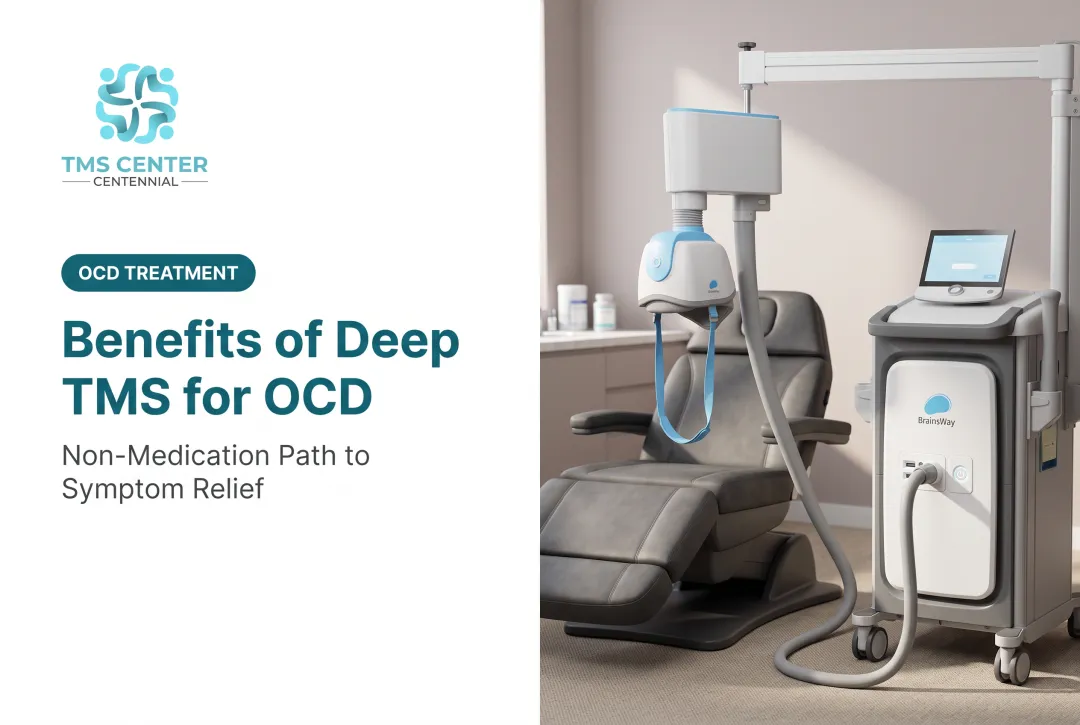
How it differs from standard TMS: Conventional rTMS reaches only surface-level cortex. Deep TMS, using BrainsWay's patented H-coil technology, penetrates roughly four times deeper, reaching broader neural pathways tied to mood and behavior circuits.
Different Targets for Different Conditions
- Depression protocols target the dorsolateral prefrontal cortex (DLPFC)
- OCD protocols target the dmPFC and ACC — the exact regions implicated in the stuck CSTC loop tied to OCD
The multicenter clinical trial published in 2019 that supported FDA clearance used the H7 coil specifically to reach these deeper structures.
Many OCD protocols also add a brief symptom-provocation step before stimulation. Patients think about a trigger so the target circuit is active when the magnetic pulse arrives, which appears to strengthen the treatment effect.
Why this matters versus medication: SSRIs work systemically, throughout your entire body, which explains common side effects like weight gain, sexual dysfunction, and emotional blunting. Deep TMS stays localized to the targeted brain circuit. No systemic chemical exposure, no whole-body side effect profile.
BrainsWay's H7 coil has been FDA-cleared for OCD since 2018. At TMS Center Centennial, certified technicians deliver treatment with this same H-coil system.

Does TMS Actually Work for OCD? Reviewing the Evidence
Three lines of evidence matter most for OCD: the pivotal randomized trial, multi-site real-world outcomes, and long-term durability data.
Pivotal randomized trial
Carmi et al., 2019, American Journal of Psychiatry randomized 94 patients to active or sham Deep TMS.
- 38.1% of active-treatment patients responded (≥30% Y-BOCS reduction) by end of treatment, versus 11.1% sham
- At 1-month follow-up, response climbed to 45.2% active versus 17.8% sham
Real-world clinical outcomes
A 2021 post-marketing study across 22 U.S. clinical sites tracked 167 patients treated per the FDA-cleared protocol:
- 72.6% showed some response at some point in treatment
- 57.9% were still responders after completing all 29 sessions
- Average time to first response: around session 18-19
Durability after treatment
A 2022 durability study in Brain Stimulation followed patients for nearly two years post-treatment. 62% remained responders at final follow-up, pointing to lasting benefit rather than a short-lived spike.
TMS works best as part of a combined approach. Most strong outcomes pair TMS with ongoing ERP therapy, medication, or both, so circuit-level changes are reinforced with behavioral practice.
| Factor | Impact on Outcomes |
|---|---|
| Coil type | H7 coil reaches deeper OCD-relevant circuits vs. standard rTMS |
| Brain target precision | dmPFC/ACC targeting distinguishes OCD protocol from depression protocol |
| Protocol adherence | Full 29-30 session course linked to higher response rates |
| Combined care | Pairing with ERP/medication supports better long-term outcomes |

What to Expect: The TMS for OCD Treatment Process
Before any magnetic pulse touches your scalp, TMS Center Centennial's physicians conduct a full evaluation to confirm Deep TMS is appropriate for you.
Getting Started
- Initial consultation: A doctor reviews your history and OCD symptoms, then builds a personalized treatment plan. Medication changes, if needed, stay with your prescribing clinician.
- Brain mapping session: A certified technician locates your motor threshold using small electromagnetic pulses. You might notice brief finger or facial twitches. Unusual, but not painful.
- Custom cap fitting: You receive a personal cap used throughout your entire course.
The Sessions Themselves
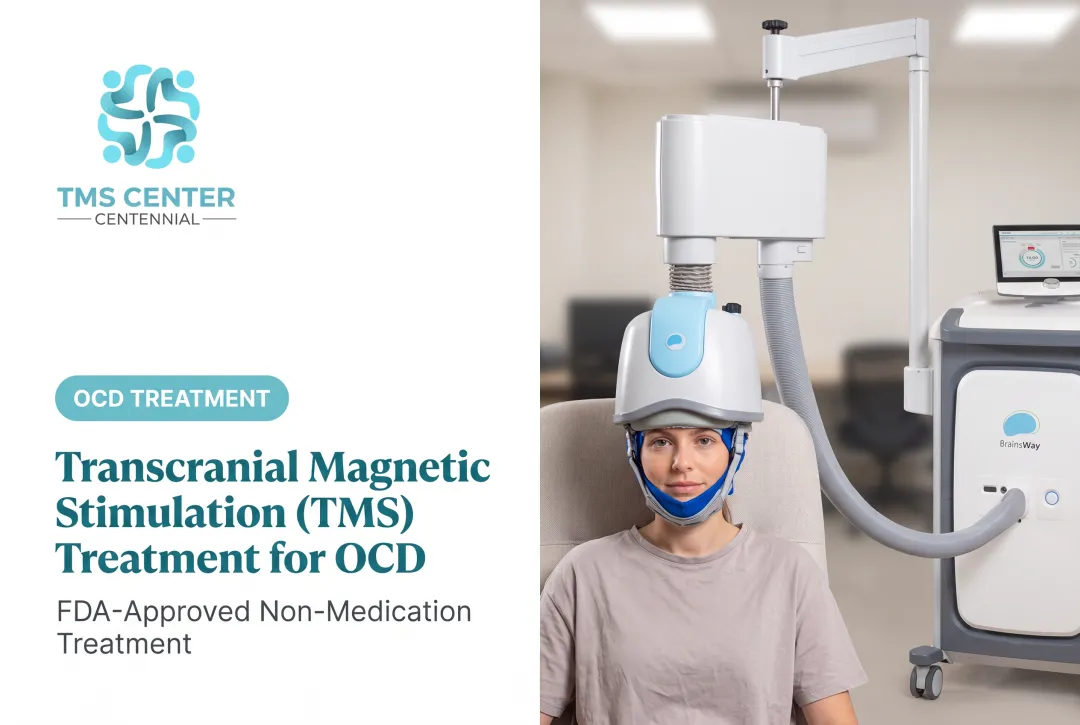
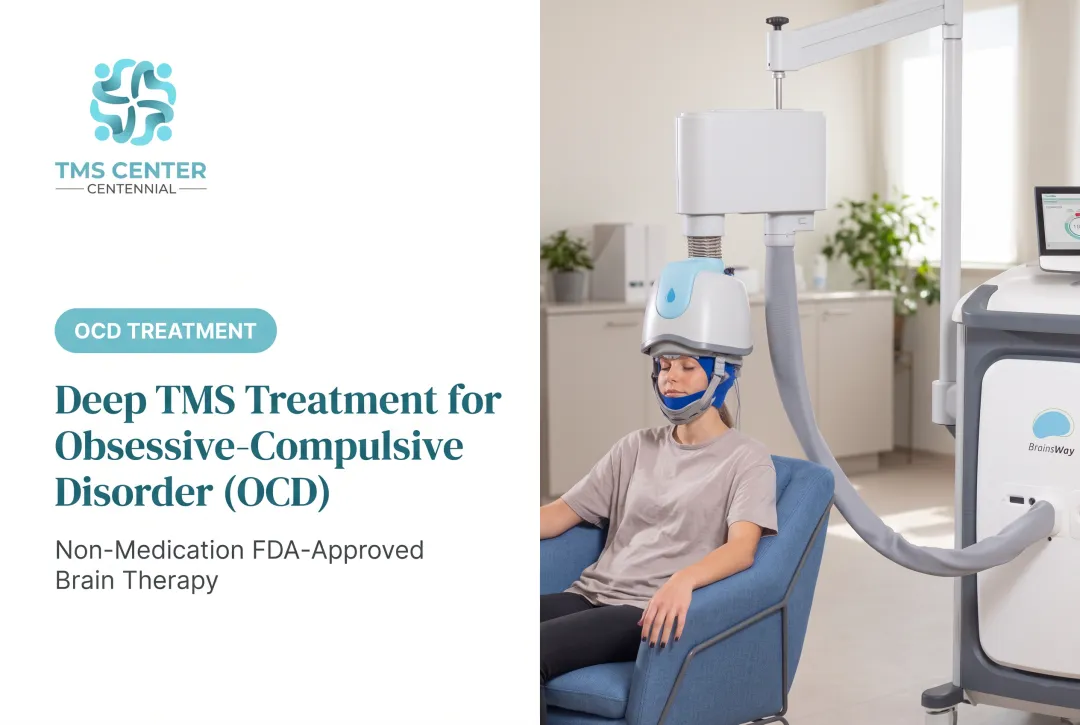
Each appointment runs about 20-30 minutes. You sit upright while the BrainsWay helmet delivers pulses to your dorsomedial prefrontal cortex and anterior cingulate cortex (dmPFC/ACC) target, often preceded by brief symptom provocation to activate OCD-related circuits. You'll feel a distinct tapping sensation on the scalp, with no anesthesia, sedation, or downtime. You drive yourself home and go about your day.
The standard schedule: five days a week for roughly 6 weeks, totaling 29-30 sessions. Real-world data shows most patients notice their first meaningful change around session 18-19. Patience matters here, since results build gradually rather than overnight.
Throughout the process, TMS Center Centennial's certified BrainsWay technicians coordinate with psychiatric staff and the collaborative counseling team. Your therapy and TMS protocol work in tandem, not in isolation.

Is TMS Right for You? Candidacy and Safety Considerations
Deep TMS isn't for everyone, but the eligibility bar is more accessible than many people expect.
General candidacy criteria:
- Confirmed OCD diagnosis
- Inadequate response to at least one full SSRI trial
- Age 18 or older
- No contraindicated metal implants or electronic devices in/around the head
Safety profile:
- Most common side effects: mild scalp discomfort and headache, usually temporary
- Seizure risk is rare — safety research estimates fewer than 1 seizure per roughly 60,000 sessions in patients without risk factors
- No systemic side effects like the weight gain or sexual dysfunction associated with long-term SSRI use
Compared to lifelong medication management, TMS carries a favorable risk profile.
Insurance coverage: TMS Center Centennial accepts most major plans, including Cigna, Anthem BCBS, TriCare, United Healthcare, Aetna, and most Medicare plans. The team manages authorization paperwork and provides a personal benefits review before you start, so you're not left guessing about costs.
Frequently Asked Questions
How many TMS sessions are needed for OCD?
The FDA-cleared protocol calls for approximately 29-30 sessions over about 6 weeks, five days a week, with each session lasting roughly 20-30 minutes.
Does TMS actually work for OCD?
Clinical research shows meaningful response in 38-58% of treatment-resistant patients, particularly when combined with exposure and response prevention (ERP) or medication. Many people improve, though results vary and aren't guaranteed for everyone.
Are there any success stories with TMS for treating OCD?
Many patients report significant drops in compulsions and intrusive thought intensity over a treatment course. TMS Center Centennial can share more specific patient experiences during a consultation.
Is TMS covered by insurance for OCD?
Many insurers, including Medicare in many cases, cover TMS for OCD once treatment resistance is documented. TMS Center Centennial accepts most major plans and handles authorization on your behalf.
What are the side effects of TMS for OCD?
Most patients experience only mild, temporary scalp discomfort or headache. Seizure risk exists but is rare, occurring in roughly 1 in 60,000 sessions.
How is TMS for OCD different from TMS for depression?
OCD protocols target the dorsomedial prefrontal cortex (dmPFC) and anterior cingulate cortex (ACC), while depression protocols target the dorsolateral prefrontal cortex (DLPFC). OCD treatment also typically includes a brief symptom-provocation step before stimulation that depression protocols don't use.