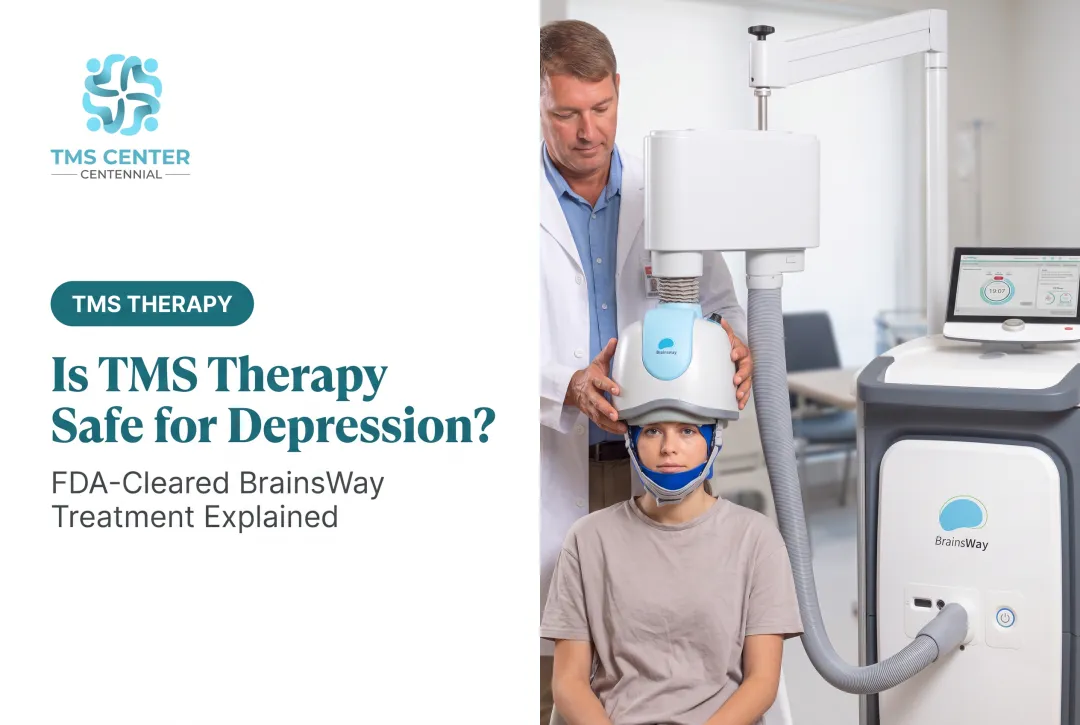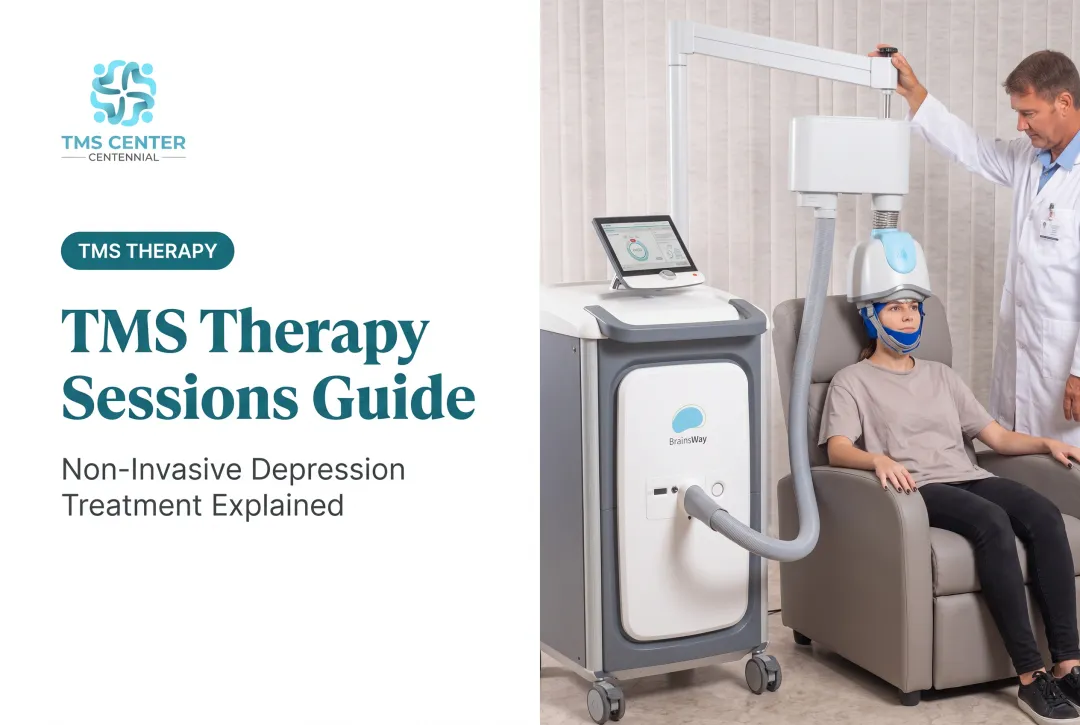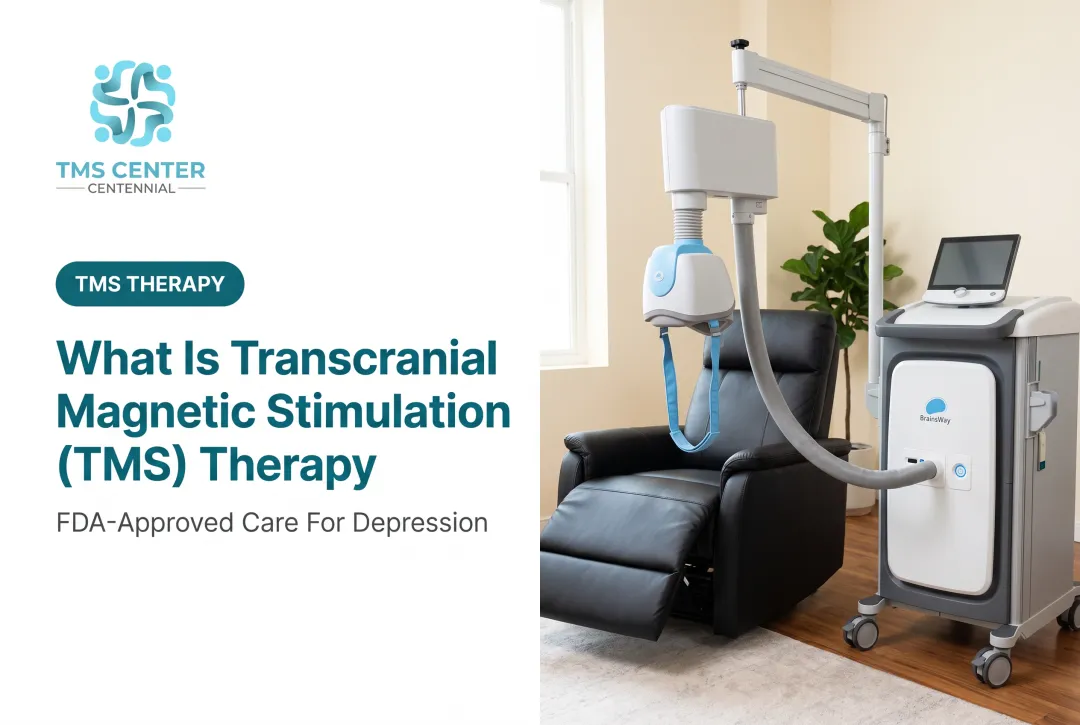

Most TMS side effects are mild and fade within the first week or two. Rare risks do exist, and you deserve straight answers about them, too. This guide walks through common reactions, serious-but-uncommon risks, the so-called "TMS dip," who shouldn't pursue treatment, and how the team at TMS Center Centennial supports patients through every session.
Key Takeaways
- Scalp discomfort and headache are the most common complaints, typically resolving within 1-2 weeks
- Seizures are extremely rare — fewer than one per 60,000 sessions in published clinical data
- The "TMS dip" is a normal, temporary mood shift that does not mean treatment has failed
- Metal implants near the head and certain seizure histories require screening beforehand
- TMS Center Centennial's certified technicians monitor comfort levels at every session
What Is TMS Therapy and How Does It Work?
TMS delivers magnetic pulses to the dorsolateral prefrontal cortex (DLPFC), the region of the brain tied to mood regulation. Repeated stimulation here helps recalibrate the neural circuits involved in depression and anxiety.
There's no anesthesia, no sedation, and no downtime. You walk in, sit in a treatment chair for the session, and walk out ready to drive home or return to work.
TMS Center Centennial uses BrainsWay Deep TMS™, an advanced version of standard TMS that reaches deeper and broader areas of the brain.
TMS is not electroconvulsive therapy (ECT). The two treatments differ in important ways:
- No electrical current passes through the brain
- No seizure is induced
- No memory loss linked to shock therapy
TMS uses magnetic fields similar to an MRI machine, and you remain fully awake and alert throughout.
Common and Mild Side Effects of TMS Therapy
Most people tolerate TMS well. Here's what tends to show up, and why.
Headache and Scalp Discomfort
Headache is the most frequently reported side effect. Clinical data on Deep TMS shows headaches in roughly 47% of patients receiving active treatment, compared to 36% on sham treatment.
Treatment-site pain affects about 25–29% of patients, according to BrainsWay's published safety information. The likely cause is stimulation near the trigeminal nerve pathway.
Most patients manage both effects without much trouble:
- Over-the-counter pain relievers usually resolve it
- Discomfort typically fades within the first few sessions
- Technicians can adjust the coil to improve comfort

Other Mild, Short-Lived Effects
- Tapping or clicking sensation — muscle contraction under the coil, not painful for most patients
- Facial muscle twitching — harmless, stops the instant the pulse ends
- Lightheadedness or fatigue — short-lived, rarely disrupts daily plans
- Temporary sleep or mood shifts — your brain adjusting to new activity patterns, usually settling as treatment continues
At TMS Center Centennial, certified BrainsWay technicians check in on comfort levels every session and can adjust settings as needed. You're never left to just "push through" discomfort alone.
Rare But Serious Risks of TMS Therapy
These risks are worth understanding, even though they're uncommon.
Seizure risk. This is the one people worry about most, and understandably. A large multi-site survey found the seizure rate during rTMS sits at 0.31 per 10,000 sessions, and a separate review estimated fewer than one seizure per 60,000 sessions overall, per research published on PubMed Central. Risk climbs for patients with a seizure history, certain medications, or significant sleep deprivation, which is exactly why intake screening matters.
Fainting (syncope). Usually a vasovagal response to anxiety about the procedure, not the magnetic pulses themselves. It can sometimes be mistaken for a seizure, which is one reason technicians stay present throughout every session.
Hypomania or mania. Rare, and almost always tied to undiagnosed or underlying bipolar disorder. That's why psychiatric screening happens before treatment starts, not after.
Hearing changes. The coil produces a clicking sound during pulses. Ear protection during sessions is standard practice to prevent temporary or, rarely, permanent hearing issues.

None of this is meant to scare you off. These events are measured in fractions of a percent, and they're why a clinical team, not a self-serve machine, runs your treatment.
Understanding the "TMS Dip" and Signs Treatment Is Working
The TMS Dip: What It Is and Why It Happens
Some patients notice their mood dips slightly before it improves. This happens as the brain forms new neural pathways in response to stimulation. Think of it as short-term static before the signal clears. It's not a sign that treatment is failing.
If you experience this, talk to your care team rather than stopping sessions. Quitting during a dip means missing the improvement that typically follows.
Signs TMS Therapy Is Working
Early wins to watch for:
- Better, more consistent sleep
- Sharper focus and concentration
- Gradual lift in overall mood
- Increased motivation for daily tasks
Most patients need patience here. At TMS Center Centennial, meaningful improvement typically emerges over four to six weeks, roughly 20-30 sessions in. The clinic reports an 89% patient symptom reduction rate.
Some notice small shifts sooner, such as better focus or sleep, while the fuller mood lift builds gradually.

Who Shouldn't Get TMS & What to Avoid During Treatment
TMS isn't right for everyone. Screening exists to keep you safe. You generally shouldn't pursue TMS if you have:
- Non-removable metal implants near the head (aneurysm clips, certain surgical hardware)
- Cochlear implants, deep-brain stimulators, or vagus nerve stimulators
- Significant seizure history that has not been carefully risk-assessed first
Good news: dental fillings and braces are safe. They contain minimal ferromagnetic material and do not interfere with treatment.
Once you are cleared, a few habits can still undercut results. During your course of treatment, avoid:
- Excessive alcohol consumption
- Chronic sleep deprivation
- Missed sessions (consistency drives results)

TMS Center Centennial's psychiatric team, including Dr. Cheryl Dasler, conducts a thorough evaluation before any patient begins treatment. This isn't a rubber-stamp process. It's designed to catch red flags early and set realistic expectations.
Frequently Asked Questions
Does TMS therapy have long-term or permanent side effects, such as cognitive decline?
No credible evidence links TMS to cognitive decline. Many patients report improved focus and concentration as their mood symptoms lift over the course of treatment.
Can TMS make depression symptoms worse?
Some patients experience the temporary "TMS dip," a short-lived mood dip before improvement. This differs from a true worsening of depression and typically resolves as treatment continues.
What is the TMS dip and how long does it last?
It's a brief mood fluctuation caused by the brain adjusting to new neural activity. Most dips last only a session or two and are not a reason to stop treatment.
What happens if TMS therapy doesn't work?
Providers may adjust the treatment protocol, recommend combining TMS with counseling, or explore other options like neurofeedback. Response varies, so care teams tailor next steps individually.
Is it safe to fall asleep during TMS therapy?
Falling asleep is harmless. That said, staying awake helps your technician monitor your comfort and response throughout the session.
Does TMS therapy work for depression?
Clinical research shows response rates around 38-60% and remission rates between 30-40% for treatment-resistant depression, depending on the study. TMS Center Centennial reports an 89% patient improvement rate and roughly 69% complete remission among its own patients.