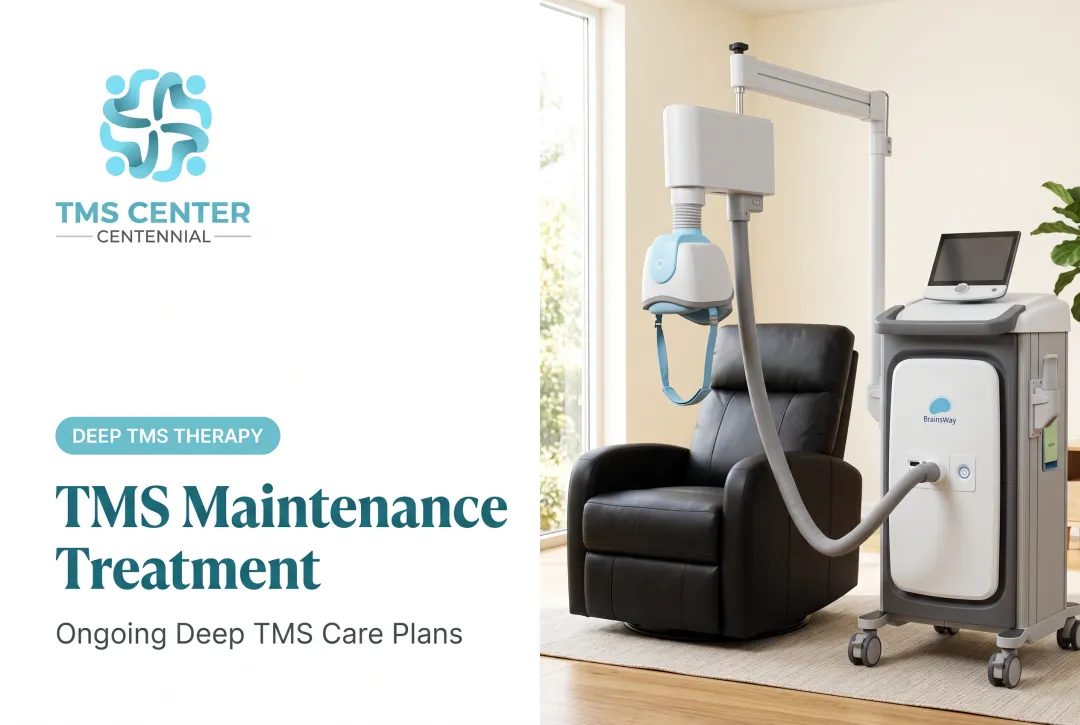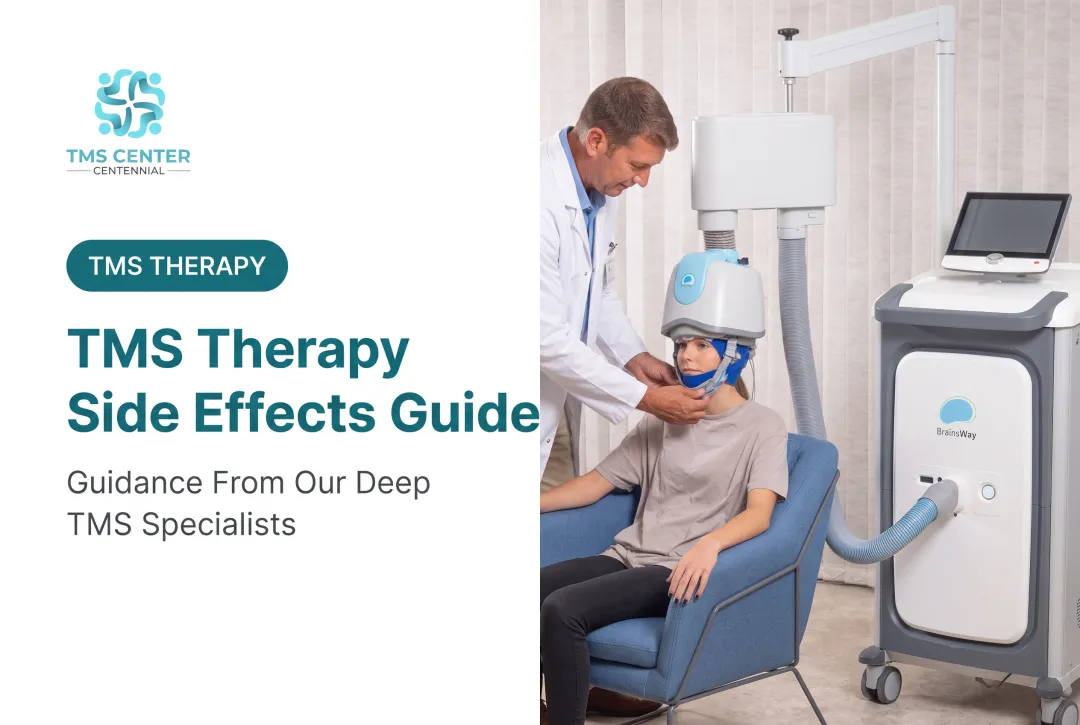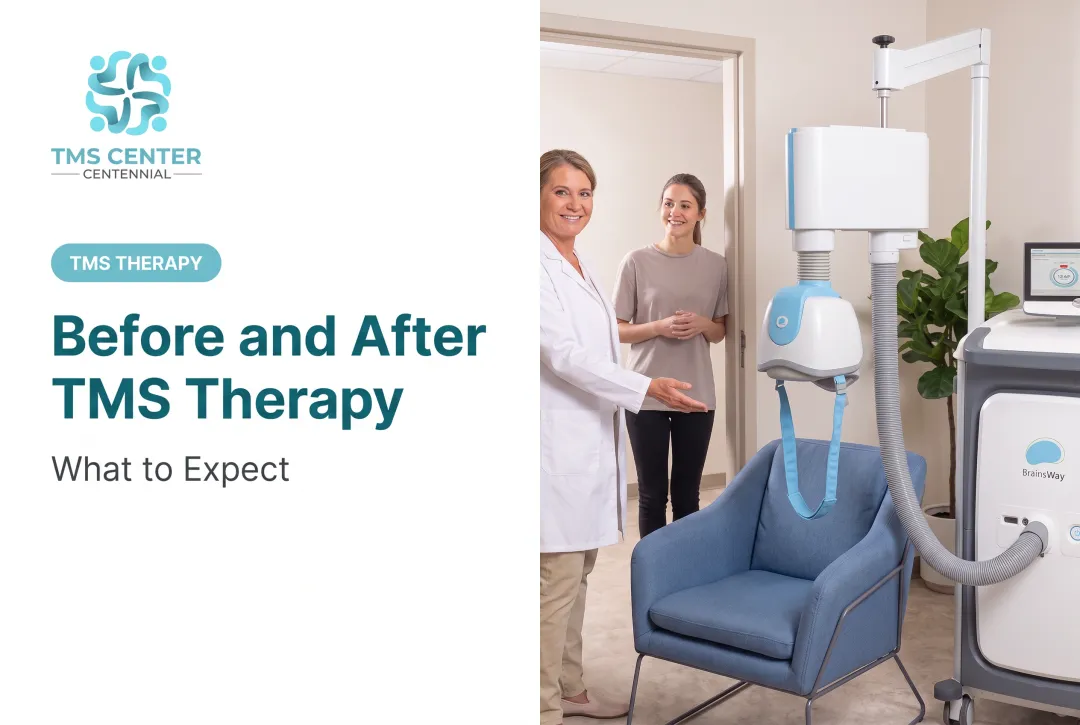

TMS (Transcranial Magnetic Stimulation) is FDA-approved, non-invasive, and used to treat depression, anxiety, PTSD, and OCD. At TMS Center Centennial, treatment is delivered using BrainsWay Deep TMS™, a technology that reaches deeper brain regions than standard rTMS coils. Below, we cover what happens before, during, and after sessions, how many you'll need, what it costs, and how to recognize progress along the way.
Key Takeaways
- TMS sessions run 20-50 minutes, are non-invasive, and require no sedation or downtime
- A full course typically means 5 days a week for 4-6 weeks (roughly 20-36 sessions)
- Most patients notice changes within 2-4 weeks, with benefits building over the full course
- Side effects are usually mild (scalp discomfort or headache) and temporary
- Major insurers, including Tricare and Medicare, typically cover TMS for treatment-resistant depression
What Happens Before Your First TMS Therapy Session
Evaluation and Candidacy Screening
Before any treatment begins, a physician conducts a thorough evaluation to confirm TMS is a good fit. This includes reviewing your mental health history and current medications.
A key screening point involves metal or implanted devices. BrainsWay Deep TMS should not be used if you have non-removable conductive metal or stimulator implants in or near the head, including:
- Cochlear implants
- Deep-brain stimulators
- Vagus-nerve stimulators
Both active and inactive implants matter, so be upfront about any hardware during intake.
Doctors also provide preparation instructions ahead of your first visit, which may include guidance on medication timing. Patients generally continue their current prescribed medications during treatment. Any changes come from the prescribing clinician, not the TMS team.
Practical tip: Complete intake forms ahead of time so your appointment stays focused on you, not paperwork.
Mapping and Calibration
During your first visit, a certified technician and the assigned physician map your individual treatment coordinates and determine your motor threshold: how strong the magnetic pulses need to be for your brain. This step is personalized every time; no two patients get identical settings.
At TMS Center Centennial, certified BrainsWay™ technicians like Christine Cook guide patients through calibration. Christine came to TMS first as a patient herself after significant personal loss, and that experience shapes how she walks new patients through an unfamiliar process.
What Happens During a TMS Therapy Session
The Setup
You'll sit comfortably in a treatment chair while a technician positions a helmet-style coil over your prefrontal cortex. Earplugs are typically provided since the device makes a repetitive clicking sound with each pulse.
Here's what you'll likely feel:
- A tapping sensation on the scalp where the coil sits
- Mild twitching in the hand, jaw, or face as pulses are calibrated
- Repetitive clicking with each pulse
None of this requires anesthesia. You're awake, alert, and can talk with your technician the entire time. Many patients watch TV or scroll their phone to pass the time.

Session Length and Technology
Session length depends on your condition and protocol:
- Depression protocols: around 30 minutes
- OCD protocols: around 30 minutes
- Anxiety protocols: around 45 minutes
- General range: 20-50 minutes across different protocols
Plan for a 45-minute appointment window even if your actual treatment time is shorter — this accounts for setup and any adjustments.
At TMS Center Centennial, sessions use FDA-cleared Deep TMS technology:
- BrainsWay Deep TMS™ with H-Coil technology reaches roughly four times the depth of conventional rTMS coils, engaging broader neural pathways
- Swift Deep TMS™ uses the same platform in an accelerated protocol that compresses a full course into a shorter timeline for eligible patients

A Calmer Environment
The clinical setup is only half the experience. Finn and Fergus, the clinic's West Highland Terriers, can sit on your lap during treatment. One patient, Candice, said her sessions felt "like a visit to a friend's house." It's a small detail, but it softens the tone of an otherwise technical appointment.
After Your Session
No recovery time is needed. You can drive yourself home and return to work, errands, or exercise right away.
How Many Sessions Are Needed and How They're Scheduled
The standard protocol for depression is 5 sessions per week for 4-6 weeks, totaling roughly 20-36 sessions. This schedule isn't arbitrary. TMS works cumulatively: consistent daily stimulation over weeks builds the therapeutic effect. Skipping around disrupts that momentum.
What the Numbers Show
Real-world outcomes vary by protocol and provider. A 2018 clinical consensus review reports that standard TMS produces roughly 50% response and 33% remission in typical practice. Deep TMS studies using the H1-coil report remission rates in the 58-65% range after 20-30 sessions.
TMS Center Centennial reports its own outcomes: 89% of patients experience significant symptom reduction, and approximately 69% reach complete remission. These figures come from the clinic's own patient data rather than a specific external trial.

Staying on Track
- Missed a session? Consistency matters for the cumulative effect, so reach out to your clinic promptly to reschedule rather than skip it entirely.
- After the initial course, some patients continue with tapering or maintenance sessions to sustain results. What continues depends on your response and what your insurance covers as medically necessary.
- Progress reviews: Providers like Dr. Cheryl Dasler monitor your response throughout treatment and adjust the plan as needed. The protocol stays flexible based on how you respond.
Signs TMS Therapy Is Working
Progress with TMS tends to be gradual, not instant. Here's what patients commonly notice, roughly in order:
- Weeks 1-2: Sleep may start improving, and some report feeling slightly less "flat"
- Weeks 2-3: Mood stabilizes, motivation starts to rise, small tasks feel less daunting
- Weeks 4-6: Energy, focus, and overall mood gains become clearer as the full course wraps up

Don't expect a dramatic turning point after one session. TMS builds effect through repeated stimulation, similar to how physical therapy strengthens a muscle over repeated sessions rather than one workout.
Track your own symptoms. Keep informal notes on sleep, mood, and energy, and share them with your care team at check-ins. This gives your provider real data to work with rather than a vague "I think I feel better."
Side Effects, Safety, and Cost Considerations
Safety Profile
TMS is non-systemic, meaning it doesn't circulate through your bloodstream or affect your whole body the way medication does. Common side effects are mild and localized, and most ease on their own or with an over-the-counter pain reliever:
- Scalp discomfort at the treatment site (most common)
- Headache
- Jaw discomfort during pulses
Seizure is a rare risk. A large multi-manufacturer safety survey estimated roughly 0.31 seizures per 10,000 treatment sessions — a very low absolute rate. Fewer than 5% of patients in clinical trials discontinued treatment due to side effects.
At TMS Center Centennial, a certified TMS technician and the assigned physician handle your individualized mapping and monitor each session, so discomfort can be adjusted in real time.
What It Costs
Exact pricing depends heavily on your insurance plan and benefits. TMS Center Centennial performs a comprehensive benefits analysis before treatment starts, so you know your likely costs upfront rather than guessing.
Major insurers typically covering TMS for qualifying treatment-resistant depression include:
- Cigna
- Anthem Blue Cross Blue Shield
- Tricare
- United Healthcare
- Aetna
- Most Medicare plans
Medicare coverage generally applies to severe major depressive disorder (MDD) when specific criteria are met, typically for up to six weeks of treatment. Maintenance sessions beyond the initial course aren't always covered.
Private-pay options are also available if you don't have qualifying coverage.
Frequently Asked Questions
How much does a TMS therapy session cost?
Per-session costs vary by clinic and insurance plan, and a full course can run into the thousands of dollars. Most patients with qualifying insurance (including Medicare and Tricare) pay significantly less out-of-pocket after a benefits analysis.
What happens during a TMS therapy session?
You sit awake and alert while a technician positions a coil over your head, which delivers magnetic pulses producing clicking sounds and a tapping sensation. There's no sedation and no recovery time, so you can drive yourself home afterward.
How many TMS therapy sessions are typically needed?
The standard protocol is 5 days a week for 4-6 weeks, totaling roughly 20-36 sessions for depression. Your exact plan depends on your condition and how you respond along the way.
How often are TMS therapy sessions scheduled, and what if I miss one?
Sessions are typically scheduled on weekdays throughout your treatment course. If you miss one, contact your clinic to reschedule promptly. Consistency matters, but an occasional missed session usually won't derail your progress.
Are there any side effects or risks of TMS therapy?
Most side effects are mild and temporary, including scalp discomfort and headache. Seizure is a rare risk, occurring in roughly 0.31 per 10,000 sessions.
Does TMS therapy rewire the brain?
TMS uses principles of neuroplasticity, your brain's ability to form new connections, to help restore healthier activity patterns in mood-regulating circuits. It doesn't rewire the brain overnight, but repeated stimulation over weeks can shift these patterns meaningfully.