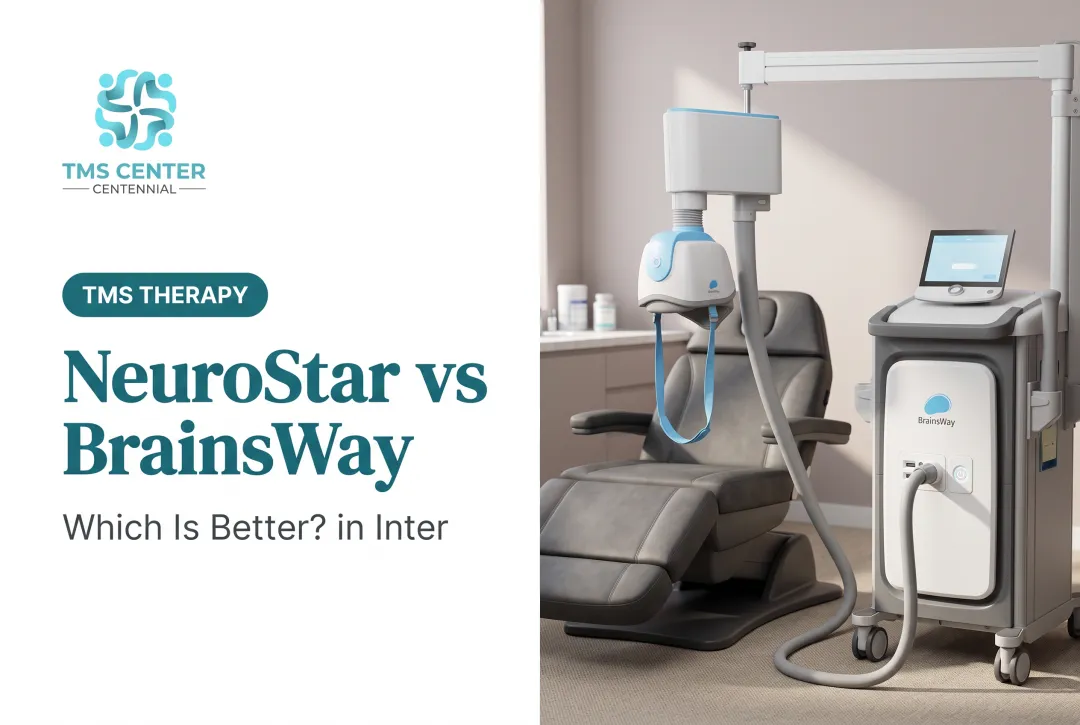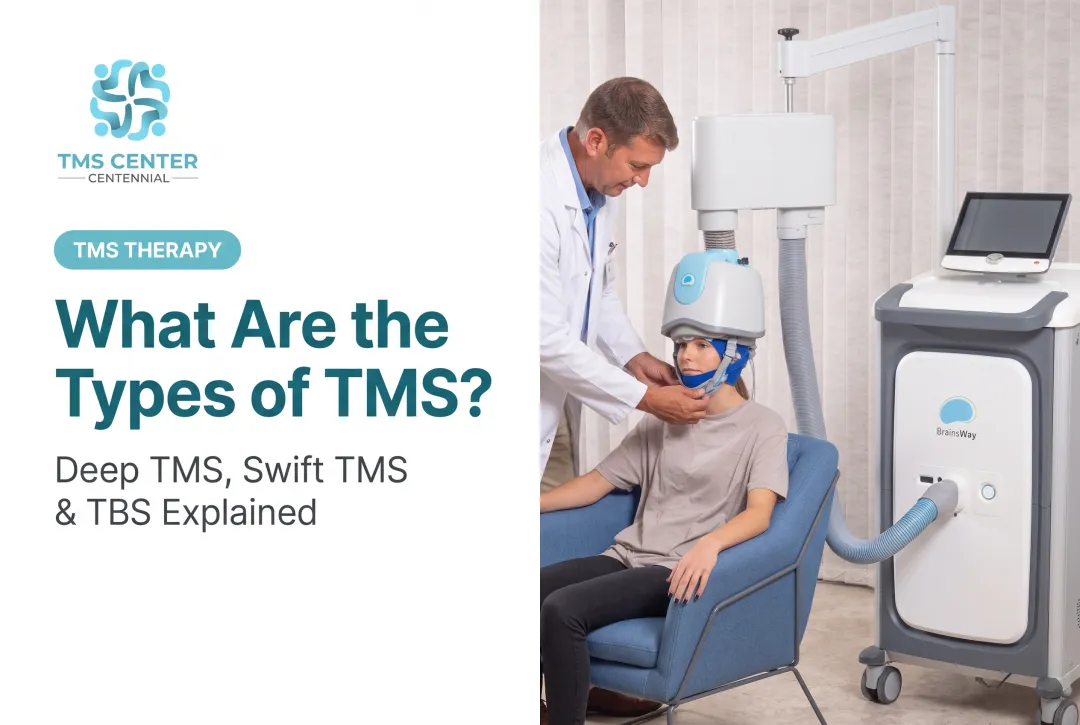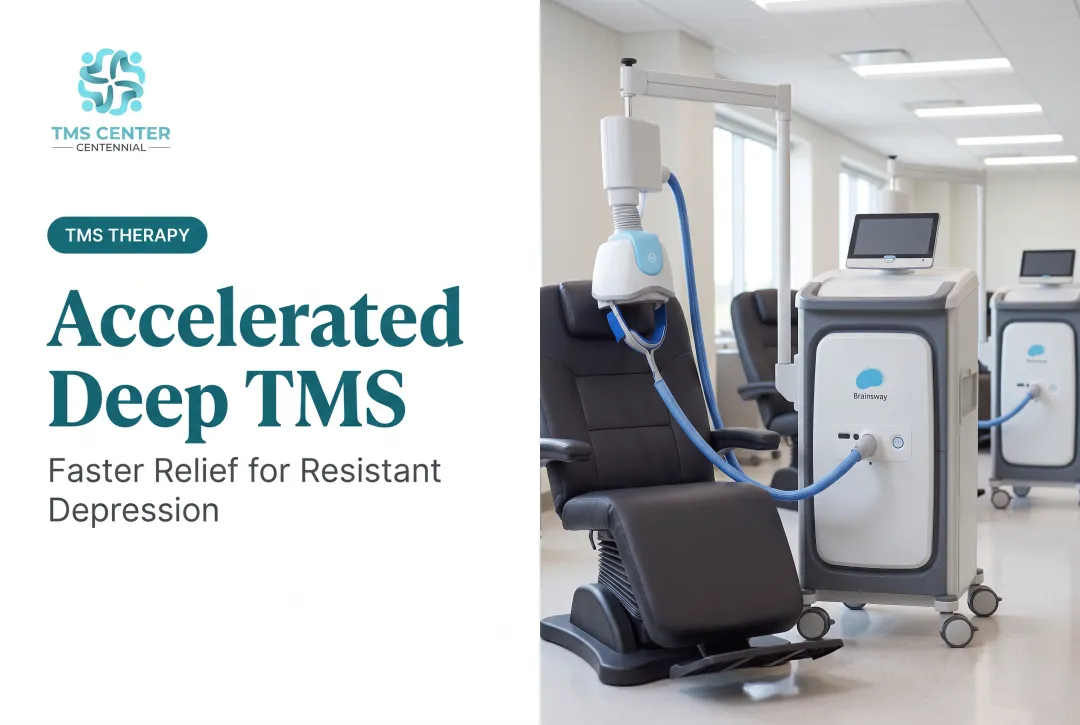

That's a fair question. TMS machines vary significantly by coil design, FDA clearance, and manufacturer, and those differences affect which conditions a device can treat and how each session actually feels. A figure-eight coil session looks and feels different from a Deep TMS session under a padded helmet.
This guide breaks down the major device types, the FDA-cleared brands you'll encounter while researching providers, and how TMS Center Centennial's BrainsWay Deep TMS™ system fits into that landscape.
Key Takeaways
- Four main TMS types guide treatment choice: standard rTMS, Deep TMS (dTMS), theta burst (TBS), and accelerated protocols like SAINT
- Coil design (figure-eight vs. H-coil) sets how deep and wide magnetic pulses reach in the brain
- FDA-cleared systems include NeuroStar, BrainsWay, MagVenture, and Magstim—each with distinct indications
- TMS Center Centennial uses BrainsWay Deep TMS™, cleared for depression, anxious depression, OCD, and smoking cessation
What Is a TMS Device and How Does It Work?
A TMS device is a medical machine that delivers magnetic pulses through a coil positioned against the scalp. Those pulses stimulate the prefrontal cortex, the brain region most closely tied to mood regulation.
The first FDA clearance for this technology went to the NeuroStar TMS System in 2008, for adults with major depressive disorder who hadn't improved on prior antidepressants. That clearance opened the door for the device category we see today.
The First-Session Mapping Process
Every patient starts with motor threshold mapping. That session usually follows three steps:
- The patient sits upright while a clinician fits the treatment cap or coil
- Small electromagnetic pulses are delivered while the clinician watches for a small twitch in the fingers or face
- The lowest level that produces that response becomes the calibration point for treatment
At TMS Center Centennial, a Certified TMS Technician works alongside the prescribing physician during this process. Patients describe it as uncomfortable but tolerable, similar to the brief twitch from a reflex test.

What a Typical Setup Includes
- A coil (figure-eight) or padded helmet (Deep TMS H-coil)
- A treatment chair
- A control screen where the technician programs the individualized protocol
- Positioning aids, such as a cap or chin strap, to keep the coil consistently placed
How those pieces are cleared matters as much as how they are set up. FDA clearance is device-specific, not treatment-specific. A clearance applies to a particular machine and coil design, not to "TMS" as a blanket concept. That's why one brand might be cleared for OCD while another isn't, even though both deliver magnetic pulses.
Lasting results still require a full course, often several weeks. The device drives gradual neuroplastic change rather than an instant fix.
Types of TMS Machines: Coil Design and Protocol Differences
Figure-Eight Coil Machines (Standard rTMS and Theta Burst)
Figure-eight coils deliver a focused, surface-level pulse reaching roughly 1-2 cm into the cortex. This coil design powers two protocols:
- Standard rTMS: Sessions run about 19-37 minutes
- Theta burst stimulation (TBS): Sessions can be as short as 3 minutes
Despite the dramatic time difference, the Lancet's THREE-D randomized trial found intermittent theta burst non-inferior to standard 10 Hz rTMS for depression—so the shorter protocol does not sacrifice effectiveness.
H-Coil Machines (Deep TMS)
H-coils, housed in a padded helmet rather than a handheld paddle, reach deeper and broader brain networks, roughly 3-4 cm according to manufacturer specifications. That deeper field is why BrainsWay Deep TMS holds FDA clearances beyond depression, including OCD and smoking cessation.
Key differences from figure-eight systems:
- Stimulation depth of roughly 3-4 cm versus 1-2 cm
- Helmet-based H-coil instead of a handheld paddle
- FDA clearances that include OCD and smoking cessation in addition to depression
The patient experience differs too. The flexible helmet allows a custom fit and lets patients relax during the session instead of sitting rigidly still to keep a handheld coil in exact position.

Clinics such as TMS Center Centennial deliver BrainsWay Deep TMS as an in-office option for patients who need that broader network reach.
Accelerated Protocols
Coil design is only half the story—protocol timing matters too. Accelerated TMS compresses many theta burst sessions into a much shorter calendar window. SAINT (Stanford Neuromodulation Therapy) received FDA clearance in 2022 for treatment-resistant depression, delivering a full course across roughly five days for patients who need faster relief. Accelerated options such as Swift Deep TMS follow the same idea: more sessions in fewer days when speed to relief is the priority.
FDA-Cleared TMS Device Brands to Know
Several manufacturers hold FDA clearance, each with its own indication profile:
| Brand | Coil Type | Key Clearances |
|---|---|---|
| NeuroStar | Figure-eight | MDD (2008), OCD adjunct (2022) |
| BrainsWay | H-coil | MDD, OCD (2018), smoking cessation (2020), anxious depression (2022) |
| MagVenture | Figure-eight | iTBS (2018), OCD (2020) |
| Magstim | Figure-eight | iTBS, MDD, OCD, anxious depression symptoms |
| CloudTMS | Figure-eight | OCD adjunct (2022) |
| Apollo TMS | Figure-eight | iTBS and MDD (2018) |
BrainsWay's clearances show a key detail: clearances are coil-specific, not blanket approvals. The H1 coil targets depression, the H7 targets OCD, and the H4 is used for smoking cessation.
No single brand is best for every patient. The right device depends on:
- The diagnosis being treated
- How much session time a patient can commit to
- The clinical evidence base behind that specific protocol
Device brand generally doesn't affect insurance coverage. Coverage decisions are based on diagnosis and documented treatment history, not which manufacturer's logo is on the machine.
TMS Center Centennial staff includes a Certified BrainsWay™ TMS Technician, and patients are treated on the FDA-cleared BrainsWay Deep TMS™ system used for the center's depression, OCD, and related protocols.

What Happens During a Deep TMS Session
Once mapping is complete, the actual treatment routine is straightforward:
- The patient sits in the treatment chair and puts on a positioning cap
- The technician places the helmet and confirms fit
- The technician programs the device via the control screen for that patient's individualized protocol
- The technician starts the non-sedating treatment, which lasts about 20 minutes
Patients don't have to sit idle. Most read, check their phone, or simply relax during the session.
Common side effects are mild and temporary:
- Scalp discomfort near the treatment site
- A tapping or clicking sensation during pulses
These effects typically diminish within the first week. In clinical trials, fewer than 5% of patients discontinued BrainsWay treatment due to adverse effects.
The center reports no negative impact on memory or sleep. Most patients resume normal activities immediately after each session.

Choosing the Right TMS Provider and Device
Clinics choose machines based on the conditions they treat most and the patients they serve. Ask any provider which system and coil type they use before you start—the answer shows what they're equipped to treat.
When you compare providers, look for:
- FDA-cleared device and coil matched to your diagnosis
- Reported response and remission rates for their protocol
- Whether TMS is paired with counseling or neurofeedback
- Insurance plans accepted and out-of-pocket estimates
TMS Center Centennial combines BrainsWay Deep TMS™ with NeurOptimal® neurofeedback and collaborative counseling, so stimulation, brain training, and talk therapy reinforce each other instead of running as separate tracks.
The center reports that 89% of patients had a significant positive response after 30 sessions, and 69% reached remission. Published Deep TMS research shows similar response and remission ranges, though figures vary by protocol and study group. Ask every clinic for its own numbers before you commit.
Insurance coverage is usually the biggest hesitation. TMS Center Centennial accepts most major plans:
- Tricare
- Cigna
- Anthem Blue Cross Blue Shield
- United Healthcare
- Aetna
That coverage removes a common barrier for patients comparing TMS with medication.
Frequently Asked Questions
Which TMS devices are FDA-approved?
Major FDA-cleared brands include NeuroStar, BrainsWay, MagVenture, Magstim, CloudTMS, and Apollo TMS. Clearances vary by specific coil and protocol, not by brand alone.
What machine is used for TMS?
TMS machines use either a figure-eight coil for standard rTMS and theta burst protocols, or an H-coil for Deep TMS. TMS Center Centennial uses the BrainsWay Deep TMS™ system.
What are the FDA-approved TMS protocols?
Three main protocols hold FDA clearance: standard rTMS, theta burst stimulation (cleared in 2018), and the accelerated SAINT protocol (cleared in 2022). Each has different session lengths and course timelines.
Does TMS actually work for depression?
Yes. TMS is FDA-cleared for treatment-resistant depression, and clinical research consistently shows meaningful response and remission rates. TMS Center Centennial reports 89% of patients see significant improvement after a full course.
Is TMS FDA approved for anxiety?
BrainsWay Deep TMS is specifically cleared for anxious depression, meaning major depressive disorder with co-occurring anxiety symptoms. That's distinct from a standalone clearance for generalized anxiety disorder.
Will insurance cover TMS for anxiety?
Coverage typically depends on diagnosis, often anxious depression rather than anxiety alone, plus documented history of prior treatment attempts. TMS Center Centennial accepts most major insurers, including Tricare, Cigna, and Aetna.