
TMS Center Centennial, a TRICARE-accepting clinic in Centennial, Colorado, was founded by Rodney Placzek, a retired Army Sergeant Major who discovered TMS during his own recovery after leaving the service. He built the clinic specifically to make this treatment accessible to people who've served.
This guide breaks down TRICARE's coverage criteria, who qualifies, what you'll actually pay, and the step-by-step process for getting approved.
Key Takeaways
- TRICARE has covered outpatient TMS for major depressive disorder since 2014, with prior authorization on every plan.
- Eligibility requires a confirmed MDD diagnosis and documented failure of a less intensive treatment first.
- Colorado falls under TRICARE West, administered by TriWest Healthcare Alliance.
- Authorized patients generally pay standard specialty-care copays instead of the full session cost.
- TMS Center Centennial handles benefits verification and paperwork before treatment starts.
What Is TMS Therapy?
Transcranial Magnetic Stimulation, or TMS, is a non-invasive, FDA-approved treatment that uses magnetic pulses to stimulate underactive regions of the brain linked to mood regulation. Unlike antidepressant medication, it doesn't circulate through your bloodstream or produce systemic side effects like weight gain, sexual dysfunction, or drowsiness.
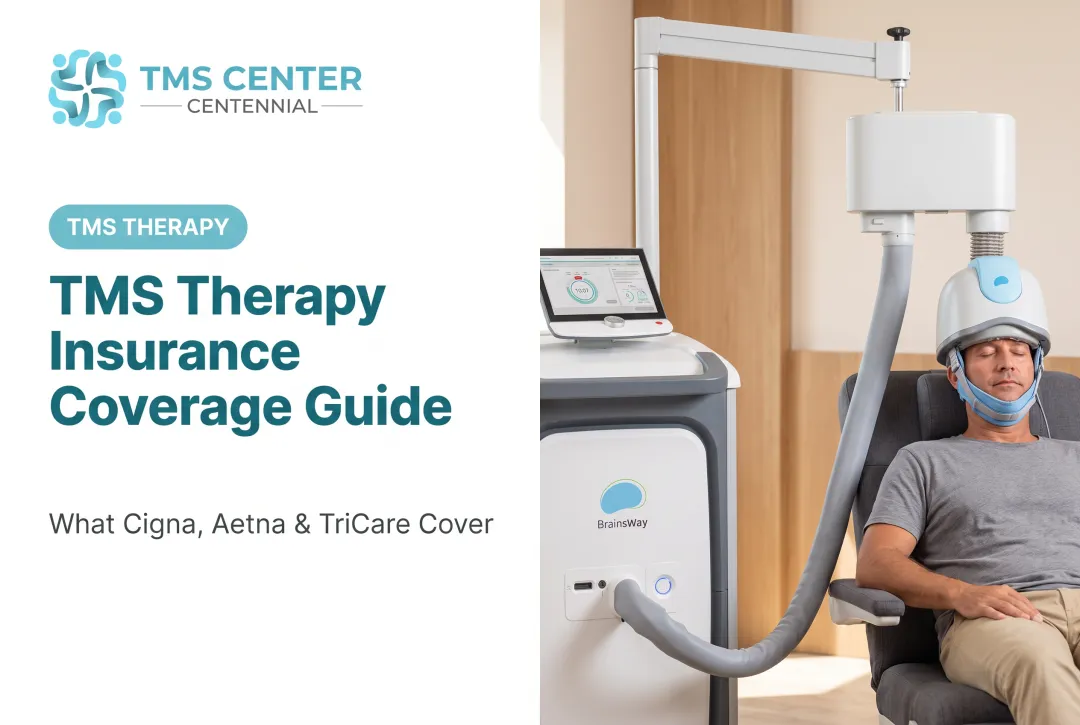
TMS Center Centennial uses BrainsWay™ Deep TMS technology, FDA-approved since 2007. The BrainsWay coil reaches broader and deeper brain regions than the standard figure-eight coils in older TMS systems. That depth lines up with the clinic's reported results: 89% of patients see significant symptom reduction, and about 69% reach full remission.
What the Treatment Actually Feels Like
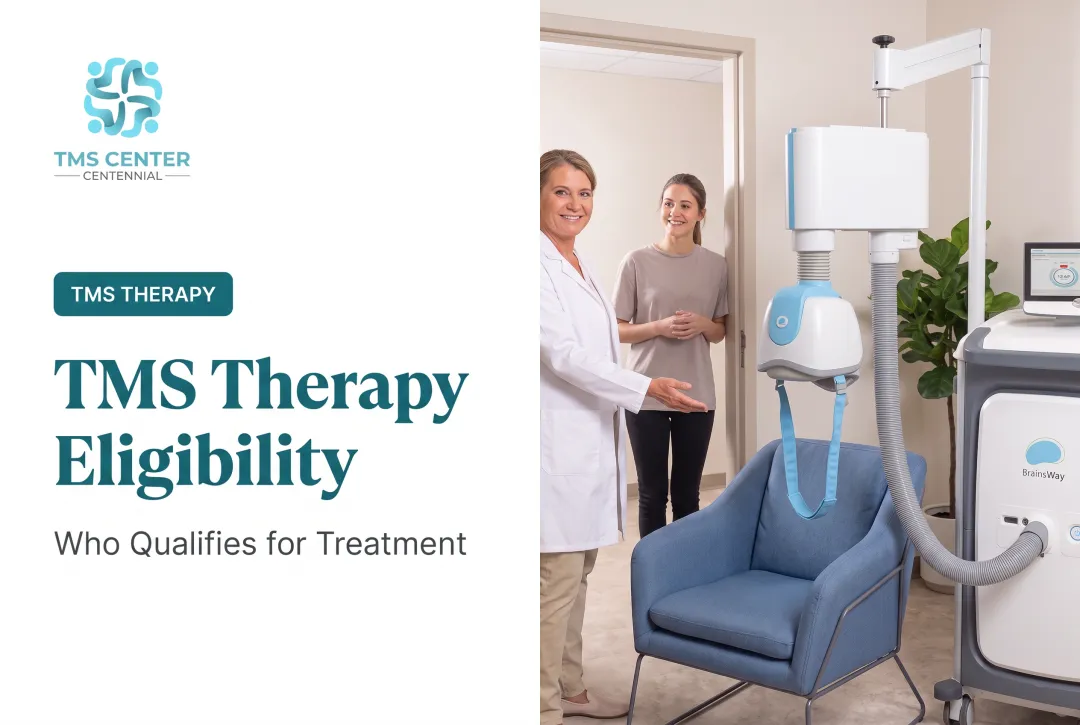
A typical session runs 20 to 40 minutes, depending on the protocol. There's no anesthesia, no sedation, and no recovery time.
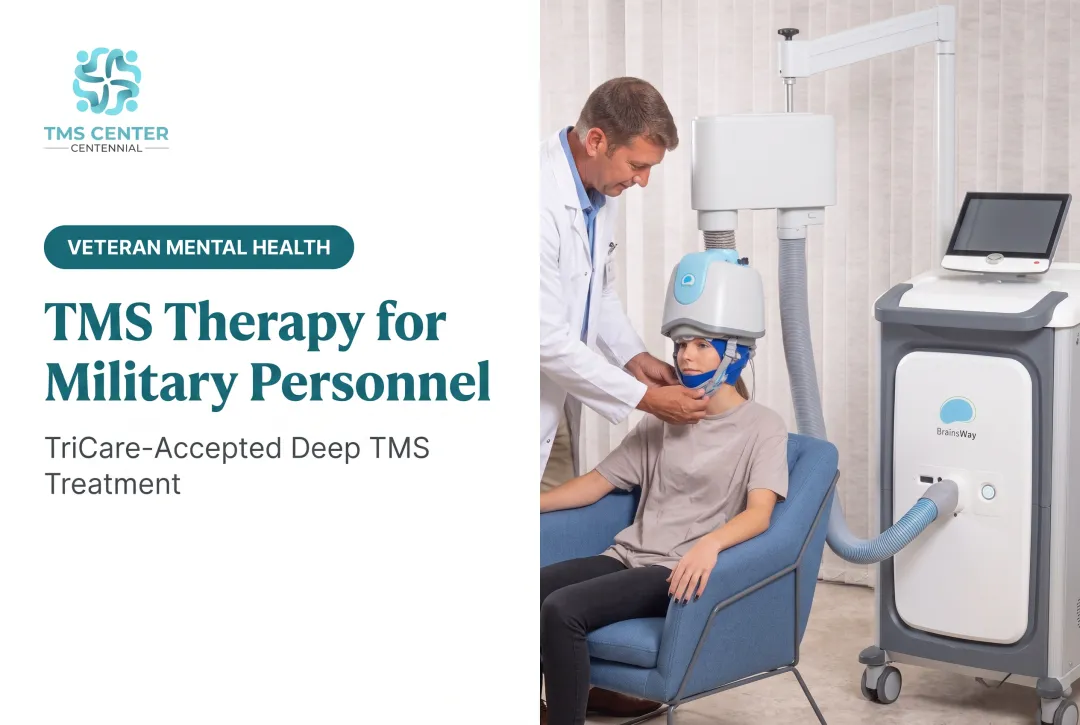
- You sit in a chair, fully awake, while a technician positions the coil against your scalp
- You'll feel tapping sensations, not pain
- You can drive yourself home immediately afterward
- Most patients return to work or normal activities the same day
For someone juggling a duty schedule, a commute, or childcare, that downtime-free format is the point. You show up, get treated, and go about your day—no time off required for recovery.

Does TRICARE Cover TMS Therapy?
Yes. TRICARE's official coverage page confirms that outpatient TMS is a covered benefit for adults with major depressive disorder. TRICARE's policy manual has listed TMS for MDD as "proven" since May 31, 2014, so it has been an established part of the benefit for over a decade.
Coverage extends to beneficiaries across TRICARE Prime, TRICARE Select, and TRICARE Reserve Select. TMS is covered under each of these plans; what changes is the referral process and cost-sharing structure, which we'll walk through below.
The Medical Necessity Criteria
TRICARE requires prior authorization before it will pay for TMS, and that authorization hinges on a few core elements:
- A confirmed diagnosis of moderate-to-severe major depressive disorder
- Confirmation from your care team that you tried and failed, or could not tolerate, a less intensive treatment (usually an antidepressant trial)
- Clinical records supporting why TMS is the appropriate next step
Even if your situation doesn't fit those criteria exactly, exceptions are possible - a more in-depth medical evaluation can reveal options that a quick checklist won't, so it's worth getting in touch.
What About PTSD or OCD?
TRICARE's published coverage language centers on major depressive disorder. It does not separately name PTSD, anxiety, or OCD as covered diagnoses on their own.
In practice, this rarely closes the door for service members and veterans dealing with co-occurring conditions. Many people with PTSD or OCD also carry a diagnosed depressive episode, and when that MDD diagnosis is properly documented alongside the other conditions, TMS coverage can still apply. A thorough psychiatric evaluation before authorization helps get that MDD diagnosis confirmed in writing.
Regional Administration Matters
TRICARE operates through regional contractors. Colorado sits in the TRICARE West Region, administered by TriWest Healthcare Alliance. That regional distinction shapes how referrals and authorizations move through the system for patients at TMS Center Centennial.
Who Qualifies for TMS Under TRICARE?
TMS coverage is available to a broad range of TRICARE beneficiaries, not just active-duty members.
Eligible categories include:
- Active duty service members
- Retirees
- Spouses and dependent children
- National Guard and Reserve members
Diagnostic and age requirements: TRICARE's benefit applies to adults 18 and older with a moderate-to-severe MDD diagnosis based on current clinical criteria. Mild depressive symptoms typically will not meet the threshold.
The "Failed Treatment" Requirement
Before TRICARE will authorize TMS, your provider needs to show that a less intensive treatment wasn't sufficient. In practice, this usually means documenting:
- Which antidepressants you've tried, including specific medications and drug classes
- Dosage and duration for each trial (how long you stayed on an adequate dose)
- Outcomes and side effects, including lack of response or intolerance
The stronger and more specific your clinician's write-up, the smoother the authorization process tends to go.
Things we need to know about (not automatic turn-aways): TMS isn't right for everyone. Providers screen for:
- Removable metal around the head and neck (earrings, necklaces, hearing aids, hairpins, and similar items): taken off before the session and not a disqualifier
- Implanted or permanent metal needing clinical evaluation: cochlear implants; deep-brain or vagus-nerve stimulators; stents; metal within about 30 centimeters of the treatment area; retained bullet fragments or other ferrous metal fragments; tattoos containing inks formulated with metals
- Pacemakers or implantable defibrillators (these require closer evaluation, not automatic exclusion)
- A personal or family history of seizures
Please raise anything you are unsure about during your evaluation.
The Evaluation Requirement
A face-to-face psychiatric evaluation and formal treatment order are essential before any authorization request moves forward. At TMS Center Centennial, the clinic's psychiatric team, including Dr. Cheryl Dasler, Psychiatrist, confirms the diagnosis and clears each patient for treatment.
Steps to Access TMS Therapy Through TRICARE
Getting from "I think I need this" to "I'm in treatment" involves a handful of concrete steps.
Schedule an initial consultation. TRICARE Prime members typically need a referral from their Primary Care Manager first. TRICARE Select and Reserve Select members can often book directly with an in-network provider without that extra step.
Complete a psychiatric evaluation. This confirms your diagnosis, reviews your medication history in detail, and screens for contraindications like implants or seizure risk.
Talk through your history. Your care team will want to know which antidepressants you have tried, roughly how long and at what dose, any side effects you ran into, and how symptoms have affected your daily functioning.
Submit prior authorization. Your provider files this request separately from any earlier referral. It is required on every TRICARE plan.
TRICARE reviews the case. In the West Region, TriWest targets 1-2 business days for routine referrals and 2-5 business days for routine authorizations after the full clinical picture is in. Once approved, treatment scheduling can begin.

TMS Center Centennial handles insurance paperwork and benefits verification throughout this process, so you're not stuck chasing forms while managing symptoms.
What Does TMS Cost With TRICARE?
Without insurance, TMS is a significant expense. A peer-reviewed consensus report puts a full acute course (typically 20 to 30 sessions) at roughly $6,000 to $12,000, depending on the practice.
That's the number TRICARE coverage protects you from.
With prior authorization approved, you're generally responsible only for your plan's standard specialty mental-health copay or cost-share, not the full session price. For 2026, that typically looks like:
| Beneficiary Category | Prime Network | Select Network |
|---|---|---|
| Active-duty family | $0 | $33–$39 |
| Retirees/families | $39 | $52 |
| TRICARE Reserve Select | N/A | $33 |
Exact costs depend on your specific plan and where your care falls in your deductible. That's why TMS Center Centennial reviews your TRICARE benefits and walks through expected costs with you before treatment begins. No billing surprises after the fact.
Why Choose TMS Center Centennial for TRICARE-Covered TMS Therapy
Navigating TRICARE authorization on your own is doable, but having a team that's done it before makes a real difference.
TMS Center Centennial brings together board-certified psychiatrists, a medical director, and certified BrainsWay technicians who assemble what TRICARE needs to approve care efficiently.
Founder Rodney Placzek brings firsthand experience from both sides of care. After 27 years in the Army, he went through his own difficult transition to civilian life and discovered TMS as a patient before becoming a certified TMS trainer and technician himself.
That background shapes how the clinic approaches veterans and service members working through depression, PTSD, and anxiety.
The clinic reports that 89% of patients see significant symptom reduction, with roughly 69% reaching full remission. Care is built around local access as well:

- Centennial, Greenwood Village, and Littleton
- Aurora, Denver, and the broader metro area
- TRICARE paperwork support from a team familiar with military life
That mix of outcomes, authorization help, and nearby care keeps TRICARE-covered TMS within reach without a long drive.
Frequently Asked Questions
Does TRICARE cover TMS treatment?
Yes. TRICARE covers outpatient TMS as a benefit for eligible beneficiaries who meet medical necessity criteria for major depressive disorder. Prior authorization is required before treatment starts.
What is the out-of-pocket cost for TMS?
Without insurance, a full course of TMS can run $6,000 to $12,000. With TRICARE authorization, patients typically pay only their standard specialty-care copay or cost-share.
Who qualifies for TMS treatment?
Adults 18 and older with moderate-to-severe MDD who have documented a failed or poorly tolerated antidepressant trial generally qualify, pending a psychiatric evaluation. Once treatment begins, yes, patients can continue their current medications during the TMS protocol. Most people remain on their prescribed medications throughout treatment and should stay stable on them. Keeping medications stable helps limit variables during treatment, so the clinical team can tell what is actually working. Any medication changes should be made under medical supervision, and preferably after finishing the TMS protocol rather than during it. Those decisions should always be guided by the prescribing clinician.
Does TRICARE cover TMS for PTSD?
TRICARE's coverage criteria center on MDD diagnosis specifically. Patients with co-occurring PTSD can often still qualify when a documented MDD diagnosis is also part of their clinical record.
How long does TRICARE prior authorization take for TMS?
TriWest's published benchmark is roughly 1-2 weeks for routine authorization review once the full clinical picture has been submitted. TMS Center Centennial helps gather and submit that paperwork to avoid delays.
Do I need a referral for TMS therapy under TRICARE?
TRICARE Prime members typically need a PCM referral first. Regardless of plan, a separate TMS-specific prior authorization is always required before treatment can begin.