
So which one actually is better?
The honest answer: it depends on your diagnosis, your treatment history, and what you're hoping to achieve. Device choice affects how deep the stimulation reaches, which conditions are covered, how long sessions run, and how comfortable treatment feels session to session.
At TMS Center Centennial in Centennial, Colorado, the team uses BrainsWay Deep TMS™ and includes a Certified BrainsWay™ Technician on staff. That gives us a close-up view of how this system performs in practice, which we'll share alongside the broader research below.
TL;DR
- NeuroStar uses a figure-8 coil for focused, shallower stimulation; BrainsWay uses an H-coil for deeper, broader Deep TMS
- Both are FDA-cleared for depression; BrainsWay also covers OCD and smoking cessation
- BrainsWay sessions run about 20 minutes; NeuroStar ranges 19–40 minutes by protocol
- Neither device wins universally; the right choice depends on your diagnosis and treatment history
- TMS Center Centennial offers BrainsWay Deep TMS™ with 89% symptom reduction and 69% remission rates
NeuroStar vs BrainsWay: Quick Comparison
Both systems deliver FDA-cleared TMS, but they differ in coil design, how deep and wide the field reaches, cleared uses, and how the session feels. Use this side-by-side view to match those tradeoffs to your clinical goals—not to pick a universal winner.
| Factor | NeuroStar | BrainsWay |
|---|---|---|
| Coil design | Figure-8 coil on a positioning arm | H-coil built into a cushioned helmet |
| Stimulation depth | About 1.5 cm into the cortex | Broader, deeper field (about 4–5 cm) |
| FDA-cleared conditions | MDD, anxious depression, OCD, adolescent depression | MDD, OCD, smoking cessation |
| Session length | 19–40 minutes (standard protocols) | About 20 minutes |
| Patient experience | Patient must stay still under the arm-mounted coil | Helmet tolerates small movements more easily |

Neither system is automatically better. NeuroStar is more focal at the surface; BrainsWay’s H-coil is built for broader, deeper stimulation. The stronger fit depends on the condition being treated, target depth, and which cleared protocol your clinic uses.
What Is NeuroStar?
NeuroStar was the first TMS device to receive FDA clearance, back in 2008, for major depressive disorder. It's often credited with bringing TMS into mainstream psychiatric care.
Its figure-8 coil delivers precise, focal stimulation to the dorsolateral prefrontal cortex, the brain region most associated with mood regulation. Because the field is narrower, NeuroStar can target that specific area with a high degree of accuracy.
Two things stand out about NeuroStar:
- Largest installed base of any TMS device in the U.S., so it's widely available across clinics
- Multiple protocols, with standard sessions of 19–40 minutes and a newer theta burst option that shortens treatment time
Use Cases of NeuroStar
NeuroStar is commonly used for adult and adolescent major depressive disorder (FDA clearance added March 2024), plus anxious depression.
According to NeuroStar's own outcomes registry of over 17,700 patients across 118 practice sites, clinician-rated results show 83% response and 62% remission after an acute treatment course. Longer market presence also means broader clinic availability if access matters to you.

What Is BrainsWay Deep TMS?
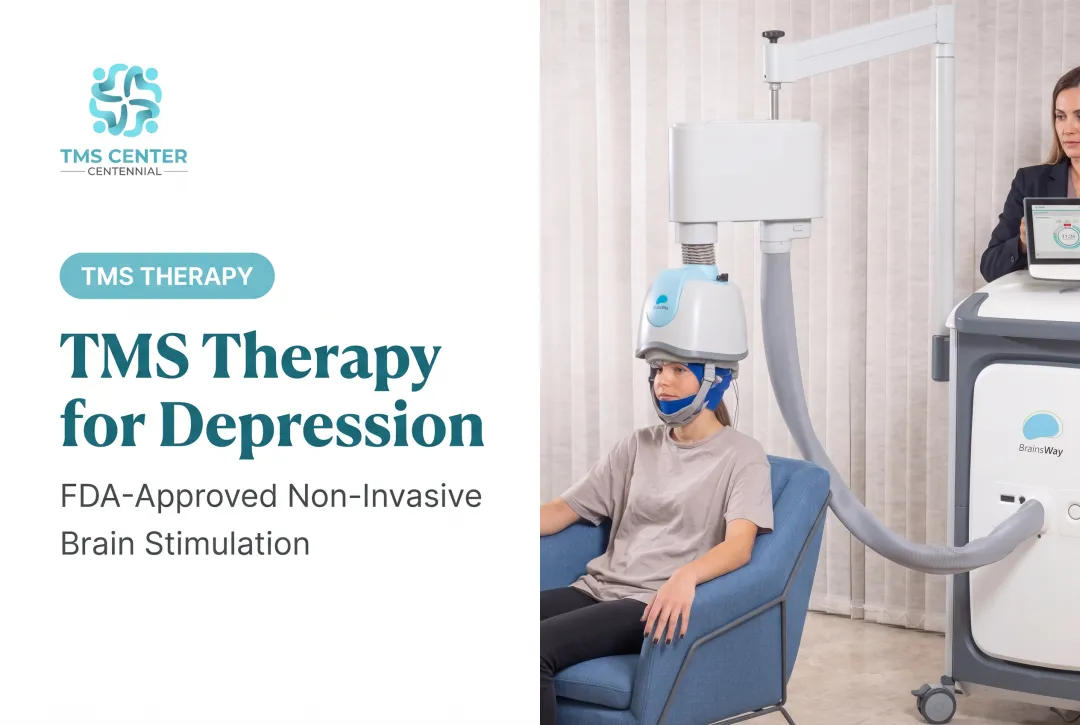
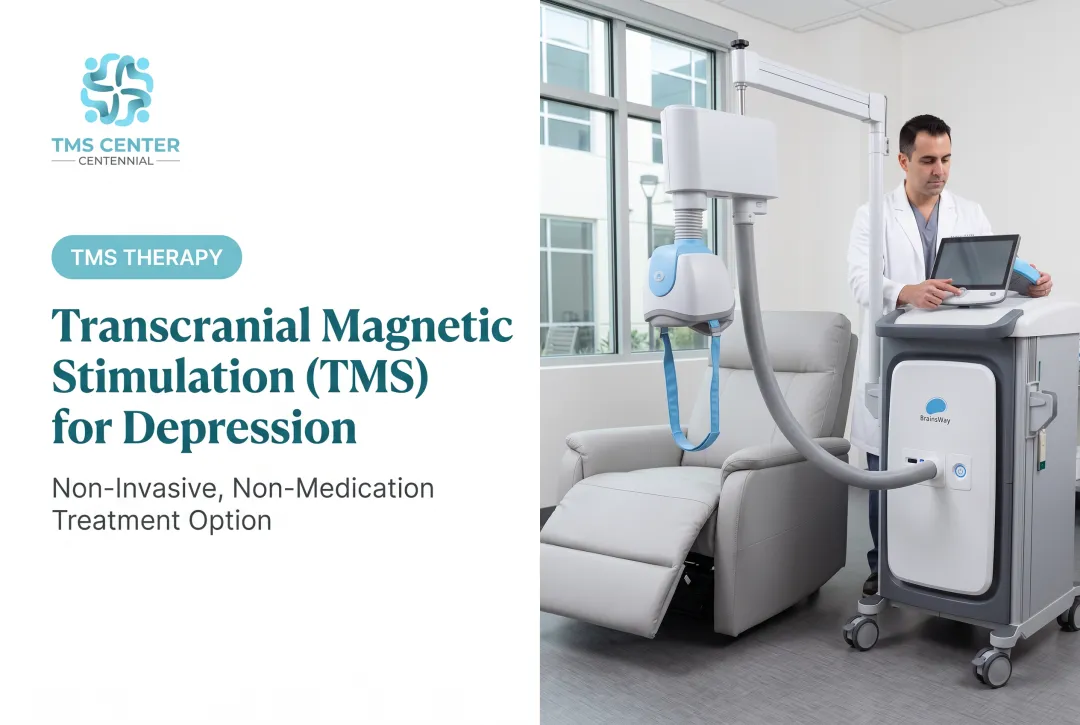
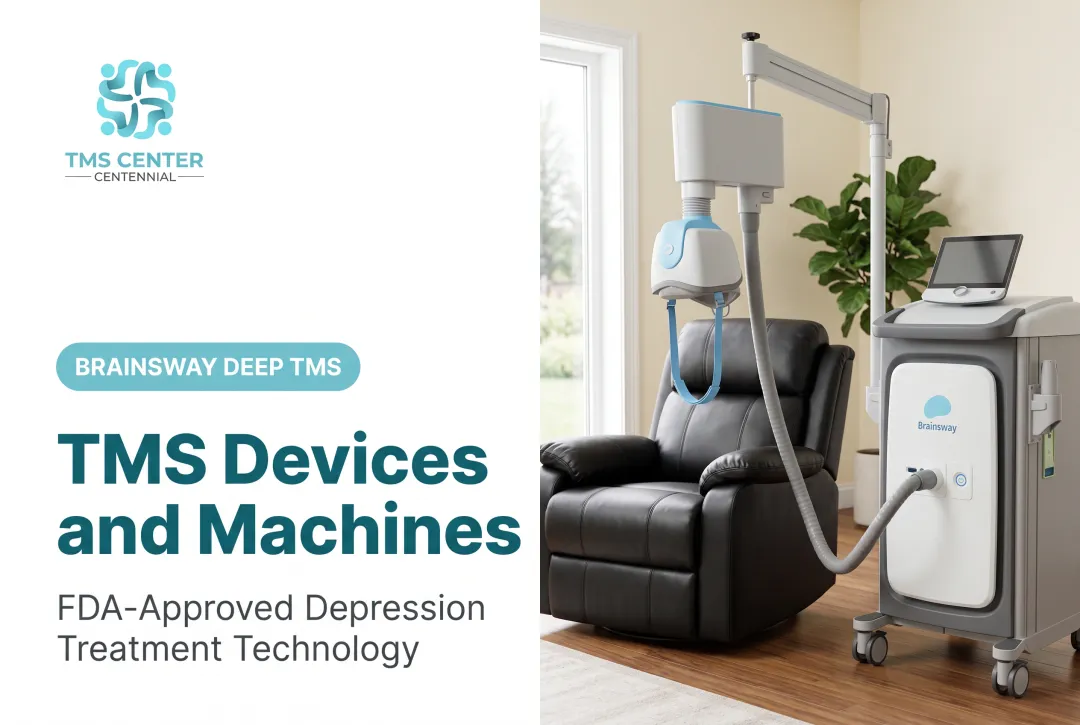
BrainsWay's approach centers on its patented H-coil, housed inside a cushioned helmet rather than mounted on an arm. The design allows the magnetic field to reach broader and deeper into brain structures than a standard figure-8 coil.
Why does depth matter clinically? Peer-reviewed modeling research found that figure-8 coils reach suprathreshold depths of about 1.5 cm, while H-coils extend to roughly 4-5 cm. Deeper, broader circuits are increasingly implicated in treatment-resistant depression and OCD.

Core advantages of the Deep TMS™ system:
- Reaches deeper brain structures linked to harder-to-treat cases
- Tolerates minor head movement better than arm-mounted coils
- Supports adherence with shorter sessions (about 20 minutes)
- Covers FDA-cleared indications for depression, OCD, and smoking cessation
BrainsWay for Treatment-Resistant Depression and OCD
BrainsWay is frequently chosen for treatment-resistant depression and OCD, where deeper circuit involvement is suspected. At TMS Center Centennial, this is exactly the population we see most: patients who've tried medication, therapy, or even standard rTMS without lasting relief.
That focus is reinforced by technicians who know the protocol from both sides. Our lead TMS Coordinator, Christine Cook, is a Certified BrainsWay™ Technician who first came to TMS as a patient after a personal loss, and now uses that experience to guide people through treatment.
Across our patient population, we've reported:
- 89% of patients experience significant symptom reduction
- 69% achieve complete remission from depression

These are clinic-reported figures, not a controlled trial—and they match what we see day to day.
NeuroStar vs BrainsWay: Which Is Better?
There's no universal winner here. The better question is: which device fits your situation?
Weigh these factors:
- Diagnosis — Do you need OCD or smoking cessation clearance specifically? BrainsWay covers both; NeuroStar covers OCD but not smoking cessation.
- Treatment history — If standard antidepressants or prior rTMS haven't worked, ask whether deeper stimulation is appropriate.
- Age — NeuroStar holds a specific adolescent depression clearance (ages 15-21) that BrainsWay does not.
- Session length preference — BrainsWay's ~20-minute sessions may fit tighter schedules better than longer standard NeuroStar protocols.

General guidance:
- Choose BrainsWay if you're pursuing OCD treatment, smoking cessation, or have treatment-resistant depression
- Choose NeuroStar if you're treating adolescent depression or want the most widely available, longest-established option
Outcomes still depend heavily on the clinical team. Protocol design, patient screening, and technician experience influence results as much as the hardware.
That is why TMS Center Centennial pairs BrainsWay technology with a multidisciplinary team: psychiatrists, certified technicians, and therapists work together instead of delivering treatment in isolation.
Real-World Example: Choosing BrainsWay Deep TMS™ at TMS Center Centennial
Our clinic's roots trace back to founder Rodney Placzek, a retired Army Sergeant Major who experienced TMS therapy firsthand during his own recovery. That experience led him to become a Certified TMS Trainer and Technician and, in 2017, to start providing TMS and neurofeedback services built around evidence-based, patient-centered care.
Many patients come to us after years of medication, talk therapy, or even a prior round of standard rTMS without lasting relief. Common needs include:
- Treatment-resistant depression, PTSD, or anxiety that has not responded elsewhere
- Deeper stimulation than standard rTMS coils typically provide
- Care from a team that understands military-related PTSD firsthand
That is why we built our program around BrainsWay Deep TMS™ and its H-coil design for deeper brain structures. Rodney's military background also shapes how we support veterans and active-duty service members.
BrainsWay clinical data report that 89% of patients experience significant symptom reduction and 69% achieve full remission from depression—results that align with why we chose this platform.
If other approaches have not brought relief, schedule a consultation with our certified BrainsWay team to see whether Deep TMS™ is the right next step.
Conclusion
Neither NeuroStar nor BrainsWay is automatically the better choice. Your diagnosis, treatment history, and goals should drive the decision, not brand reputation alone. Use the comparison points above as a starting point for a conversation with your provider.
The device matters less than the team running it. At TMS Center Centennial, certified BrainsWay™ technicians work alongside psychiatrists, and 89% of patients report significant symptom reduction. That mix makes us a strong option for people across the Denver-Centennial area exploring Deep TMS™.
Frequently Asked Questions
What are the success rates of NeuroStar and BrainsWay?
NeuroStar's outcomes registry reports 83% response and 62% remission (clinician-rated) after an acute course in 17,700+ patients. BrainsWay clinical data shows about 89% symptom reduction and 69% remission. Individual results vary by diagnosis and treatment history.
Is BrainsWay FDA approved?
Yes. BrainsWay Deep TMS™ is FDA-cleared for major depressive disorder, obsessive-compulsive disorder (since 2018), and smoking cessation (since 2020).
Is BrainsWay the same as Deep TMS?
Yes. BrainsWay is the company behind Deep TMS™. Its patented H-coil sits in a cushioned helmet and delivers deeper, broader stimulation than standard figure-8 coils.
Does insurance cover both NeuroStar and BrainsWay treatments?
Coverage is generally based on your diagnosis and FDA-cleared indication, not the device brand. TMS Center Centennial accepts most major plans, including Cigna, Anthem BCBS, TriCare, United Healthcare, and Aetna.
Which device is more comfortable for patients?
Both are well-tolerated. BrainsWay's helmet design allows more head movement during treatment and offers shorter, roughly 20-minute sessions.
Can I switch from one device to another mid-treatment?
Switching mid-treatment is uncommon but possible after completing a full trial period. This decision should be made in consultation with your treating psychiatrist.