
You're not alone in this, and you're not failing at treatment. Deep TMS is an FDA-cleared, non-medication option for OCD that works differently than anything you've tried before. This guide covers how it works, what the research actually shows, and what a typical course of treatment looks like. TMS Center Centennial in Centennial, Colorado, offers BrainsWay Deep TMS™ for patients throughout the Denver metro area whose OCD hasn't responded fully to standard care.
Key Takeaways
- Deep TMS has been FDA-cleared for OCD since August 2018 as an add-on, non-medication treatment
- About 40–60% of OCD patients don't get adequate relief from SSRIs alone
- In the pivotal trial, active Deep TMS beat sham on Y-BOCS scores (p=0.0127)
- Standard protocol runs 5 sessions a week for roughly 6 weeks, no anesthesia, no downtime
- TMS Center Centennial accepts most major insurance plans and uses certified BrainsWay technicians
Why Standard OCD Treatments Don't Always Work
SSRIs and exposure and response prevention (ERP) are the recommended first-line treatments for OCD, and they help a lot of people. But they don't help everyone.
The gap shows up clearly in the data:
- Only 40-60% of patients respond to their first SSRI trial, according to the International OCD Foundation
- ERP dropout averages 14.7%, with overall attrition estimated at 18.7% across studies
That leaves a substantial group still searching for relief.
Part of the problem is structural, not just behavioral. OCD is increasingly understood as dysfunction within cortico-striato-thalamo-cortical (CSTC) brain circuits — a loop connecting the frontal cortex, striatum, and thalamus that gets stuck in overdrive. This isn't purely a chemical imbalance you can dial back with medication. It's a circuit problem.
That circuit-level view matters for ERP too. Confronting a feared trigger without performing the compulsion asks a patient to override a hyperactive loop through willpower alone. When that loop is firing intensely, some people find the demand too overwhelming to sustain, which helps explain the dropout numbers above.

Deep TMS takes a different approach. Instead of working indirectly through neurotransmitter levels or asking patients to out-muscle their brain circuitry, it applies stimulation directly to the regions driving the loop.
What Is Deep TMS and How Does It Work for OCD?
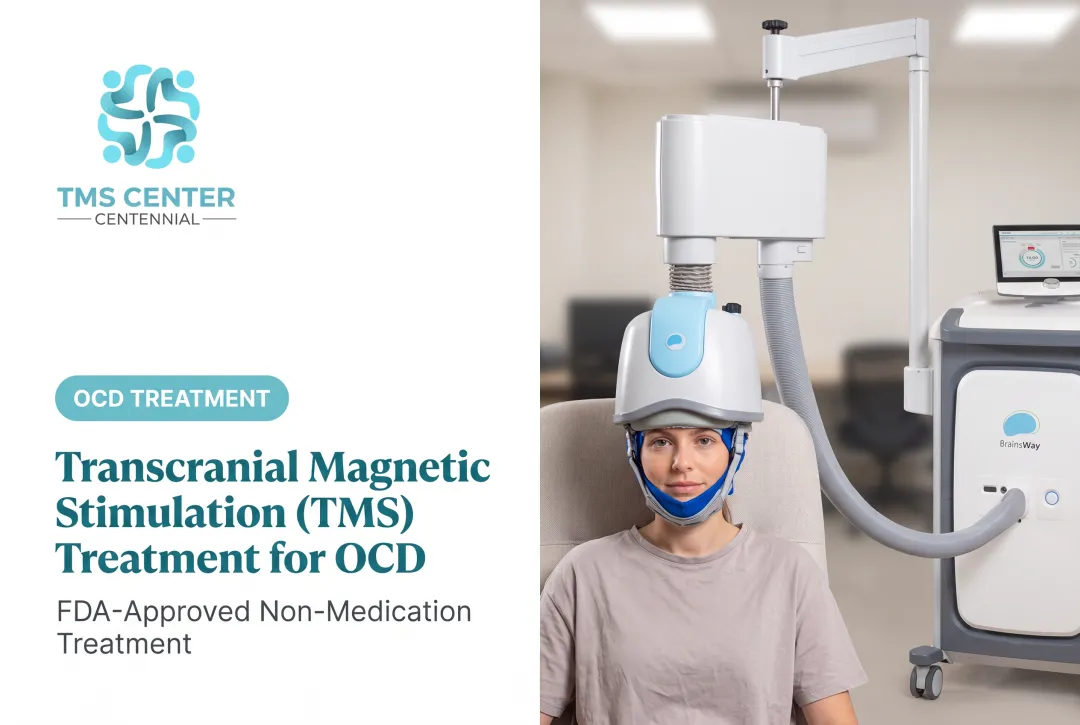
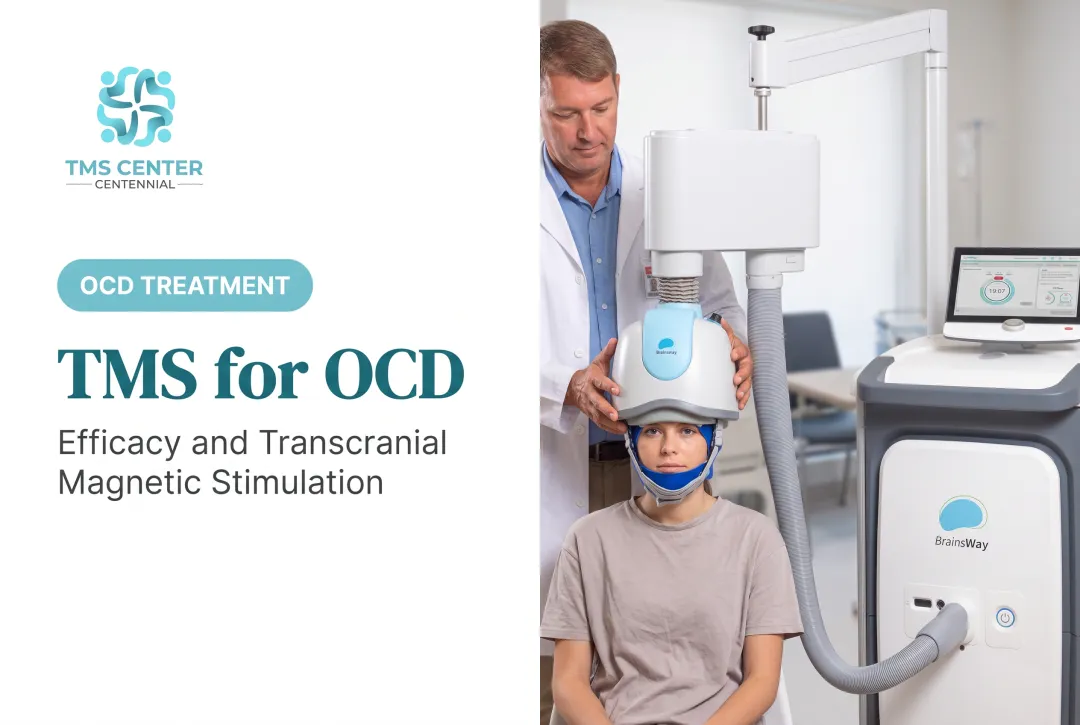
Deep TMS uses a magnetic coil placed against the scalp to deliver pulses that induce small electrical currents in targeted brain tissue. Those currents modulate activity in the regions the coil is aimed at.
For OCD, the targets are the medial prefrontal cortex (mPFC) and anterior cingulate cortex (ACC), regions tied to the CSTC circuit described above. This differs from depression treatment, which targets the dorsolateral prefrontal cortex instead.
Why the H7 Coil Matters
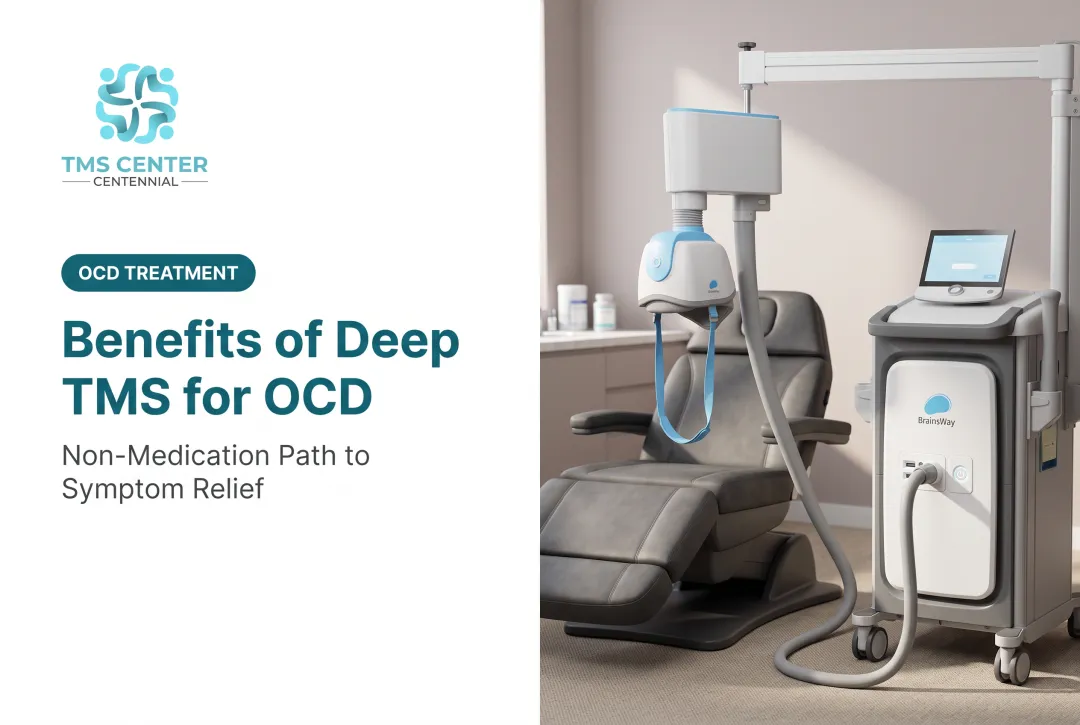
BrainsWay's H7 coil is built to reach these deeper, more central structures. Standard figure-eight coils used in older rTMS systems are more focal and superficial.
Modeling research shows that at depths of 40-60 mm, H-coils stimulate a larger brain volume than figure-eight coils, which matters when the mPFC and ACC sit deeper than the targets used for depression.

The Symptom Provocation Step
Before each OCD session, patients go through a brief, personalized symptom provocation: recalling or engaging with something that typically triggers their obsessions. The pivotal clinical trial built this step directly into its protocol, pairing the provocation with stimulation to enhance the neuroplastic effect on the OCD circuit. The idea is to catch the circuit while it's active, so the stimulation has more to work with.
A few practical notes:
- FDA clearance for OCD came in August 2018, specific to the BrainsWay device
- TMS Center Centennial's staff includes certified BrainsWay technicians
- Deep TMS is meant as an adjunctive treatment, used alongside medication or therapy rather than as a replacement for either
Is Deep TMS Effective for OCD? What the Research Shows
The pivotal FDA-clearance trial was a multicenter, randomized, double-blind, placebo-controlled study. It applied high-frequency Deep TMS to the mPFC and ACC, with symptom provocation before each session, and measured outcomes using the Yale-Brown Obsessive-Compulsive Scale (Y-BOCS), the standard tool for rating OCD severity. Patients receiving active treatment showed significantly greater improvement than those receiving sham treatment. That finding was published in the American Journal of Psychiatry with a p-value of 0.0127. Follow-up research points in the same direction:
- Post-marketing outcomes across 22 clinical sites found most patients in routine practice saw meaningful benefit, typically within 20 sessions
- A Brain Stimulation study tracked treatment-resistant OCD beyond the six-week course and found gains held up over the following year
- Across this body of evidence, Deep TMS produces lasting improvement for many responders Some researchers also believe Deep TMS may work best when introduced earlier in a patient's treatment journey, rather than saved as a last resort after years of unsuccessful attempts. That is not yet settled science, but it is a reasonable case for not waiting until every other option is exhausted.
What to Expect: The Deep TMS Treatment Journey
A standard OCD protocol runs 5 sessions a week for about 6 weeks. Each appointment includes the symptom provocation step followed by roughly 18 minutes of stimulation, with the full visit typically taking around 30 minutes.
During the session, you'll feel a tapping or knocking sensation on your scalp where the coil sits. You stay fully awake: no sedation, no IV, nothing invasive.
Here's what a typical visit looks like:
- Check-in and helmet placement using your personalized head mapping
- Brief symptom provocation, guided by a technician, to activate your OCD triggers
- Stimulation session, about 18 minutes
- Immediate return to your day: drive yourself home, go back to work, no recovery period needed

Most patients start noticing changes within the first 20 sessions, though timing varies from person to person. The neuroplastic changes that drive improvement build gradually across the full course.
Who Is a Good Candidate & Is It Safe?
Deep TMS for OCD is generally appropriate for adults 18 or older who:
- Have a confirmed OCD diagnosis
- Have tried an SSRI without adequate symptom relief
- Do not have metal implants or stimulator devices near the head
Contraindications include:
- Non-removable metallic implants or stimulators in or near the head (cochlear implants, deep-brain stimulators, vagus-nerve stimulators)
- A history of seizures
- Use of medications that lower seizure threshold
The most common side effects are mild headache or scalp discomfort at the stimulation site, and these usually fade quickly. TMS as a device class carries a well-documented but low seizure risk.
Unlike many OCD medications, Deep TMS does not cause systemic side effects such as weight gain or sexual dysfunction.
At TMS Center Centennial, candidacy is set through a suitability screening that reviews your medical history before any treatment plan is finalized. Patients generally stay on their current medications during the protocol, with adjustments made under a prescribing clinician's guidance.

Insurance Coverage and Getting Started at TMS Center Centennial
Insurance coverage for Deep TMS in OCD varies by plan, but it's becoming more accessible. Many major insurers now cover it once treatment resistance has been documented, similar to how coverage evolved for depression.
TMS Center Centennial accepts most major plans, including:
- Cigna
- Anthem Blue Cross Blue Shield
- TriCare
- United Healthcare
- Aetna
- Most Medicare plans
The center's team includes psychiatrists and certified BrainsWay technicians who manage the paperwork, prior authorizations, and benefits analysis before treatment begins. You're not left untangling insurance details on your own.
Getting started is straightforward. Reach out by phone at (720) 642-6555 or by email at info@tmscentercentennial.com to schedule a consultation. The team will review your history, determine whether Deep TMS fits your situation, and walk you through next steps.
Patients often mention the compassionate, one-on-one atmosphere at the center, including therapy dogs on-site during visits, which can take some of the edge off before a session.
Frequently Asked Questions
Is Deep TMS effective for OCD?
Yes. A pivotal clinical trial found significantly greater improvement with active treatment versus sham (p=0.0127). Real-world data from 22 clinical sites also confirms most patients see meaningful symptom reduction outside trial settings.
Can you get Deep TMS if you have OCD?
Deep TMS is FDA-cleared for OCD in adults 18 and older who have tried at least one SSRI without adequate relief. A thorough medical evaluation determines final candidacy.
How long does Deep TMS for OCD last?
The standard course runs 5 sessions a week for about 6 weeks. Research suggests symptom improvements can be maintained well beyond the treatment period for many responders.
Will insurance cover Deep TMS for OCD?
Coverage varies by plan and often requires documented treatment resistance to medication or therapy. TMS Center Centennial accepts most major insurers, including Cigna, Anthem BCBS, TriCare, United Healthcare, and Aetna.
What are the newest treatments for OCD?
Beyond standard Deep TMS, accelerated protocols compress treatment into fewer weeks, and researchers continue to study fMRI-guided targeting for more precise stimulation. Standard and accelerated Deep TMS are both available options today.