
Introduction
If you've cycled through two, three, or more antidepressants without real relief, you're not alone, and you haven't done anything wrong. Research suggests at least 30% of people with depression meet the clinical definition of treatment-resistant depression, meaning two or more medication trials failed to bring adequate relief (McIntyre et al., 2023).
That kind of trial-and-error is exhausting. You wait weeks to see if a drug works, then spend more weeks managing side effects like weight gain, fatigue, or low libido—only to start over.
More patients are turning to FDA-cleared, non-medication options like Transcranial Magnetic Stimulation (TMS). This article breaks down what published research shows about TMS response and remission rates, how it compares to antidepressants, ketamine, and ECT, and which factors shape individual outcomes. You'll also see real-world results from TMS Center Centennial's Deep TMS™ program in Centennial, Colorado.
Key Takeaways
- TMS response rates range from ~24% in strict trials to over 80% with accelerated protocols
- Newer, targeted approaches (Deep TMS, iTBS, SAINT/SNT) generally outperform standard rTMS in published research
- BrainsWay Deep TMS™ patients at TMS Center Centennial see an 89% improvement rate and ~69% full remission
- Your age, resistance level, targeting accuracy, and finishing the full course all affect results
- Non-invasive with minimal side effects, and covered by most major insurance plans
What Is TMS Therapy for Depression?
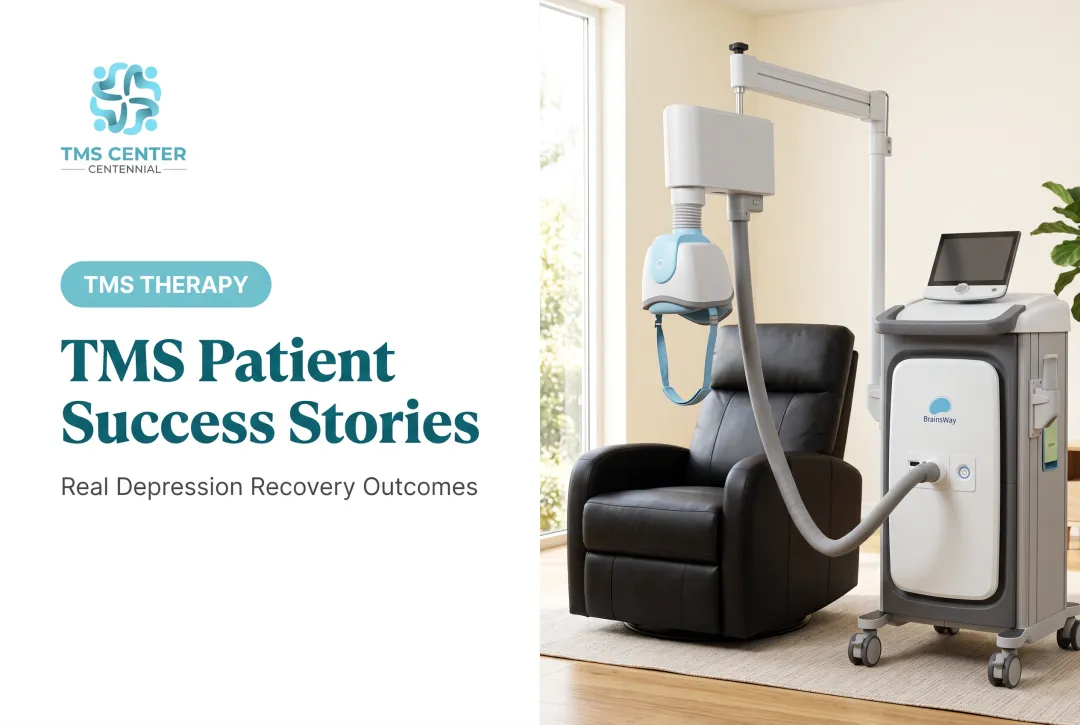
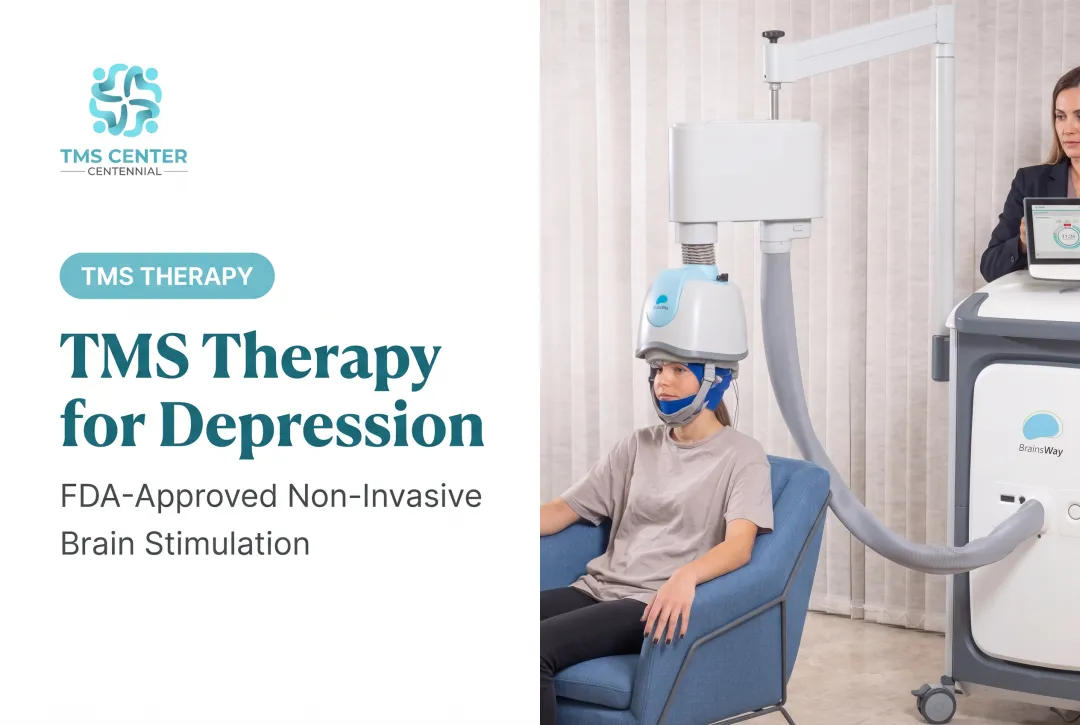
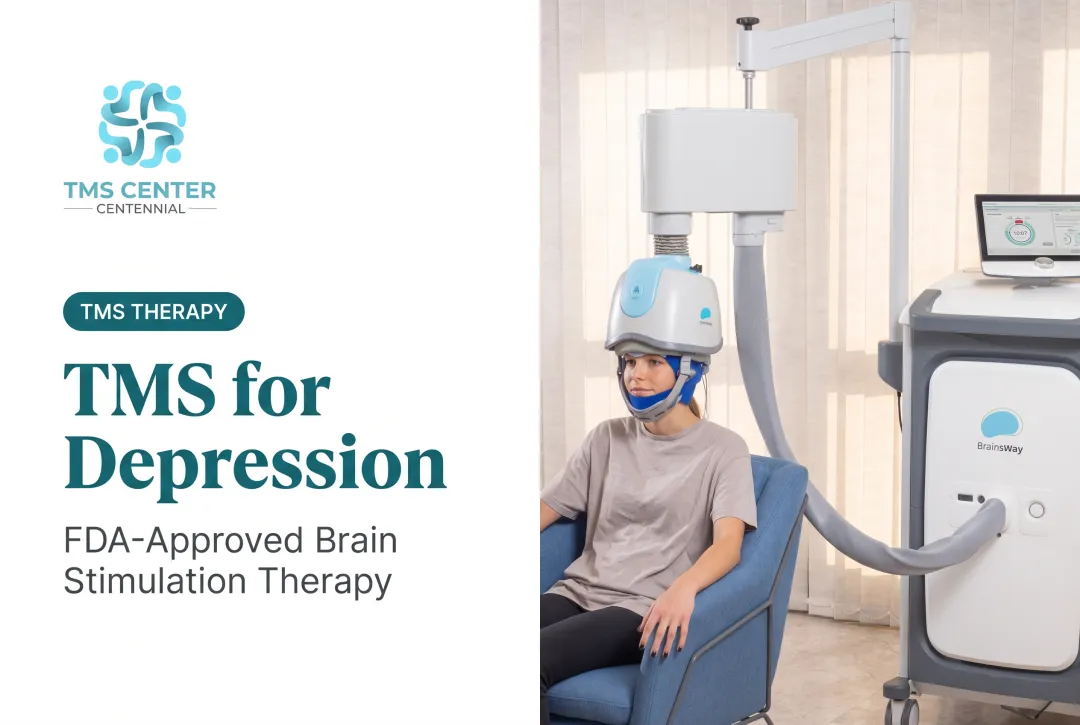
TMS uses magnetic pulses, similar in strength to an MRI machine, to stimulate the dorsolateral prefrontal cortex (DLPFC). This is the brain region most closely tied to mood regulation and executive function. A coil placed against your scalp delivers the pulses while you sit awake in a chair. No anesthesia is required.
NeuroStar TMS received FDA clearance in 2008, and BrainsWay Deep TMS followed in 2013. Both are cleared for adults with major depressive disorder who haven't found adequate relief from antidepressant medication. Because it's non-invasive, most patients drive themselves home and return to normal activities the same day.
Standard rTMS vs. Deep TMS
Standard rTMS uses a figure-8 coil that stimulates a relatively narrow, focal area of the cortex. BrainsWay's Deep TMS uses a helmet-shaped H-coil built to reach broader and deeper cortical volumes, including the left DLPFC and nearby neural circuitry, extending roughly four times deeper than traditional rTMS while engaging a wider network of neural pathways.

TMS Center Centennial uses certified BrainsWay Deep TMS™ technology and offers three protocol options:
- Standard Deep TMS™ — the traditional daily course
- Swift Deep TMS™ — an accelerated version of the same FDA-cleared technology
- Theta Burst Stimulation (TBS) — a faster stimulation pattern, often included at no additional cost
What a Treatment Course Looks Like
A standard Deep TMS course typically runs 20-30 sessions, five days a week, over four to six weeks. A depression session takes about 30 minutes in the office.
Swift Deep TMS compresses a similar number of sessions, often 30, into roughly two weeks by delivering multiple treatments per day. TBS can stimulate the frontal cortex in about three minutes and may be layered into either protocol depending on your evaluation.
TMS Success Rates for Depression: What Research Shows
Two terms matter here. Response means at least a 50% reduction in depression symptom scores from baseline. Remission means symptoms drop below a clinical cutoff, essentially symptom-free. They're not the same thing, and mixing them up is where a lot of confusing statistics come from.
Published rates vary considerably depending on protocol and study design. A large naturalistic study of 307 patients treated in routine clinical practice found 58% response and 37.1% remission.
Controlled trials of standard rTMS, by contrast, have reported active response rates as low as 24% to 37%. Real-world outcomes tend to run higher than strict trial data, partly because clinics can adjust treatment based on how a patient is actually responding.
Success Rates by TMS Protocol
| Protocol | Study/Source | Response Rate | Remission Rate |
|---|---|---|---|
| Standard rTMS (10 Hz) | THREE-D trial | 47% | 27% |
| iTBS (theta burst) | THREE-D trial | 49% | 32% |
| Deep TMS (BrainsWay H1-coil) | Pivotal trial (Levkovitz et al., 2015) | 38.4% active vs. 21.4% sham | 32.6% active vs. 14.6% sham |
| SAINT/SNT accelerated protocol | Stanford randomized pilot | 85.7% active vs. 26.7% sham | 78.6% active vs. 13.3% sham |
The SAINT/SNT numbers are eye-catching, but that trial included just 14 active and 15 sham participants at a single site. Promising, not yet broadly replicated. Deep TMS's pivotal trial, by comparison, drew on 212 patients across multiple sites, which gives it stronger evidentiary weight.
TMS Center Centennial's Real-World Deep TMS Results
TMS Center Centennial tracks its own BrainsWay Deep TMS outcomes. Clinic results show:
- 89% of patients experience a significant reduction in depression symptoms
- Roughly 69% achieve full remission
Deep TMS's broader stimulation field may partly explain why treatment-resistant patients respond well. Rather than hitting one narrow cortical spot, the H-coil engages a wider network tied to mood regulation, which matters for patients whose depression hasn't budged with medication alone.
Results also hold up over time. In one multisite follow-up study, 62.5% of patients who initially responded or remitted stayed responders across a full year. Among those who reached full remission, half sustained it at every assessment point. If symptoms return later, maintenance sessions are worth discussing with your care team.

Timing also predicts outcome. UCLA researchers found that improvement within the first one to two weeks is a strong signal of how a patient will ultimately respond. That is why consistent session attendance—especially early on—matters so much.
How TMS Compares to Other Depression Treatments
Versus antidepressants: The landmark STAR*D trial tracked remission across successive medication attempts and found it dropped sharply: 36.8%, then 30.6%, then 13.7%, then 13.0% by the fourth medication trial (Rush et al., 2006). Each failed drug lowers the odds the next one works. Antidepressants also typically need 6-8 weeks to show effect, while some TMS patients notice change within the first week or two.
Side effects differ sharply:
| Treatment | Common side effects |
|---|---|
| Antidepressants | Nausea, weight gain, sexual dysfunction (reported in over half of SSRI users in some studies) |
| TMS/Deep TMS | Mild headache or scalp discomfort, typically resolving quickly |
Versus ketamine: Ketamine can produce rapid relief, sometimes within hours, with one study reporting a 70.8% response rate after repeated infusions. But that relief often fades fast. Among responders in that same study, the median time to relapse after the last infusion was just 18 days. TMS gains tend to hold longer without repeat dosing.
Versus ECT: Electroconvulsive therapy shows strong outcomes, with one study reporting 85.7% response and 54.8% remission in treatment-resistant patients. But ECT requires anesthesia and carries a higher risk of memory and cognitive side effects, and some studies find that 60% of patients report memory problems afterward. TMS offers a non-invasive path without that trade-off.
That contrast is why clinicians typically recommend TMS after one or two antidepressant trials fail, not as a last resort. FDA clearance for both NeuroStar and BrainsWay covers adults who haven't seen adequate improvement from at least one prior antidepressant, though most insurers set the bar at two.
Factors That Influence Your TMS Success Rate
TMS does not work the same for every patient. Research points to several factors that help explain why success rates differ:
- Age: A 2024 study of 687 patients found no significant overall age effect. Patients 60 and older showed response and remission ranges comparable to, or slightly higher than, younger patients.
- Treatment-resistance level: Three or more prior failed medications meant lower remission (17.3%) than fewer failed trials (29.4%). Lower isn't hopeless. Meaningful improvement is still common for highly treatment-resistant patients.
- Concurrent antidepressant use: A 2024 meta-analysis of 663 patients found continuing SSRIs with rTMS improved severity, response, and remission. SNRIs showed no similar boost. In clinical practice, yes, patients can continue their current medications during the TMS protocol. Most people remain on their prescribed medications throughout treatment and should stay stable on them. Keeping medications stable helps limit variables during treatment, so the clinical team can tell what is actually working. Any medication changes should be made under medical supervision, and preferably after finishing the TMS protocol rather than during it, always guided by the prescribing clinician.
- Targeting precision: Studies comparing manual coil placement (the "5cm method") to MRI-guided targeting found more precise placement produced better four-week outcomes. Before your first session at TMS Center Centennial, a certified technician and your assigned physiatrist map proper coil placement.
- Treatment adherence: Completing the full course, typically 20-30 sessions, matters more than any other factor here. Stopping early undercuts everything else.
- Personality traits: Small pilot studies suggest a possible link. One found higher conscientiousness and agreeableness scores tied to more frequent remission, though samples remain small.

Is TMS Right for You? Candidacy and Getting Started
TMS candidacy typically includes adults with major depressive disorder who haven't achieved relief from at least two antidepressants. That's the baseline most insurers use when reviewing coverage, though exceptions may exist with a more in-depth medical evaluation.
Things we need to know about are screened before treatment begins (not framed as automatic turn-aways):
- History of seizures (needs clinical discussion; not always an automatic disqualifier)
- Removable metal around the head and neck (earrings, necklaces, hearing aids, hairpins, and similar items): taken off before the session and not a disqualifier
- Implanted or permanent metal needing clinical evaluation: cochlear implants or deep-brain or vagus-nerve stimulators; stents; metal within about 30 centimeters of the treatment area; retained bullet fragments or other ferrous metal fragments; tattoos containing inks formulated with metals
- Other neurological conditions that haven't been evaluated by a clinician
At TMS Center Centennial, Dr. Cheryl Dasler, Psychiatrist, leads that evaluation with certified TMS coordinators. Please raise anything you are unsure about during your evaluation.
The center also handles insurance verification directly, accepting Cigna, Anthem, Tricare, United Healthcare, Aetna, and most Medicare plans, so patients aren't left navigating benefits alone.
Beyond the clinical side, small touches matter. On-site therapy dogs greet patients during sessions, and the same coordinators who map your first treatment usually stay involved through the full course. If medication hasn't worked, a consultation is the clearest next step to see whether Deep TMS fits your situation.
Frequently Asked Questions
Does TMS really work?
Yes. Clinical research and real-world clinic data show meaningful symptom improvement for most patients. Deep TMS protocols used at TMS Center Centennial report about 89% significant symptom reduction and roughly 69% full remission.
What disqualifies you for TMS?
A history of seizures, implanted or permanent metal near the head, and certain neurological conditions typically affect candidacy and need clinical review rather than automatic exclusion. Things we need to know about metal: removable items such as earrings, necklaces, hearing aids, and hairpins are taken off before the session and are not a disqualifier. Implanted or permanent concerns include cochlear implants, deep-brain stimulators, aneurysm clips, stents, metal within about 30 centimeters of the treatment area, retained bullet fragments or other ferrous metal fragments, and tattoos containing inks formulated with metals. A clinical evaluation determines whether TMS is safe for your specific situation. Please raise anything you are unsure about during your evaluation.
How long does it take to see results from TMS?
Most patients notice changes within 2 to 6 weeks of starting treatment, and some report improvement as early as the first week. How you respond in those first one to two weeks often predicts your overall outcome.
Is TMS covered by insurance?
Most major insurers cover TMS for treatment-resistant depression, including Cigna, Anthem, Tricare, United Healthcare, Aetna, and most Medicare plans. TMS Center Centennial handles insurance verification for new patients before treatment begins.
What is the difference between TMS and Deep TMS?
Standard TMS uses a figure-8 coil that stimulates a narrower brain area, while Deep TMS (BrainsWay) uses a helmet-shaped coil reaching broader, deeper cortical regions - about four times deeper than conventional rTMS, with broader neural pathway coverage. Published trials generally show higher response and remission rates with Deep TMS than with standard figure-8 coil TMS.
How many TMS sessions are needed for depression?
A typical course runs 20 to 30 daily sessions over four to six weeks, though accelerated options like Swift Deep TMS™ compress a similar number of sessions into about two weeks. Your exact plan depends on your evaluation and treatment goals.