
That frustration has a name: treatment-resistant depression, meaning depression that hasn't lifted despite trying two or more different antidepressants at adequate doses. You're not imagining it, and you're not doing something wrong.
The numbers back this up. In the landmark STAR*D study, only about one in three patients reached full remission on their first antidepressant, and remission rates kept dropping with each subsequent medication trial, according to the National Institute of Mental Health.
This article covers what actually drives Treatment-Resistant Depression, medication and therapy strategies worth exploring, brain stimulation options including TMS, and how to build a treatment plan that finally works.
Key Takeaways
- Treatment-Resistant Depression is typically defined after two or more adequate antidepressant trials from different drug classes fail
- No single treatment fixes Treatment-Resistant Depression—brain stimulation, therapy, and lifestyle changes work best together
- FDA-approved Deep TMS can produce strong remission rates when standard medications fall short
- A specialized, multidisciplinary team gives the clearest path to lasting recovery
What Is Treatment-Resistant Depression?
Clinically, treatment-resistant depression means depression symptoms that persist despite adequate treatment: the right dose, taken long enough, across two or more different antidepressant classes.
Most clinicians call a trial adequate after 4 to 6 weeks at an optimal dose. Some extend that window to 8 weeks before labeling a medication ineffective.
That distinction matters. Stopping a medication after two weeks because it "isn't working," or never getting the dose adjusted upward, isn't treatment resistance. It's an incomplete trial. A specialist needs to confirm you actually gave each medication a fair shot before Treatment-Resistant Depression becomes the right label.
How Common Is Treatment-Resistant Depression?
Large trials show Treatment-Resistant Depression is common in real-world care. The STAR*D trial tracked remission rates across four sequential treatment steps:
- Step 1: 36.8% reached remission
- Step 2: 30.6% reached remission
- Step 3: 13.7% reached remission
- Step 4: 13.0% reached remission

Remission dropped sharply at each stage. You may have seen a widely cited figure claiming 67% of patients eventually remit. That number is theoretical, assuming zero dropout and that patients who left the study would have responded at the same rate as those who stayed, which real-world data doesn't support.
Why Does Depression Stop Responding to Treatment?
Depression that resists treatment often involves more than a simple chemical imbalance. Research points to poor communication between the prefrontal cortex and deeper mood-regulating structures like the amygdala and hippocampus. That is a breakdown in the brain's mood circuitry, not simply low serotonin.
Several other factors can contribute:
- Genetic and metabolic differences that change how your body processes medications
- Chronic stress that reshapes the brain's stress-response system over time
- Inflammation, an emerging research area linked to treatment resistance
- Thyroid or hormonal imbalances that should be ruled out, not assumed
Could It Be Something Else? Ruling Out Misdiagnosis
Before anyone confirms a Treatment-Resistant Depression diagnosis, a specialist should rule out conditions that mimic depression or complicate treatment. Bipolar disorder is the biggest one.
One review found that nearly 40% of bipolar patients were initially misdiagnosed with unipolar depression. Many were prescribed antidepressants alone, without a mood stabilizer.
A thorough workup should also screen for:
- Thyroid dysfunction and other medical conditions
- Chronic pain, which frequently overlaps with depression
- Personality disorders and substance use
- Medication adherence and whether past trials were truly adequate
This kind of screening works best with a psychiatrist, not a general practitioner. At TMS Center Centennial, that means a full intake review: a psychiatrist evaluates each patient's medical and treatment history before deciding whether TMS is appropriate.
Medication Strategies Beyond the First Antidepressant
When the first antidepressant doesn't work, psychiatrists typically choose between two paths: switching to a different medication or adding one to boost the original.
Switching Strategies
Moving to a different antidepressant class—say from an SSRI to an SNRI, or sometimes an older MAOI—gives the brain a different chemical pathway to work with. STAR*D's data on switching after an SSRI failed was humbling:
- Bupropion: 25.5% remission
- Sertraline: 26.6% remission
- Venlafaxine: 25.0% remission
No single switch option clearly beat the others.

Augmentation Strategies
Rather than switching entirely, augmentation adds a second medication to an existing antidepressant. Options include:
- Lithium: Often paired with tricyclics; about 15.9% remission in STAR*D's augmentation step
- T3 thyroid hormone: Comparable 24.7% remission rate
- Aripiprazole: Atypical antipsychotic with FDA approval as an add-on for major depressive disorder
Neither lithium nor T3 clearly outperformed the other in STAR*D, though lithium caused more people to stop treatment due to side effects.
Pharmacogenomic Testing: An Emerging Tool
Pharmacogenomic testing looks at how your genes affect medication metabolism, with the goal of helping psychiatrists choose drugs more efficiently.
The PRIME Care trial found genotype-guided prescribing improved remission by just 2.8 percentage points over 24 weeks—a modest, statistically nonsignificant edge. Promising, but not a proven shortcut yet.
For many patients, medication adjustments alone still aren't enough. That's where therapy and brain stimulation come in.
Psychotherapy Approaches That Can Help
Medication isn't the only lever to pull. Evidence-based therapy plays a real role in Treatment-Resistant Depression recovery, and unlike medication, its benefits tend to stick around after treatment ends.
Cognitive behavioral therapy (CBT) remains the most studied option. CBT works by identifying distorted thought patterns, the automatic "I'm a failure" or "nothing will ever change" thinking, and systematically reshaping them.
The CoBalT trial followed Treatment-Resistant Depression patients for nearly four years and found 43% of those who added CBT to usual care achieved at least a 50% symptom reduction long-term, compared with 27% of those who received usual care alone, according to research published in The Lancet Psychiatry.
Other approaches worth knowing:
- Mindfulness-based cognitive therapy (MBCT) helps reduce relapse risk, particularly for recurrent depression
- Acceptance and commitment therapy (ACT) focuses on psychological flexibility rather than eliminating negative thoughts
- Dialectical behavior therapy (DBT) is especially useful for patients experiencing chronic suicidal ideation
Because therapy works differently than medication, reshaping thought patterns rather than adjusting brain chemistry directly, it pairs well with faster-acting treatments like brain stimulation.
At TMS Center Centennial, licensed marriage and family therapist Carolyn Riviere provides trauma-informed and emotionally focused therapy alongside TMS and neurofeedback, adding a therapeutic layer that complements brain stimulation treatment.

Brain Stimulation & TMS: A Non-Medication Path Forward
Neuromodulation, commonly known as brain stimulation, takes a different approach than medication. Instead of working indirectly through neurotransmitter levels, these treatments directly stimulate the neural circuits responsible for mood regulation. For patients who've cycled through multiple medications without relief, that direct approach can make a real difference.
Repetitive TMS and Deep TMS
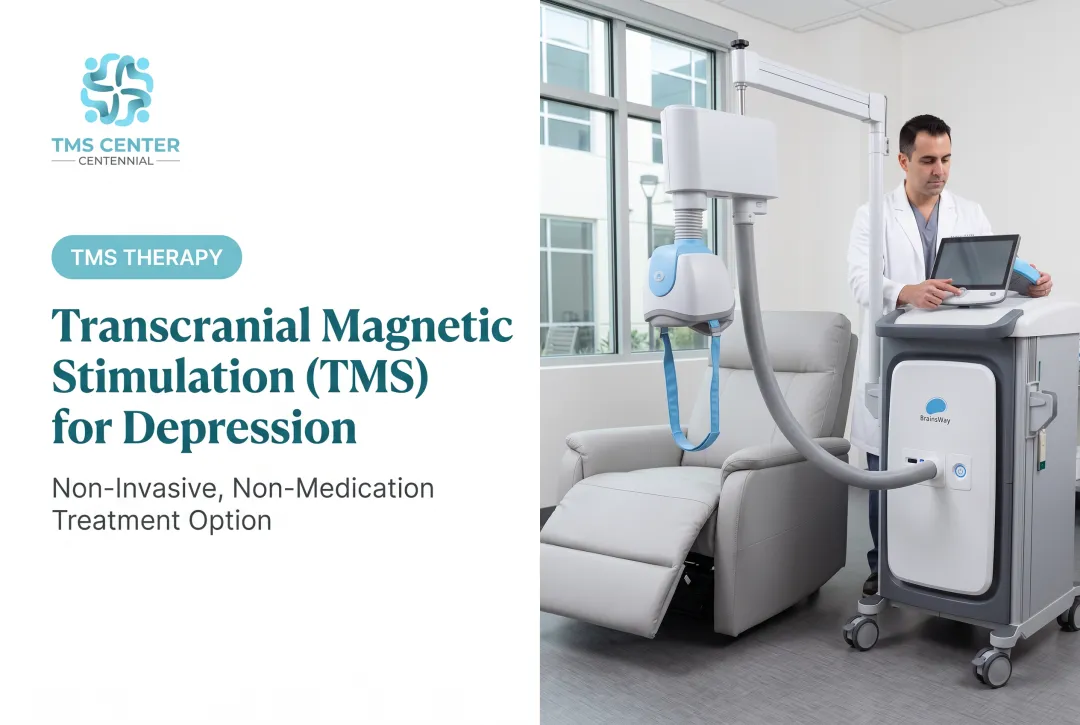
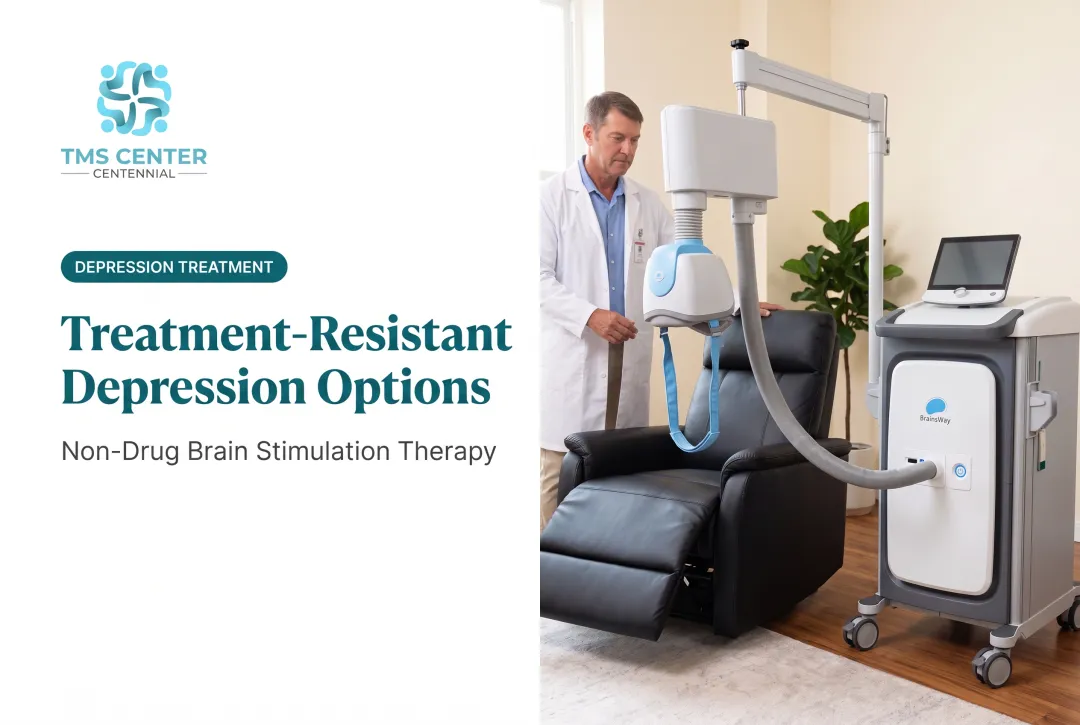
Standard repetitive transcranial magnetic stimulation (rTMS) uses magnetic pulses delivered through a coil placed against the scalp to stimulate the prefrontal cortex. The FDA cleared it for depression in 2008. A typical course runs 20 to 30 sessions over 4 to 6 weeks, with each session lasting roughly 20 to 30 minutes. Patients sit in a chair, remain fully awake, and can resume normal activities right afterward.
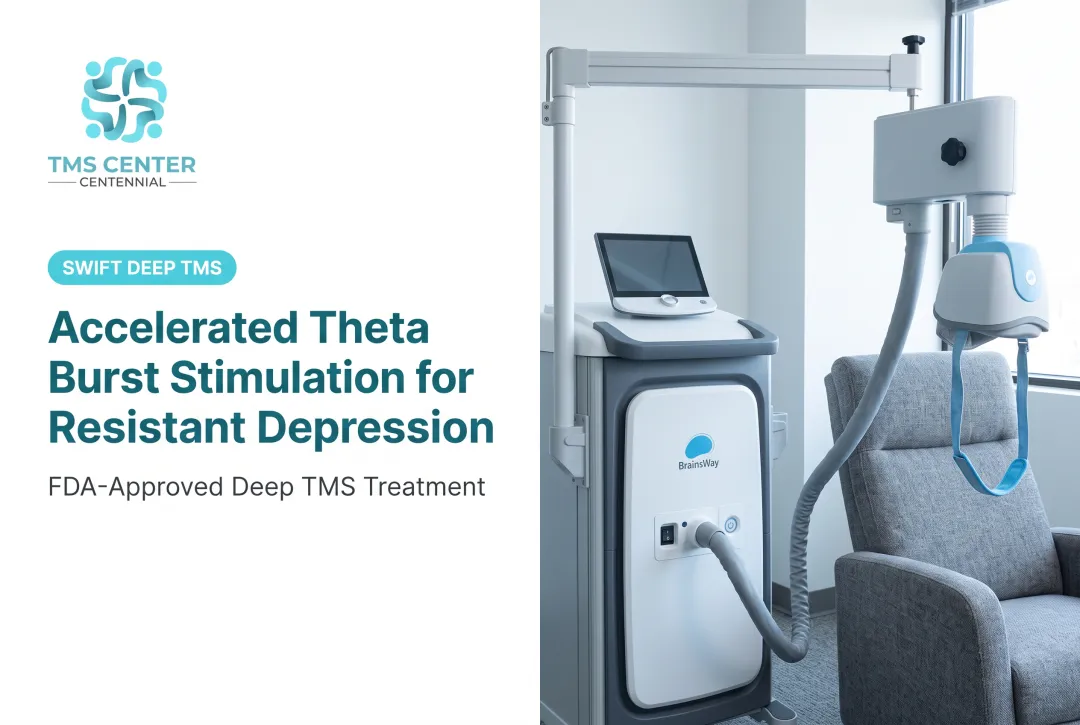
Deep TMS, delivered through BrainsWay's patented H-coil technology, received FDA clearance in 2013. Its coil design stimulates a broader and deeper field of brain tissue than standard figure-8 rTMS coils, reaching about four times deeper into the brain and covering a wider range of neural pathways. In the pivotal clinical trial, Deep TMS produced a 38.4% response rate and 32.6% remission rate at five weeks, compared with 21.4% and 14.6% for sham treatment, according to the pivotal Deep TMS depression trial (PMC).
TMS Center Centennial offers Deep TMS delivered by certified BrainsWay technicians, including lead TMS coordinator Christine Cook. The clinic reports:
- 89% of patients experience a significant reduction in depression symptoms
- 69% achieve complete remission
For patients who want a faster timeline, the center also offers Swift Deep TMS, an accelerated protocol using Theta Burst Stimulation that compresses a full course into about two weeks instead of the standard four to six. A history of psychotherapy is generally required as part of the clinical evaluation - you'll just need to tell us who you saw for therapy and roughly when.
Other Treatments Used in Severe or Urgent Cases
When depression is severe, psychotic, or needs faster crisis-level intervention, other clinical settings may use treatments TMS clinics typically do not provide:
- Electroconvulsive therapy (ECT): Brief, controlled seizure under anesthesia; strong remission rates in severe or psychotic depression, with risks such as temporary memory loss.
- Ketamine / esketamine (Spravato): Supervised infusion or nasal spray that can ease symptoms within 24 hours; relief usually requires ongoing maintenance sessions.
- Vagus nerve stimulation (VNS): Surgically implanted device for last-resort use after multiple adequate treatments have failed.
Neurofeedback: A Complementary Non-Medication Tool
Neurofeedback trains the brain toward healthier patterns of activity using real-time feedback, rather than direct stimulation. TMS Center Centennial uses NeurOptimal, a system that monitors brainwave activity during 33-minute sessions and provides subtle audio cues that prompt the brain to self-correct.
Patients often pair neurofeedback with Deep TMS to support sleep, focus, and emotional regulation. Research on neurofeedback for depression is still early—promising, but not yet a standalone standard of care—so it works best as a complement to TMS or therapy, not a replacement.

How to Recover: Building a Comprehensive Treatment Plan
Recovery from Treatment-Resistant Depression rarely comes from one treatment alone. Research on pairing approaches such as rTMS with CBT shows combination care often improves symptoms more than any single treatment on its own.
Stick With the Plan
Once you start feeling better, stopping medication or ending sessions abruptly is one of the most common ways progress unravels. Brain changes from TMS, therapy, or medication need time to stabilize. Always work with your care team before adjusting or stopping treatment, even if symptoms have improved significantly.
That same principle applies during an active TMS course. Patients can generally continue their current medications during the TMS protocol and should stay stable on those medications while treatment is underway. Keeping medications stable helps limit variables during treatment, so the clinical team can tell what is actually working. Any medication changes should be made under medical supervision, and preferably after finishing the TMS protocol rather than during it, always guided by the prescribing clinician.
Build a Foundation With Lifestyle Changes
Treatment works better when paired with basic lifestyle support:
- Address substance use — alcohol and drugs blunt treatment response and can worsen depression
- Keep a consistent sleep routine to support the brain changes treatment is building
- Move regularly; even moderate activity helps with mood regulation
- Use stress-reduction practices such as mindfulness to calm an overactive stress response
Work With a Specialized, Multidisciplinary Team
Treatment-Resistant Depression responds best to coordinated care rather than trial-and-error with a single provider. At TMS Center Centennial, that looks like a team matched to different parts of recovery:
- Psychiatrist Dr. Cheryl Dasler evaluates mood and medication needs and supports TMS for resistant depression
- LMFT Carolyn Riviere provides trauma-informed counseling
- Certified TMS coordinators handle day-to-day treatment delivery
That collaboration helps fit treatment to the person, not the other way around.
If multiple medications and therapy have not brought lasting relief, consider a second opinion from a clinician who focuses on treatment-resistant depression—rather than cycling through the same approach alone.
Frequently Asked Questions
How do you recover from treatment-resistant depression?
Recovery typically requires a combination approach: adjusting or augmenting medication, adding evidence-based therapy, and considering brain stimulation like Deep TMS. Working with a specialist who coordinates all three tends to produce better, longer-lasting results.
What therapy is best for treatment-resistant depression?
Cognitive behavioral therapy has the strongest evidence base for Treatment-Resistant Depression, with long-term response rates roughly 16 percentage points higher than usual care alone. Combining CBT with treatments like TMS often produces better outcomes than therapy by itself.
Is lithium an effective treatment for treatment-resistant depression?
Lithium augmentation can help, especially alongside tricyclic antidepressants, with research showing meaningfully improved response rates. It requires regular blood testing to monitor lithium levels along with thyroid and kidney function.
How long does it take to see results from TMS for treatment-resistant depression?
Most patients notice improvement over a standard 4 to 6 week course of Deep TMS, with response building gradually across sessions. Some patients report noticing subtle changes within the first couple of weeks.
Is TMS therapy covered by insurance?
Most major insurance plans cover TMS once documented medication trials have failed. TMS Center Centennial accepts plans including Cigna, Aetna, Tricare, Anthem Blue Cross Blue Shield, United Healthcare, and most Medicare plans.
Can treatment-resistant depression be fully cured?
Many patients reach complete remission through the right combination of treatments, though depression can be a recurring condition for some. Ongoing maintenance care and monitoring help sustain results long-term.