
Introduction
"When will I actually feel different?" It's the question almost every new TMS patient asks before their first session, and it's a fair one. Depression doesn't wait patiently, and neither do the people living with it.
Here's the honest answer: TMS doesn't work overnight. Repeated stimulation of mood-related brain circuits builds change over weeks, not days. Many people notice early shifts around weeks 2 to 4, and BrainsWay Deep TMS clinical data shows about 89% of patients reach significant symptom reduction by the end of a full course.
At TMS Center Centennial, our team hears this question constantly. Rodney Placzek, our clinical director, went through TMS treatment himself after a difficult stretch following his military retirement. He understands the anxious wait for results firsthand.
This guide walks through the week-by-week timeline, early and later signs of progress, what speeds or slows results, and what to do if improvement stalls.
Key Takeaways
- Subtle changes often appear within 2-4 weeks; fuller benefits typically show up around weeks 5-6.
- Progress builds gradually — small wins in sleep and energy usually come before major mood shifts.
- Age, symptom severity, and daily habits all shape response speed.
- Finishing the complete recommended course matters more than any single week's results.
The TMS Therapy Timeline: What to Expect Week by Week
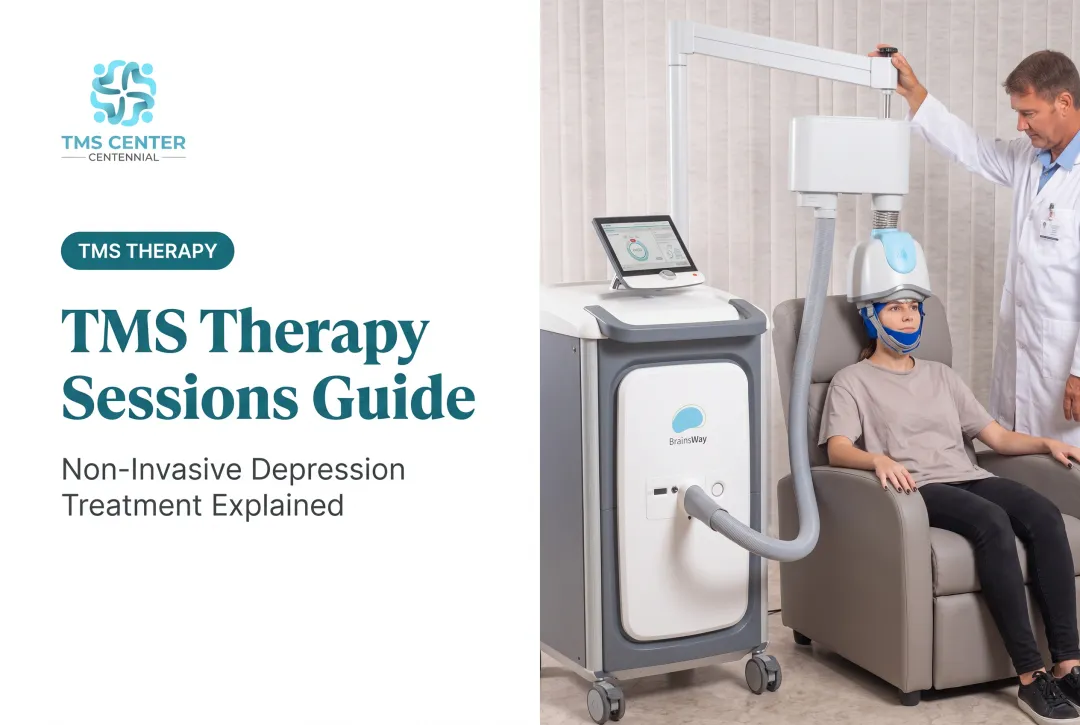
TMS targets the dorsolateral prefrontal cortex (DLPFC), a brain region that tends to be underactive in people with depression. Each session sends magnetic pulses to stimulate that area, and over time, the brain builds new activity patterns. This is a cumulative process: one session won't do much, but 20 to 30 sessions can meaningfully shift brain function.
That's why patience matters here. The brain needs repetition to change, much like a muscle needs repeated training to get stronger.
Weeks 1-2: The Adjustment Phase
Early on, changes are subtle and easy to dismiss. Some patients notice:
- Slightly better sleep quality
- A touch more energy during the day
- No noticeable change at all (this is common and normal)
Mild side effects are also typical during this window, including scalp discomfort and headache. These usually fade as your brain and scalp adjust to the stimulation, often within the first week or two of consistent treatment.
Weeks 3-4: Building Momentum
This is where things often start moving. Patients frequently report steadier mood, more consistent sleep, and an easier time getting through daily tasks. In one large VA patient cohort, sleep-related symptoms showed measurable improvement in 51.75% of patients by week 3, up from 37.38% after just one week, according to a 2024 study on TMS and sleep outcomes. That pattern points to momentum building steadily rather than all at once.
Not everyone hits this pace exactly, but by this stage, most patients have some evidence that something is shifting.
Weeks 5-6 and Beyond: Peak Benefits
The final stretch of a standard course is typically where the most significant relief shows up. In the pivotal clinical trial supporting Deep TMS, patients receiving active treatment reached a 30.4% remission rate by week 5, compared to 15.8% with sham treatment, according to a 2015 multicenter randomized controlled trial.
At TMS Center Centennial, we use BrainsWay Deep TMS™ with a structured acute and continuation-phase approach. Our clinic has reported 89% of patients experiencing significant symptom improvement, with roughly 69% reaching complete remission. Those results show what finishing a full course can look like outside a trial setting.

Signs Your TMS Therapy Is Working
Progress with TMS rarely arrives as one dramatic "aha" moment. It shows up in layers, across different areas of daily life.
Physical signs often come first:
- More consistent, restorative sleep
- Less daytime fatigue
- Less of that physically "slowed down" feeling
Emotional signs tend to follow:
- A brighter baseline mood, even on hard days
- Less hopelessness or irritability
- More resilience when stress hits
Cognitive and behavioral signs frequently emerge later in the course:
- Sharper focus, less mental fog
- Easier decision-making
- Renewed interest in hobbies or people you'd stopped engaging with
- Better follow-through on everyday responsibilities
Loved ones sometimes notice these shifts before the patient does. A partner might comment that you seem "lighter" or more talkative weeks before you'd describe yourself that way.
Track it yourself. Keep a simple daily log rating your mood, sleep, and energy on a 1-10 scale. Gradual progress is hard to see day to day, but a few weeks of entries side by side makes the trend obvious.
Factors That Influence How Quickly TMS Works
No two brains respond identically, and several factors shape the pace of improvement.
Age and brain chemistry. Younger patients and those with certain neural connectivity patterns often see faster gains. Older patients or those with longer-standing, treatment-resistant depression may need more sessions before noticing meaningful change. Outcomes are still often meaningful once achieved.
Symptom severity and history. More severe or chronic depression tends to take longer to respond. This doesn't mean the outlook is worse; it just means the timeline stretches a bit further.
Lifestyle and complementary care. Habits that support the brain's ability to adapt during treatment include:
- Consistent sleep quality
- Regular exercise
- Active stress management
Pairing TMS with collaborative counseling can also reinforce progress. At TMS Center Centennial, therapy services led by Carolyn Riviere, LMFT, work alongside TMS to address the emotional and relational side of recovery, not just the neurological one.
What to Do (and Avoid) While Waiting for TMS to Work
The "TMS dip" is real for some patients. Occasionally, your mood temporarily feels worse in the early weeks as your brain reorganizes itself. This doesn't mean treatment has failed. Any meaningful worsening should still be reported to your care team right away.
Do these things while you wait:
- Keep every scheduled session, even when progress feels slow
- Note small shifts in sleep, energy, mood, or focus between visits
- Tell your care team promptly if symptoms worsen or stall
Avoid these common mistakes:
- Skipping sessions because you don't feel different yet
- Expecting overnight results
- Stopping treatment early, before your brain has had time to adjust
- Drinking excessively, which can blunt response and, in rare cases, affect seizure threshold
If progress feels stalled after several weeks, your providers can review your protocol and discuss whether adjustments make sense. Waiting it out alone rarely helps; a quick check-in often resolves the concern.

How Many TMS Sessions Will You Need?
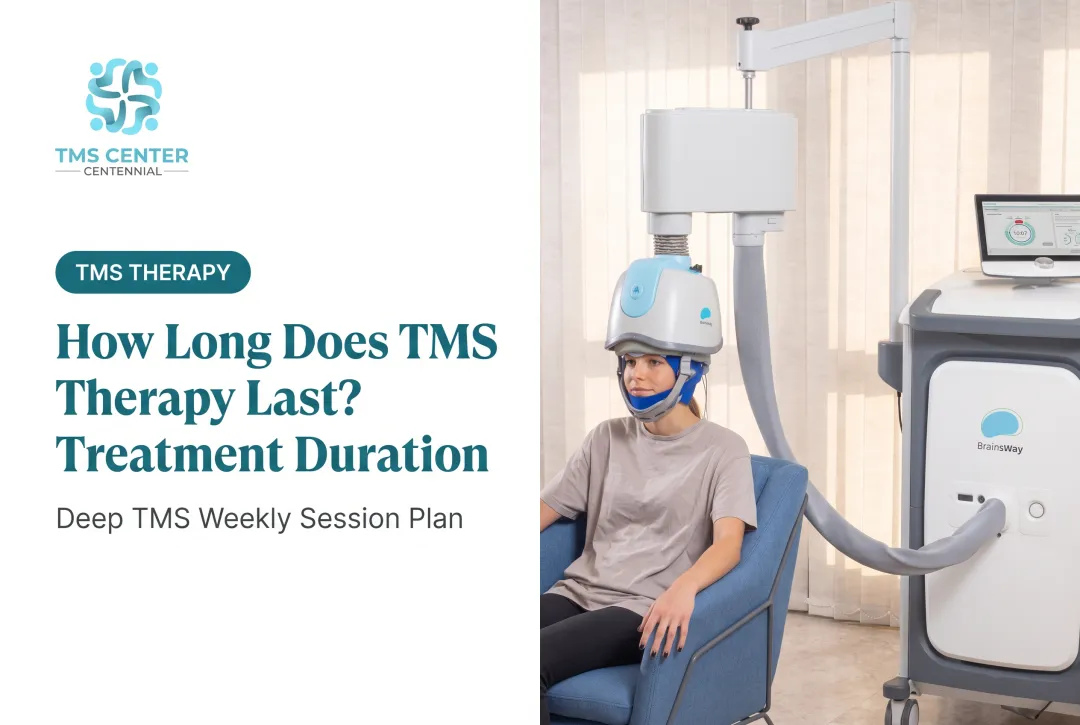
A standard TMS course typically runs five sessions per week for four to six weeks, totaling 20 to 30 sessions. Some patients need fewer; others benefit from extending treatment if response is slower than average.
Your total usually depends on a few clinical factors:
- Symptom severity and diagnosis at intake
- How you respond in the first two weeks
- Whether your clinician adds a short extension or taper
At TMS Center Centennial, we use BrainsWay Deep TMS™ technology, FDA-cleared for major depressive disorder since 2013. The team builds your session plan from your evaluation and adjusts it as treatment progresses.
Finishing the full course matters for results. We accept most major plans—including Tricare, Cigna, Anthem BCBS, United Healthcare, and Aetna—so Denver-area patients can complete the recommended timeline instead of stopping early.
Frequently Asked Questions
How long after TMS do you see results?
Most patients notice subtle changes, such as better sleep or slightly more energy, within 2-4 weeks. More significant improvement typically appears around weeks 5-6 of a standard course.
How do I know if TMS is working?
Look for improved sleep, steadier mood, sharper focus, and easier daily functioning. Tracking these in a daily journal, alongside regular check-ins with your provider, makes gradual progress easier to spot.
Does TMS rewire the brain?
TMS uses magnetic pulses to stimulate underactive brain circuits involved in mood regulation, especially the dorsolateral prefrontal cortex (DLPFC). Over repeated sessions, those pathways linked to emotional regulation can strengthen.
What not to do during TMS?
Avoid skipping sessions, drinking excessively, or expecting immediate results. Consistency across the full course matters far more than any single session. On medications: patients can generally continue their current medications during the TMS protocol, and they should stay stable on those medications throughout treatment. Keeping medications stable helps limit variables during treatment, so the clinical team can tell what is actually working. Any medication changes should be made under medical supervision, and preferably after finishing the TMS protocol rather than during it, always guided by the prescribing clinician. Do not stop, start, or change medications on your own.
How many TMS sessions are typically needed to see full results?
A standard course runs five sessions weekly for four to six weeks, totaling 20-30 sessions. BrainsWay Deep TMS™ protocols may also include an additional continuation phase for some patients.
How long do the effects of TMS last after treatment ends?
Per a 2025 consensus review, about 66.5% of patients still respond at three months and 52.9% at six months. Maintenance sessions are an option if symptoms return.