
That's not shyness. It's social anxiety disorder, and it affects 7.1% of U.S. adults every year, with a 12.1% lifetime prevalence, according to the National Institute of Mental Health. For many people, therapy and medication help. For others, symptoms persist despite years of trying.
This article covers how Transcranial Magnetic Stimulation (TMS) works for social anxiety, what the research actually shows, and what a treatment journey looks like at a clinic like TMS Center Centennial in Centennial, Colorado.
Key Takeaways
- TMS is FDA-cleared for depression and OCD, and used off-label for social anxiety
- Clinical studies show meaningful symptom drops on the Liebowitz Social Anxiety Scale (LSAS)
- Sessions target the prefrontal cortex to calm an overactive fear response
- Pairing TMS with counseling produces the strongest treatment outcomes
- TMS Center Centennial pairs Deep TMS™ with collaborative counseling for anxiety care
Understanding Social Anxiety Disorder
Social anxiety disorder is a persistent, intense fear of judgment or embarrassment in social situations, lasting six months or longer and interfering with daily life. It's not the same as being introverted or occasionally nervous before a presentation.
Common symptoms include:
- Fear of public speaking or being watched while performing everyday tasks
- Physical reactions like sweating, blushing, racing heart, or nausea
- Avoidance of social gatherings, phone calls, or eye contact
- Anxiety that builds for days or weeks before an anticipated event
Root causes vary. Genetics play a role, as does an overactive amygdala — the brain's fear-detection center. Life experiences, including bullying or repeated rejection, can also wire in these fear responses early.
Once those fear responses take hold, leaving social anxiety untreated carries real costs. People miss job promotions, avoid dating, skip family events, and often develop depression alongside it. A 2007 ADAA survey found that 36% of people with social anxiety waited 10 years or more before seeking help (ADAA).
How TMS Works for Social Anxiety
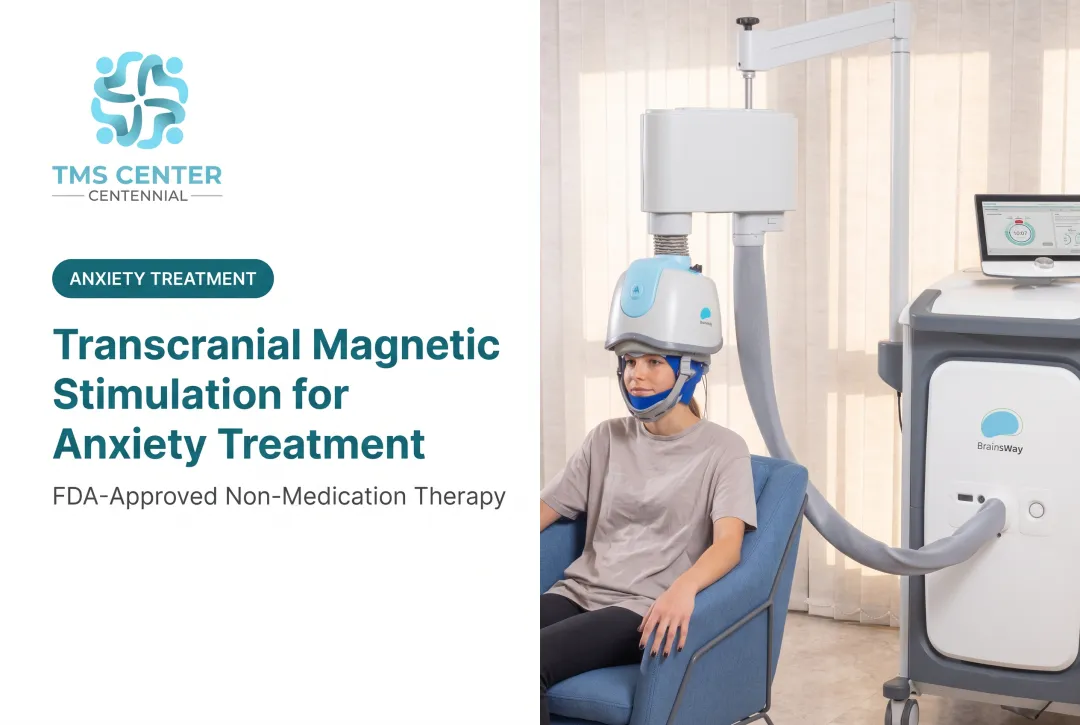
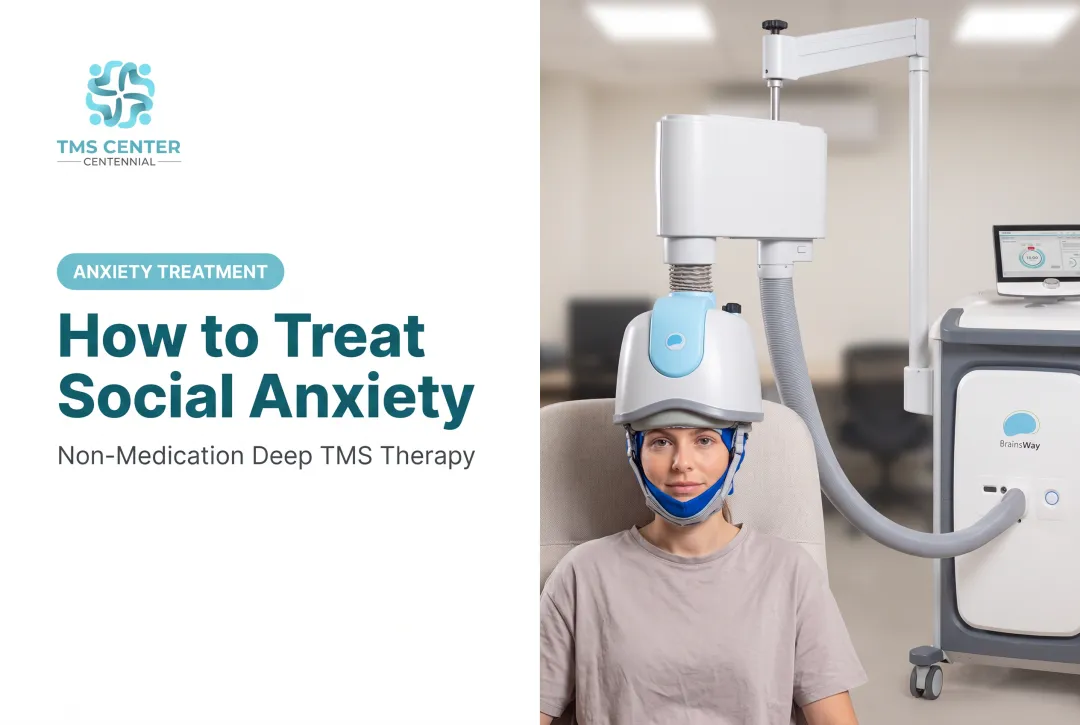
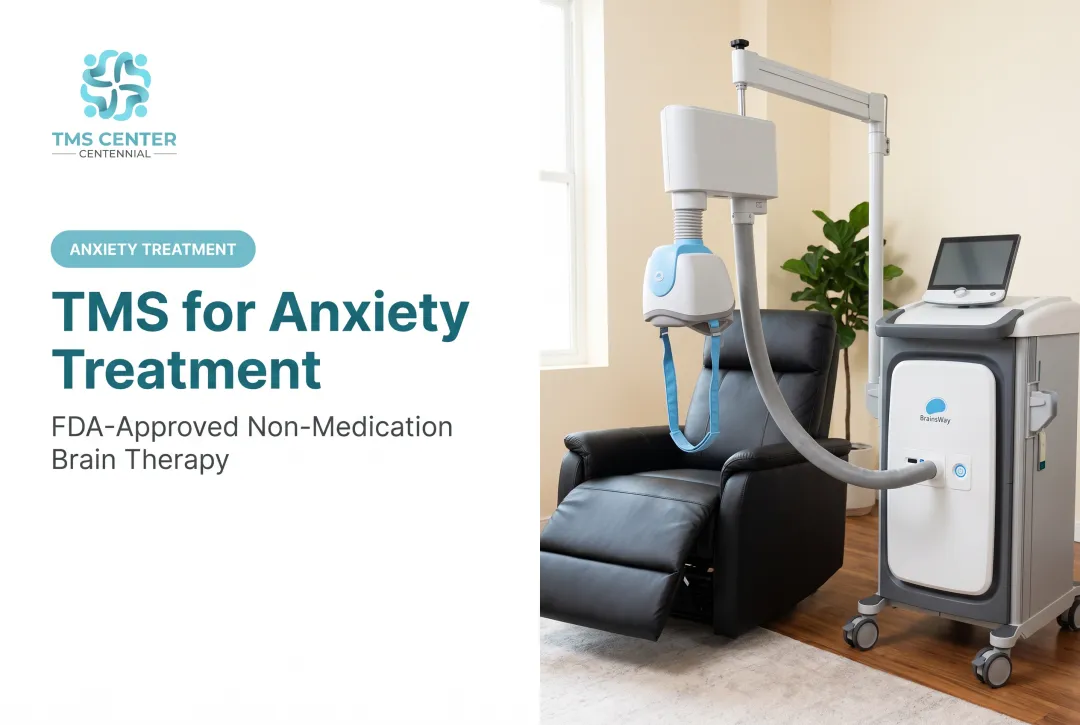
TMS uses magnetic pulses, similar in strength to an MRI machine, to create small electrical currents in targeted brain regions. No surgery, no sedation, no anesthesia.
Targeting the Fear Circuit
For anxiety treatment, providers typically focus on the dorsolateral prefrontal cortex (DLPFC) and medial prefrontal cortex (mPFC), regions that regulate emotion and dampen fear signals. In social anxiety, these regulatory areas often underperform while the amygdala runs hot.
A 2025 neuroscience review points to this mPFC-amygdala pathway as central to anxiety regulation.
Repeated sessions aim to strengthen this top-down control through neuroplasticity, the brain's ability to reorganize neural pathways with repeated stimulation. It is closer to retraining an overactive alarm system so it stops sounding for false alarms.

Deep TMS vs. Standard Coils
Standard rTMS coils reach roughly 3 cm into the skull. Deep TMS™, delivered through BrainsWay's H-Coil technology, is designed to stimulate more broadly and reach deeper cortical regions, up to 4 cm per manufacturer specifications. The broader field can activate more neurons across mood- and anxiety-related networks, rather than a narrow spot.

Whatever the coil type, the process is drug-free. Patients walk in, sit in a chair, receive stimulation, and walk out ready to resume their day. No downtime required.
Does TMS Work? Reviewing the Research and Effectiveness
Here's the honest answer: TMS shows promise for social anxiety, but it is not yet FDA-approved specifically for that diagnosis. Current FDA clearances cover major depressive disorder (since 2008), OCD (since 2018), and as of 2021, reducing comorbid anxiety symptoms in patients with depression (BrainsWay). Use for primary social anxiety disorder is considered off-label.
That doesn't mean the evidence is empty. A small case series measuring the Liebowitz Social Anxiety Scale (LSAS) found meaningful score reductions at 2 weeks, 4 weeks, and follow-up, alongside improvements in anxiety and depression scores (PMC, Paes et al., 2013). It's a small, uncontrolled study, not a large randomized trial, but it's a signal worth noting.
What this means for expectations:
- Symptom change, when it happens, often begins within the 2–4 week mark
- Most patients finish a standard 4–6 week protocol before judging full results
- Long-term durability past 6–12 months for social anxiety is still thinly studied

For context, SSRI trials in anxiety often show separation from placebo only at weeks 4–6, and patients who have already cycled through multiple SSRIs frequently see diminishing returns with each new try.
To be direct: research on TMS for social anxiety specifically is smaller and newer than the depression literature. Anyone considering it should go in with realistic, not miracle-cure, expectations.
What to Expect: The TMS Treatment Journey at TMS Center Centennial
Here is how care typically unfolds if you start TMS for social anxiety at the center.
1. Initial evaluation. Providers such as Dr. Cheryl Dasler, double board-certified in general and child/adolescent psychiatry, conduct a thorough psychiatric assessment, review your treatment history, and screen for medical suitability before recommending TMS.
2. A typical session. You sit in a comfortable chair while a certified technician positions the coil. Sessions generally run 20–30 minutes, and the full appointment (including setup) takes about 45 minutes. Anxiety protocols at the center typically run about 36 treatment days, somewhat longer than the standard depression course.
3. Comfort and support. Care is multidisciplinary: psychiatric oversight, certified BrainsWay™ technicians, and collaborative counseling from therapists like Carolyn Riviere and Barbra Ori. Two resident therapy dogs, Finn and Fergus, can sit with you during sessions if you want the company.

4. Insurance. TMS Center Centennial accepts most major plans, including:
- Cigna
- Anthem Blue Cross Blue Shield
- Aetna
- United Healthcare
- Tricare
- Medicare
The center handles benefits verification and pre-authorization paperwork directly, so you are not left navigating it alone.
5. Side effects. The most commonly reported effects are mild scalp discomfort and headache during the course, generally short-lived according to NIMH safety data. Serious adverse events are rare.
TMS vs. Other Social Anxiety Treatments
TMS does not replace therapy or medication. It is often used alongside both.
TMS and CBT/psychotherapy
Cognitive behavioral therapy remains the most established, research-backed treatment for social anxiety. TMS does not compete with therapy. It may make patients more responsive by calming the fear circuitry that makes exposure work so hard in the first place.
TMS and medication (SSRIs/SNRIs)
Medications often take 4–6 weeks to show effect and can bring systemic side effects, including:
- Weight changes
- Sexual side effects
- Withdrawal symptoms
TMS avoids those systemic effects and is not addictive. That combination appeals to patients who have cycled through multiple prescriptions without relief.

Who often chooses TMS
Veterans, active-duty service members, and patients with treatment-resistant symptoms often turn to non-medication options.
TMS Center Centennial's Clinical Director, Rodney Placzek (a retired Army Sergeant Major), experienced TMS firsthand during his own mental health recovery after leaving the military. That experience is part of why he later helped bring the treatment to other patients in the Denver area.
Frequently Asked Questions
Does TMS work for social anxiety?
Small clinical studies show meaningful symptom reduction on scales like the Liebowitz Social Anxiety Scale (LSAS), though TMS isn't yet FDA-approved specifically for social anxiety. Results tend to be strongest when combined with therapy.
What type of therapy is best for social anxiety?
Cognitive behavioral therapy (CBT) has the strongest research base for social anxiety. For patients who haven't responded fully to CBT alone, combining it with TMS or other non-medication approaches may improve outcomes.
How long does it take to see results from TMS for social anxiety?
Most patients who respond notice changes within 2-4 weeks into a standard 4-6 week treatment course. Some anxiety protocols last about 36 days.
Is TMS covered by insurance for anxiety treatment?
Coverage varies by plan and often depends on documented treatment history. TMS Center Centennial accepts most major insurance plans, including Cigna, Aetna, Tricare, and United Healthcare, and handles pre-authorization on the patient's behalf.
Are there side effects of TMS treatment?
The most common side effects are mild scalp discomfort and headache during the treatment course. Serious side effects are rare, especially with proper medical screening beforehand.
Can TMS be combined with medication or therapy?
Yes. Most patients continue existing counseling and prescribed medications during TMS treatment, with any medication adjustments guided by the prescribing clinician rather than made independently.