
Transcranial Magnetic Stimulation (TMS) is changing that calculus. It's FDA-approved, drug-free, and doesn't require downtime. At TMS Center Centennial, this approach carries extra weight: co-founder Rodney Placzek is a retired Army Sergeant Major who turned to TMS during his own recovery after 27 years of service.
This article covers the mental health challenges unique to military life, how TMS actually works, where it stands for PTSD specifically, TRICARE coverage details, and what treatment looks like day to day.
Key Takeaways
- FDA-approved TMS is non-invasive and medication-free, so side effects won’t compromise duty performance
- TRICARE and most major insurers cover TMS for eligible diagnoses like treatment-resistant depression
- Veteran-founded TMS Center Centennial reports an 89% patient improvement rate
- Sessions last 20–30 minutes with no downtime, fitting demanding military schedules
Understanding Mental Health Challenges Unique to Military Personnel
Depression and Treatment-Resistant Depression in Service Members
Depression hits military populations differently than civilian life. In the 2015 RAND Health Related Behaviors Survey, 9.4% of active-duty members screened positive for probable depression in the prior year, a number that likely undercounts those who avoid screening altogether.
Several factors compound the risk:
- Combat exposure and traumatic brain injury (TBI)
- Loss of unit cohesion after separation from service
- Difficult reintegration into civilian routines and relationships
- Stacking losses of career identity, structure, and social support all at once
Standard antidepressants don't always work for this population. National data shows roughly 30.9% of adults treated for major depressive disorder meet criteria for treatment-resistant depression, according to a claims-based analysis including VHA data sources. For veterans who've already cycled through multiple medications, that statistic hits close to home.
PTSD and Anxiety in Military Populations
PTSD prevalence varies significantly by deployment history. Among veterans treated through the VA in fiscal year 2024, about 14% of men and 24% of women carried a PTSD diagnosis, according to the VA National Center for PTSD. Some studies of service members returning from Iraq reported rates around 12–13%.
PTSD, depression, and anxiety symptoms overlap constantly: sleep disruption, irritability, hypervigilance, and low mood feed into each other. That overlap is why single-symptom treatment often falls short. Addressing one condition in isolation rarely resolves the tangled mess underneath.
The Stigma Barrier
Military culture prizes toughness and self-reliance. Asking for help can feel like admitting weakness, or worse, risking career consequences. Many service members worry a mental health diagnosis will show up on a fitness-for-duty review or affect security clearance.
Non-medication options like TMS sidestep some of that fear. There's no pill bottle, no prescription record tied to psychiatric medication, and no systemic side effects that could raise questions during a physical.
How TMS Therapy Works for Military-Related Depression and PTSD
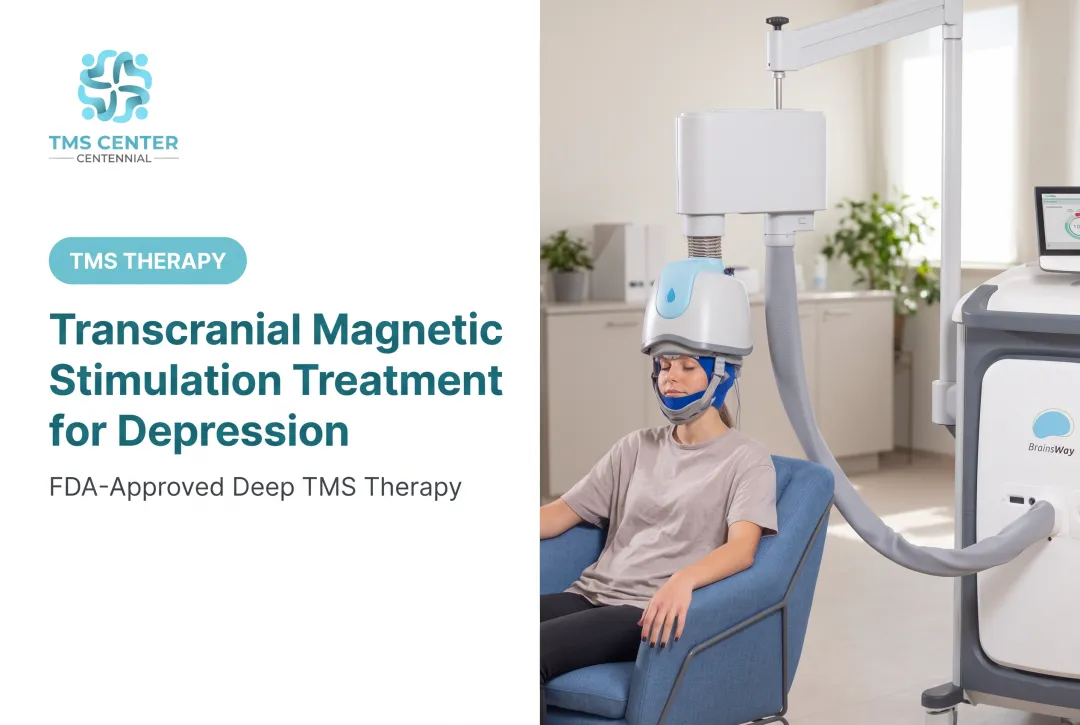
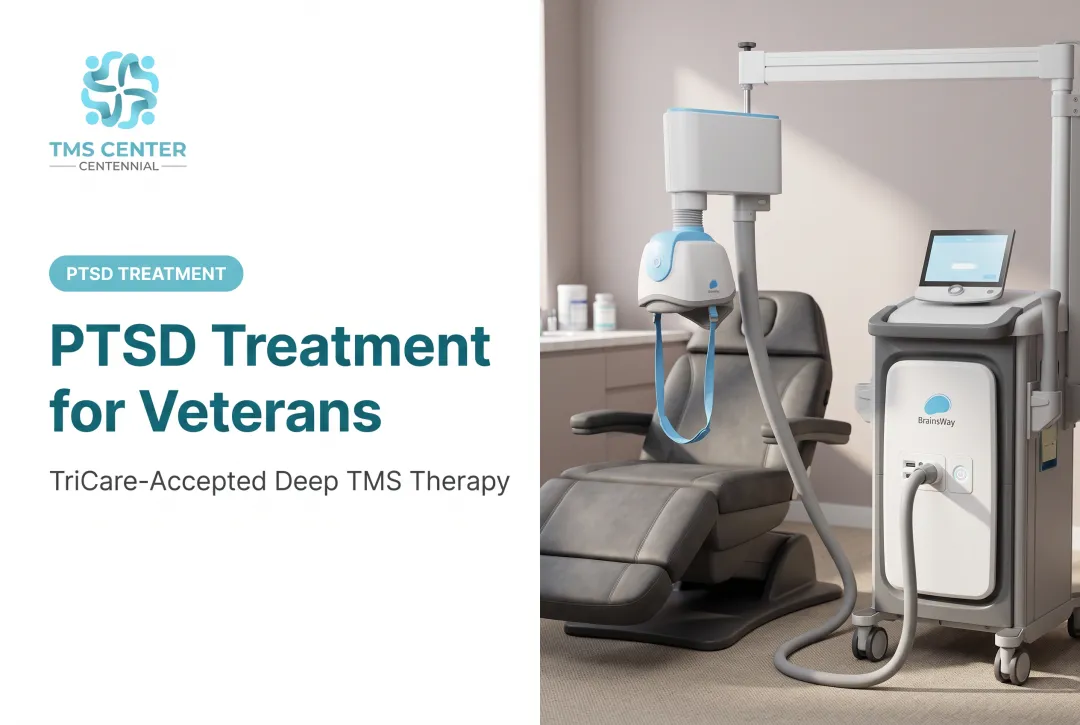
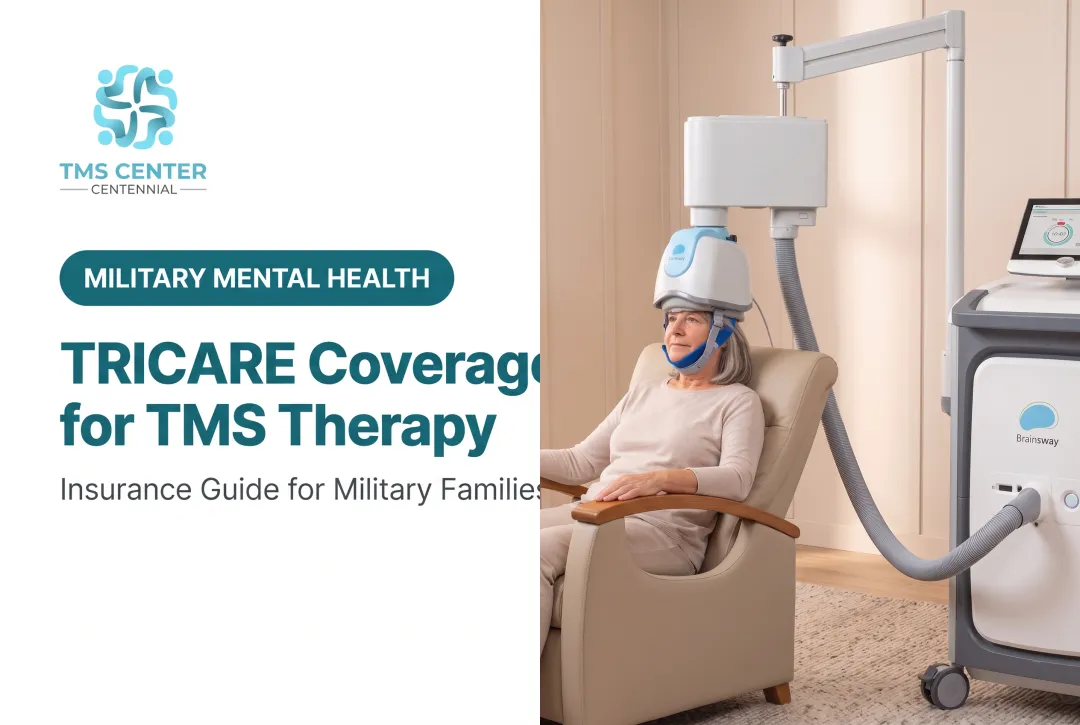
TMS uses magnetic pulses to stimulate the prefrontal cortex, the brain region tied to mood regulation that's often underactive in depression and PTSD. The pulses help recalibrate neural circuits stuck in unhelpful patterns. What a session actually looks like:
- Patient sits in a chair, fully awake, with no anesthesia or sedation
- A coil is positioned near the scalp and delivers magnetic pulses
- Sessions run 20-30 minutes
- Patients drive themselves home and resume normal activities immediately TMS Center Centennial uses BrainsWay Deep TMS™, which reaches roughly 3.2 cm into the brain compared to about 0.7 cm for standard rTMS, according to BrainsWay's technical comparison. The wider stimulation field is designed to reach more of the prefrontal circuitry involved in mood regulation. The evidence for veterans specifically is encouraging. A VA naturalistic cohort study across 27 sites tracked veterans who completed at least 30 sessions. Per peer-reviewed research:
- 41.4% responded to treatment for depression
- 65.3% of those with comorbid PTSD saw clinically meaningful symptom reduction
- 46.1% no longer met the diagnostic threshold for PTSD A typical course runs four to six weeks, five days a week. Accelerated options are available when schedules are tight. The center also offers NeurOptimal® neurofeedback, a 33-minute brainwave session some patients pair with TMS as a complementary, non-medication tool.

Is TMS Cleared for PTSD? Understanding FDA Status and Off-Label Use
TMS is FDA-cleared for major depressive disorder and OCD, not for PTSD itself. When clinicians use it for PTSD, treatment is typically off-label and guided by clinical research rather than a dedicated FDA indication.
That does not mean it fails to help. Many veterans improve because co-occurring depression symptoms often respond well to TMS. Common gains include:
- Better sleep
- Fewer flashbacks
- More stable mood
A multisite VA study of 756 veterans with comorbid PTSD and depression reported:
- PTSD response rates of 63% to 78%, depending on protocol
- Remission rates around 47–49%
VA clinical guidance still lists trauma-focused psychotherapies such as Prolonged Exposure or CPT as first-line PTSD care. TMS works best inside a broader plan, not as a standalone fix. A psychiatric consultation is the right starting point to decide whether TMS fits a service member’s specific PTSD presentation.

TRICARE, VA, and Insurance Coverage for TMS Therapy
Cost concerns shouldn't keep anyone from exploring TMS. TRICARE covers TMS therapy for eligible beneficiaries who meet medical necessity criteria, per the TRICARE Policy Manual:
- Confirmed diagnosis of major depressive disorder
- Documented failure of prior medication trials
- Referral or preauthorization confirming a less intensive treatment isn't appropriate
Coverage extends to:
- Active-duty service members
- Retired military
- National Guard and Reserve
- Dependents and spouses
VA facilities also run their own Clinical TMS Program, operating across 27 sites nationwide, so enrolled veterans can access treatment directly through a VA provider referral.
TMS Center Centennial accepts TRICARE alongside Cigna, Anthem BCBS, United Healthcare, Aetna, and most Medicare plans. Medicare reimbursement for a standard rTMS session is about $206. With coverage in place, most patients pay little out of pocket for a full treatment course compared with self-pay rates.

Why Military Members Choose TMS Center Centennial
Rodney Placzek co-founded TMS Center Centennial after living the patient experience himself. After 27 years in the Army, he faced the loss of his son, a divorce, and the disorienting shift to civilian life. He tried TMS and neurofeedback as a patient first, then became a Certified TMS Trainer and Technician and built a clinic where 89% of patients see meaningful symptom improvement.
That perspective shapes how the center operates:
- Board-certified psychiatrist, licensed marriage and family therapists, and certified TMS coordinators work as one team, not in silos
- Counseling runs alongside TMS so talk therapy and stimulation reinforce each other
- Therapy dogs on-site ease the tension many feel walking into a mental health appointment for the first time

For service members hesitant about treatment, a founder who has worn the uniform and sat in the treatment chair himself often carries more weight than a brochure ever could.
Frequently Asked Questions
How much does a TMS therapy session cost?
Individual session costs vary, but full treatment courses are typically covered by TRICARE and major insurers. Eligible patients face minimal out-of-pocket expense once benefits are verified.
Does TRICARE or the VA cover TMS therapy for military members?
Yes. TRICARE covers TMS when criteria are met: confirmed MDD diagnosis, failed medication trials, and psychiatrist referral. VA facilities also offer TMS directly to enrolled veterans through their own clinical programs.
Is TMS therapy cleared for PTSD?
FDA clearance covers major depressive disorder and OCD, not PTSD specifically. PTSD treatment with TMS is often off-label but supported by clinical evidence and delivered under psychiatric guidance.
How long does a course of TMS treatment take?
Standard treatment runs four to six weeks, five days a week, totaling around 30 sessions. Accelerated protocols exist for patients with tighter schedules.
Are there side effects from TMS therapy?
Most side effects are mild and short-lived, such as scalp discomfort or headache. TMS carries no systemic side effects such as weight gain or sexual dysfunction, and serious risks like seizures are rare.
Can active-duty service members receive TMS therapy?
Yes, with proper referral and authorization. TMS treatment doesn't typically affect security clearance or fitness-for-duty status, though individual circumstances should be discussed with a psychiatrist.