
Choosing between them affects your timeline, your budget, and your odds of relief. TMS Center Centennial offers both BrainsWay Deep TMS™ and NeurOptimal® neurofeedback at one Centennial, Colorado location, so patients don't have to guess which path fits before getting real guidance.
This guide breaks down how each treatment works, what the evidence shows, and how to decide.
Key Takeaways
- Magnetic pulses in TMS stimulate mood-related brain regions; neurofeedback trains self-regulation with real-time EEG
- Stronger FDA clearance and clinical evidence support TMS for depression and OCD
- Neurofeedback shows more promise for ADHD, anxiety, and sleep—and coverage is less consistent than TMS
- Response varies by person; a qualified provider consultation is the best way to decide
TMS vs Neurofeedback: Quick Comparison
| Factor | TMS Therapy | Neurofeedback |
|---|---|---|
| Mechanism | Magnetic pulses stimulate the DLPFC directly | EEG sensors feed back brainwave data for self-training |
| FDA Status | Cleared for MDD, OCD, anxious depression | Not FDA-approved for depression; used as adjunct |
| Session Length | 20-40 min daily, 4-6 weeks | 30-60 min, 1-3x/week over months |
| Cost (self-pay) | $300-$500/session; $6,000-$15,000 full course | ~$80-$200/session; $2,000-$6,000+ for 20-40 sessions |
| Insurance | Covered by Medicare and most major insurers for FDA-cleared conditions | Inconsistent; often considered experimental |
| Patient Role | Passive during sessions | Often active training; some systems (e.g., NeurOptimal) are passive |
At TMS Center Centennial, a standard BrainsWay Deep TMS appointment runs about 45 minutes total, with roughly 20 minutes of actual stimulation. NeurOptimal sessions run 33 minutes with no puzzles or effort required. You simply relax while sensors read your brainwaves.

What Is TMS Therapy?
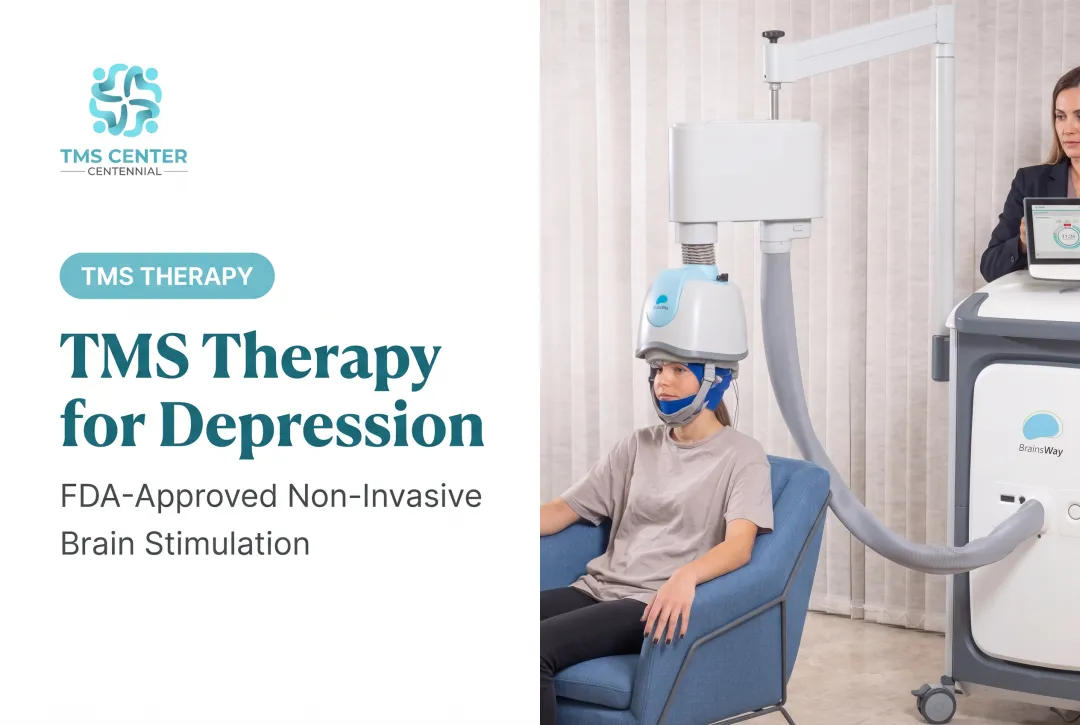
TMS (Transcranial Magnetic Stimulation) is a non-invasive treatment that uses magnetic pulses to stimulate the dorsolateral prefrontal cortex (DLPFC), the brain region tied to mood regulation. Research shows left DLPFC underactivity is linked to depression, which is why this area is the primary target.
Deep TMS vs. Traditional rTMS
BrainsWay Deep TMS uses an H1-coil that reaches broader, deeper cortical regions than traditional rTMS:
- Traditional rTMS: Reaches up to 3 cm, delivers repetitive pulsing with increasing strength
- Deep TMS: Reaches up to 4 cm, uses a steadier electromagnetic pulse
- Theta Burst Stimulation (TBS): A patterned protocol that stimulates the frontal cortex in about 3 minutes
TMS Center Centennial offers TBS as a free addition to depression protocols.
FDA clearance helps explain how these protocols entered routine care. The first TMS device was cleared for MDD in 2008. BrainsWay Deep TMS earned OCD clearance in 2018, and anxious-depression clearance has followed for multiple devices since 2022 (FDA press release).
Those clearances rest on clinical evidence. A large RCT found dTMS response rates of 38.4% versus 21.4% for sham treatment, with remission rates of 32.6% versus 14.6%. Broader clinical data shows roughly 75% response and 51% remission after six weeks of Deep TMS.

Use Cases of TMS
TMS works best for:
- Major depressive disorder, especially after antidepressants have failed
- Anxious depression
- OCD as an adjunct therapy
- PTSD, including symptoms common among veterans and service members TMS Center Centennial reports an 89% patient improvement rate and 69% remission rate based on its own clinical outcomes. Exact study parameters vary by treatment cohort, so these figures are worth discussing directly with the clinic. For veterans and active-duty service members, those results carry extra weight. More than 30% of military personnel and veterans experience PTSD, often without seeking treatment. Clinical Director Rodney Placzek, a retired Army Sergeant Major, personally underwent TMS therapy before co-founding the center. That experience gives the team firsthand insight into treating fellow service members dealing with PTSD, depression, and anxiety.

What Is Neurofeedback Treatment?
Neurofeedback is a form of biofeedback that teaches your brain to self-regulate its electrical activity. EEG sensors record brainwave patterns and feed that information back through visual or audio cues, training your brain through operant conditioning rather than external stimulation.
TMS Center Centennial uses NeurOptimal®, a "dynamical" neurofeedback system. Unlike traditional neurofeedback, it doesn't require solving puzzles or playing games. You simply relax in a darkened room for 33 minutes while soothing music and geometric images play, with occasional audio interruptions prompting your brain to reset.
Core benefits include:
- Improved focus and concentration
- Better sleep quality
- Enhanced emotional regulation
Use Cases of Neurofeedback
Neurofeedback is commonly used for:
- ADHD
- Anxiety
- Sleep disorders
- PTSD and trauma-related symptoms
Evidence for these applications is mixed. A large 2025 JAMA Psychiatry meta-analysis of 38 RCTs (n=2,472) found no group-level evidence supporting neurofeedback as a standalone ADHD treatment (Westwood et al., 2025).
A separate systematic review found significant symptom reduction for PTSD, with pooled remission rates of 79.3% for neurofeedback versus 24.4% for controls (Askovic et al., 2023).

Some patients also use neurofeedback as complementary support or ongoing maintenance after a TMS course. That combination approach is based on clinical practice rather than formal outcome studies.
TMS vs. Neurofeedback: Which Is Right for You?
Your decision hinges on a few factors:
- Diagnosis severity: Treatment-resistant depression and OCD lean toward TMS
- Timeline: TMS offers a defined 4-6 week course; neurofeedback often runs longer
- Evidence strength: TMS has FDA backing; neurofeedback's evidence varies by condition
- Personal preference: Passive treatment (TMS) versus active brain training (neurofeedback)

Choose TMS if you're dealing with treatment-resistant depression, OCD, or want a structured, evidence-backed course.
Choose neurofeedback if you're managing ADHD, milder anxiety, sleep issues, or want a long-term skill-building approach.
Some patients benefit from both, using neurofeedback as maintenance after finishing a TMS protocol.
At TMS Center Centennial, psychiatrists evaluate whether TMS fits your case. If it does, a Certified TMS Technician maps your head placement before your first session.
For neurofeedback, a certified NeurOptimal trainer guides your intake, starting with a brief survey about your goals. Psychiatrists, an LMFT, and certified technicians coordinate so your plan matches your diagnosis, timeline, and preferences.
Conclusion
Neither treatment is universally "better." The right choice depends on your diagnosis, treatment history, and personal goals.
- TMS — Faster, more evidence-backed symptom relief for depression and OCD
- Neurofeedback — Gradual, skill-based improvement, especially for anxiety and sleep concerns
TMS Center Centennial provides compassionate, one-on-one guidance to help you navigate this decision. Insurance is accepted from Cigna, Anthem Blue Cross Blue Shield, Tricare, United Healthcare, and Aetna.
Talk to a licensed provider before deciding. Your mental health deserves a plan built around your specific needs, not guesswork.
Frequently Asked Questions
Which is better, TMS or neurofeedback?
TMS has stronger FDA backing and clinical evidence for depression and OCD. Neurofeedback may fit ADHD, anxiety, or patients who prefer non-stimulation brain training. The better choice depends on your diagnosis and goals.
Can TMS and neurofeedback be used together?
Yes. Some patients use neurofeedback as maintenance after a TMS course, or combine both in one care plan. Discuss this option with your provider.
How long does it take to see results from each treatment?
TMS often shows results in 2–6 weeks across about 20–30 sessions. Neurofeedback usually takes longer—typically 20–40 sessions—before meaningful change appears.
Is neurofeedback covered by insurance the same way TMS is?
No. TMS is more consistently covered due to its FDA clearance for specific conditions. Neurofeedback coverage varies by plan and is often considered experimental.
What conditions is each treatment FDA-cleared or approved for?
TMS is FDA-cleared for major depressive disorder, OCD (as adjunct therapy), and anxious depression. Neurofeedback lacks FDA approval for these psychiatric conditions and is generally used as a complementary tool.
Are there side effects with either treatment?
TMS may cause mild, short-lived headaches or scalp discomfort during treatment. Neurofeedback side effects are minimal, occasionally including fatigue or temporary difficulty concentrating.